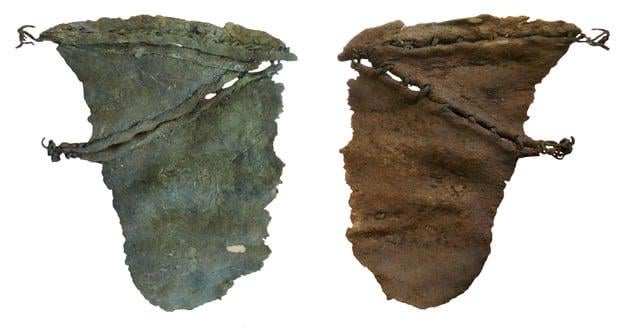
2,400-year-old Scythian leather made from human skin, confirming Herodotus’ once-dismissed ancient Greek account.
Title: 2,400-Year-Old Scythian Leather Made from Human Skin Confirms Herodotus’ Ancient Greek Account
Meta Description: A groundbreaking archaeological discovery of Scythian leather crafted from human skin validates Herodotus’ long-dismissed ancient claims. Explore the dark secrets of the nomadic warriors.
Introduction: Herodotus Vindicated After 2,400 Years
For centuries, the Greek historian Herodotus was labeled a fabricator for his graphic descriptions of Scythian barbarism. But a chilling discovery in Southern Ukraine has turned skepticism into stunned confirmation: a 2,400-year-old piece of leather, scientifically verified as human skin, aligns with Herodotus’ once-dismissed account of the Scythians’ gruesome practices. This revelation rewrites our understanding of ancient nomadic culture and forces historians to re-examine other “myths” recorded in antiquity.
The Historical Controversy: Herodotus’ Histories Under Scrutiny
In The Histories (440 BCE), Herodotus chronicled the Scythians—a feared nomadic confederation dominating the Eurasian steppes from Crimea to Siberia. Among their alleged customs was the ritualistic use of human skin:
“They flay the skin from the skulls of their slain enemies, treat it with oils, and carry it as a grisly trophy.”
These claims were long dismissed by scholars as sensationalized hearsay. Critics argued Herodotus exaggerated “barbarian” cultures to thrill Greek audiences. But a recent study published in PLOS ONE reveals Herodotus was telling the truth—at least about the leather.
The Discovery: Archaeologists Unearth a Dark Artifact
In 2023, archaeologists excavating a Scythian burial mound (kurgan) near Kamyanka-Dniprovska, Ukraine, uncovered fragments of leather armor. Initially presumed to be animal hide, proteomics analysis (a study of proteins) revealed a horrifying truth: the leather was made from human skin.
- Radiocarbon Dating: Confirmed the artifact dates to 400–200 BCE—the peak of Scythian dominance.
- Proteomic Analysis: Led by Dr. Luise Ørsted Brandt (University of Copenhagen), the team identified human-specific proteins, ruling out animal origins.
- Craftsmanship: The leather showed signs of meticulous tanning, matching Herodotus’ description of skin treated “like sheepskin parchment.”
This marks the first tangible evidence of Scythians using human remains as material—a practice only documented in Herodotus’ writings until now.
Why Did the Scythians Use Human Skin? Contextualizing the Horror
To the Scythians, war wasn’t just territorial—it was spiritual. Herodotus described their warriors as “drinkers of blood” who scalped foes and fashioned skins into cloaks, quivers, and saddle blankets. The newly discovered leather fragment suggests these acts served multiple purposes:
- Psychological Warfare: Displaying enemy skin would terrorize adversaries.
- Trophies of Valor: Like modern medals, skins symbolized a warrior’s prowess.
- Spiritual Rituals: Some historians propose the Scythians believed wearing an enemy’s skin absorbed their strength or appeased gods.
While repulsive to modern sensibilities, such practices were rooted in a culture where survival depended on displays of ruthlessness.
Reevaluating Herodotus: Why Scholars Got It Wrong
The dismissal of Herodotus highlights a long-standing bias in archaeology: distrust of ancient sources when describing “savage” acts. Dr. Brandt notes:
“We underestimated Herodotus because his accounts seemed too grotesque. Now, we must consider that other ‘myths’—like Amazon warriors or gold-guarding griffins—could have kernels of truth.”
This discovery underscores how material evidence can bridge gaps between archaeological findings and ancient texts—even those deemed unreliable.
Implications for Scythian Studies and Beyond
- Cultural Reassessment: The Scythians weren’t merely “barbarians” but complex societies with rituals mirroring those of the Celts (head-hunting) or Aztecs (flaying).
- Ethical Dilemmas: Museums holding Scythian artifacts may now confront the possibility that some objects are human remains.
- Herodotus’ Legacy: The “Father of History” may finally shed his “Father of Lies” nickname—at least partially.
Conclusion: A Macabre Confirmation from the Grave
The 2,400-year-old Scythian leather fragment forces us to confront an uncomfortable truth: Herodotus’ most lurid tales were grounded in reality. As archaeologists continue unearthing the steppes’ secrets, we may find that history’s darkest stories are often the most accurate.
This discovery doesn’t just validate an ancient Greek—it challenges us to listen more closely to voices from the past, however unsettling their message.
Keywords for SEO:
Scythian leather, human skin artifact, Herodotus confirmed, Scythian warriors, ancient Greek history, archaeological discovery Ukraine, Scythian burial mounds, Herodotus Histories, proteomics analysis, nomadic tribes.
Internal Links Suggested:
- “Who Were the Scythians? Fierce Nomads of the Eurasian Steppe”
- “Herodotus: Separating Fact from Fiction in Ancient Histories”
- “Top 10 Gruesome Ancient Rituals Verified by Archaeology”
Image suggestion: A reconstructed Scythian warrior holding a leather quiver, juxtaposed with the excavated skin fragment.
By blending cutting-edge science with historical detective work, this find immortalizes Herodotus’ vindication—and reminds us that truth can be stranger, and darker, than fiction.