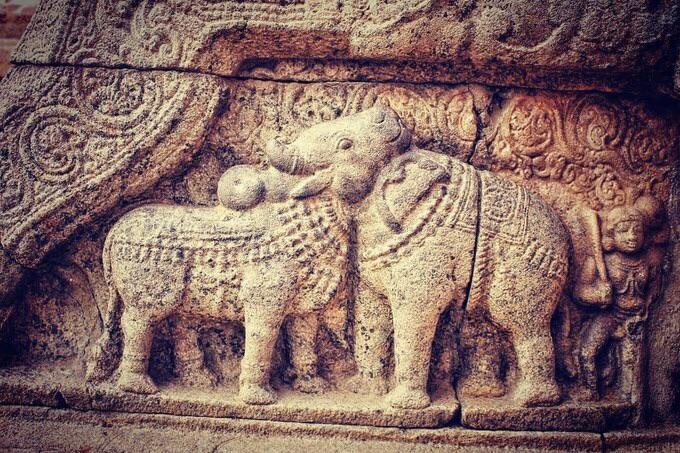
900 year old optical illusion carved on stone in India. An elephant and a bull sharing a common head. Airavatesvara Temple, India.
Unraveling the 900-Year-Old Stone Illusion at Airavatesvara Temple: An Elephant & Bull Sharing a Single Head
Meta Description: Discover the ancient marvel at Airavatesvara Temple, India — a 900-year-old optical illusion carved in stone where an elephant and a bull share a common head. Explore its history, symbolism, and secrets.
The Mysterious Stone Carving of Airavatesvara Temple: Where Two Animals Become One
Nestled in the serene temple town of Darasuram, Tamil Nadu, the Airavatesvara Temple stands as a testament to the artistic genius of the Chola dynasty. Built in the 12th century under King Rajaraja Chola II, this UNESCO World Heritage Site is famed for its intricate stone carvings. Yet one sculpture, in particular, has puzzled visitors and experts for centuries: a 900-year-old optical illusion where an elephant and a bull share a single head.
The Illusion Unveiled: A Masterpiece of Perception
At first glance, the carving appears to depict two distinct animals. But upon closer inspection, viewers notice something extraordinary:
- From the left: The figure clearly morphs into the profile of an elephant, complete with tusks, trunk, and ears.
- From the right: The same stone transforms into the silhouette of a bull (Nandi, Lord Shiva’s sacred vehicle), with horns, a muscular neck, and a sturdy hump.
This seamless visual trick relies on the clever use of perspective and contour lines, blurring the boundaries between the two creatures. The artists of the Chola era showcased their deep understanding of human perception, carving the shared head so precisely that shifting just a few steps alters the entire image.
Why This Illusion Matters: Symbolism & Craftsmanship
1. A Testament to Chola Engineering & Artistry
The Chola dynasty (300 BCE–1279 CE) was renowned for architectural innovation. This sculpture exemplifies:
- Precision stonework: Achieving depth and fluidity in granite.
- Mathematical mastery: Aligning proportions to create a dual-image effect.
- Narrative storytelling: Integrating spiritual symbolism into artistry.
2. Duality in Hindu Mythology
The elephant (Gaja) and bull (Nandi) hold deep cultural significance:
- Elephants symbolize wisdom, royalty, and strength (associated with Indra’s mount, Airavata).
- Nandi, the bull, represents devotion, justice, and loyalty as Shiva’s companion.
Their shared head likely reflects Hindu philosophies of unity and duality, like the interplay between humanity and divinity or the balance of opposites (Ardhanarishvara).
3. An Ancient “Viral” Puzzle
Long before modern optical illusions (like the Rubin Vase or “duck-rabbit”), this carving challenged observers’ perceptions. Historians speculate such designs were meant to:
- Engage worshippers in mindful observation during temple rituals.
- Demonstrate the Cholas’ intellectual sophistication.
Exploring Airavatesvara Temple: More Than Just an Illusion
While the elephant-bull carving steals the spotlight, the temple’s other marvels are equally breathtaking:
- Musical Steps: Stairs that produce melodic notes when tapped.
- Micro-Carvings: Miniature sculptures depicting scenes from Hindu epics.
- Shiva’s Legend: The temple is named after Airavata, the white elephant of Lord Indra, who regained his purity here after bathing in the temple’s sacred waters.
How to Visit the Airavatesvara Temple
- Location: Darasuram, Tamil Nadu (10 km from Kumbakonam).
- Best Time to Visit: October–March (cooler weather).
- Travel Tip: Hire a local guide to decode hidden carvings and legends.
Conclusion: A Timeless Enigma Carved in Stone
The elephant-bull illusion at Airavatesvara Temple is more than a clever trick—it’s a window into the Chola dynasty’s unparalleled creativity and spiritual depth. As you walk through this architectural wonder, let the shared head remind you that art, like faith, invites us to see the world from multiple angles.
Whether you’re an archaeology enthusiast, a spiritual seeker, or a lover of mysteries, this 900-year-old marvel proves that ancient India’s genius still resonates today.
Keywords for SEO:
Airavatesvara Temple, Chola dynasty optical illusion, elephant bull shared head, ancient Indian stone carvings, UNESCO World Heritage Site India, Hindu temple mysteries, Darasuram temple, Tamil Nadu heritage.
Experience history in 3D: Plan your visit to Airavatesvara Temple and witness this ancient illusion firsthand!