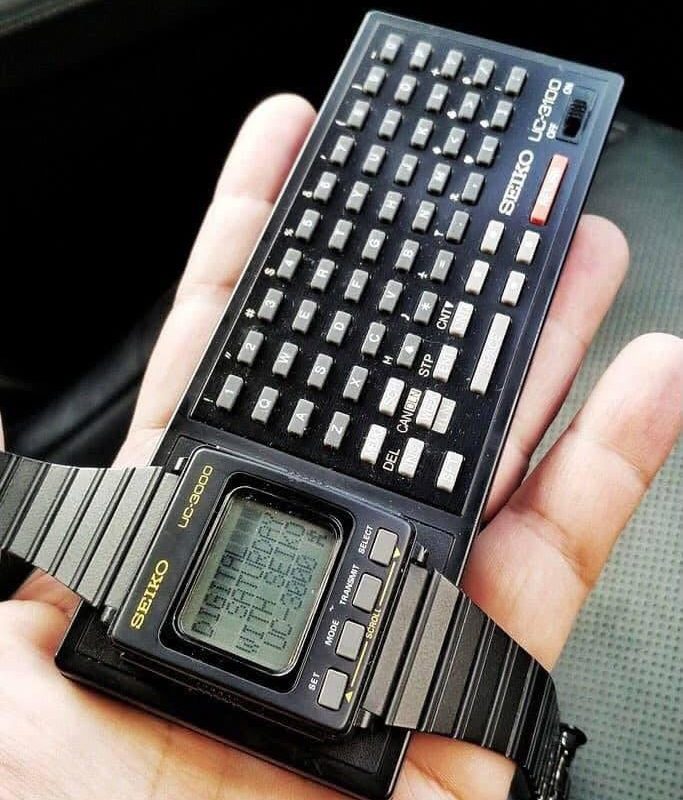
Everyone knows an Apple Watch – but this is a SEIKO UC 3000 from 1984, one of the first smartwatches.
Title: Before the Apple Watch, There Was the Seiko UC-3000: The Forgotten Smartwatch Pioneer of 1984
Meta Description: Discover the Seiko UC-3000, a groundbreaking smartwatch from 1984 that predated the Apple Watch by decades. Explore its features, legacy, and why it’s a marvel of retro tech.
Slug: seiko-uc-3000-1984-first-smartwatch-history
Introduction
When we think of “smartwatches” today, names like Apple Watch, Samsung Galaxy Watch, or Fitbit dominate the conversation. But long before wearables became mainstream, a Japanese tech pioneer dared to redefine what a watch could do. Meet the Seiko UC-3000, released in 1984—a device that combined computing power with wristwear, earning its place as one of the world’s first smartwatches. Let’s dive into the fascinating story of this forgotten icon and why it remains a milestone in wearable tech history.
The Birth of a Concept: Seiko’s Vision for Wearable Tech
In the early 1980s, Seiko was already synonymous with innovation. The brand had revolutionized the watch industry with the first quartz watch (the Astron in 1969) and the first TV watch (the T001 in 1982). But the UC-3000 (short for “Ultra Compact”) took ambition further—blending a digital watch with a handheld computer, all synced via a keyboard docking station.
At its core, the UC-3000 wasn’t just a timekeeper. It was a programmable device aimed at business professionals, offering calendaring, memos, and time zone management—years before PDAs like the Palm Pilot hit the market.
Inside the Seiko UC-3000: Ahead of Its Time
While primitive by today’s standards, the UC-3000 packed impressive tech for 1984:
- Dot-Matrix LCD Display: A stepped, dual-screen design showed time on top and data below (a precursor to multi-function displays).
- Keyboard Dock: Typing required docking the watch into a full QWERTY keyboard, which doubled as a charger/data hub.
- 2KB RAM: Enough to store contacts, notes, and schedules—albeit with serious storage limitations.
- Syncing Capabilities: Data could transfer to other Seiko devices, like the “UC-2000” computer watch.
- Modular Design: Users could snap the watch face into different modules, like a calculator or gaming add-on.
It even had a custom program language called UC BASIC, allowing tech-savvy users to code apps—a jaw-dropping feature in 1984.
Why Did It Fail? The Challenges of 1980s Tech
The UC-3000 was revolutionary, but commercial success eluded it. Here’s why:
- Price: At $250–$300 (≈$700+ today), it was a luxury only early adopters could afford.
- Size: Bulky by modern standards, though remarkably slim for the era (just 10mm thick).
- Niche Use Case: Without internet or apps, its utility was limited to basic organization—no notifications, GPS, or fitness tracking.
- Market Readiness: The world wasn’t ready for “smart” wearables yet.
Still, it paved the way for future innovations, inspiring concepts like Microsoft’s SPOT watch (2004) and, eventually, the Apple Watch.
The Legacy of the UC-3000: A Proto-Smartwatch Triumph
The Seiko UC-3000 may have faded into obscurity, but its impact is undeniable:
- First-Mover Status: Predated the Apple Watch by 31 years and even IBM’s 2000 Linux watch.
- Retro Chic: Today, vintage units fetch $500+ among collectors for their rarity and historical value.
- Design Influence: Its modularity anticipates modern wearables’ swappable bands/watch faces.
Seiko continued iterating with devices like the RC-1000 Wrist Terminal (1984), which synced with PCs—proving the UC-3000 was no gimmick, but the start of a wearable computing revolution.
From 1984 to Today: How Smartwatches Evolved
The UC-3000’s DNA lives on in modern smartwatches:
| 1984 (Seiko UC-3000) | 2024 (Apple Watch Ultra) |
|————————–|——————————|
| Dot-matrix LCD | Retina LTPO OLED display |
| 2KB storage | 64GB storage + cloud sync |
| Keyboard dock | Voice commands & touchscreen |
| Basic scheduling | Fitness tracking, calls, payments |
Yet, Seiko’s early bet on wrist-worn computing remains awe-inspiring—a reminder that true innovation often happens decades before the masses catch on.
Conclusion: A Time Capsule of Tech Bravery
The Seiko UC-3000 wasn’t just a watch; it was a bold experiment in merging humanity with machines. While the Apple Watch dominates today, we owe a nod to this 1984 trailblazer—proof that imagination always outpaces adoption. For retro-tech lovers horology buffs, or anyone curious about wearables’ roots, the UC-3000 isn’t just history. It’s a timeless lesson in daring to think different.
Fun Fact: Seiko sold a companion “UC” printer that could output data from the UC-3000—an entire office ecosystem on your wrist!
Keywords for SEO: Seiko UC-3000, first smartwatch 1984, retro smartwatch, vintage wearable tech, Seiko computer watch, Apple Watch predecessor, history of smartwatches, Seiko UC-3000 features.
Explore more forgotten tech pioneers—subscribe for deep dives into gadgets that shaped our digital world!