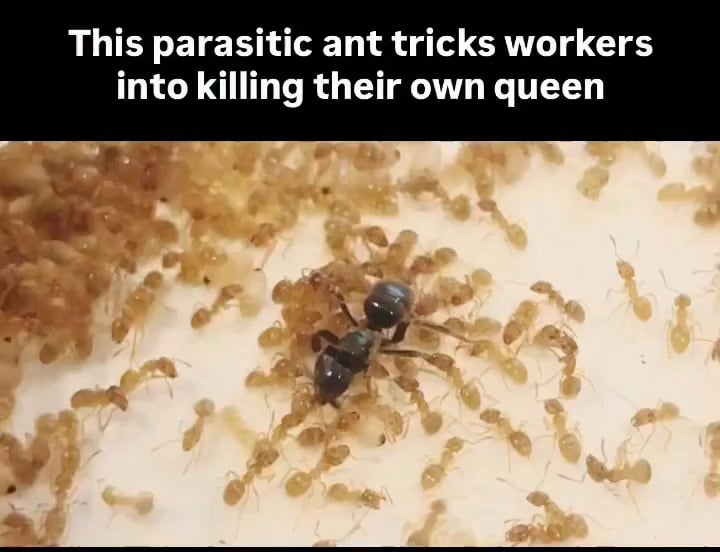
A parasitic queen ant tricks the workers of a colony to kill their own queen
Title: Nature’s Ultimate Betrayal: How a Parasitic Queen Ant Tricks Workers into Murdering Their Own Queen
Meta Description: Discover the shocking strategy of parasitic queen ants, which infiltrate colonies, manipulate worker ants with chemical deception, and orchestrate the assassination of their host queen.
Introduction
In the intricate world of ants, colonies operate like well-oiled machines, with loyalty, teamwork, and pheromone-driven communication at their core. But lurking in the shadows is a master manipulator: the parasitic queen ant. This cunning invader employs biochemical trickery to infiltrate colonies, turn workers against their rightful queen, and seize power in a ruthless act of “social parasitism.” Here’s how this real-life horror story unfolds.
The Parasitic Queen’s Infiltration Strategy
Parasitic queen ants, like those from the Polyergus (Amazon ant) or Lasius umbratus species, don’t build their own empires—they steal them. Their survival depends on infiltrating established colonies, often of closely related species. To do this, they deploy a multi-step deception:
- Stealthy Entry: The parasitic queen sneaks into a host colony, avoiding detection by minimizing physical contact.
- Chemical Camouflage: She secretes pheromones that mimic the scent of the host’s workers, disguising herself as a colony member.
- Avoiding Aggression: By masking her foreign odor, she bypasses the colony’s defenses, which would otherwise trigger an attack.
The Pheromone Deception: Turning Workers Against Their Queen
Ant colonies rely on pheromones—chemical signals—to identify allies, hierarchy, and threats. The host queen emits a unique pheromone “signature” that commands loyalty from her workers. But the parasitic queen weaponizes this system:
- Scent Overload: She releases overpowering pheromones that confuse workers, masking the host queen’s signals.
- False Loyalty: Workers begin to associate the parasitic queen’s scent with authority, redirecting their care toward the invader.
- Regicide Orders: In a twisted turn, the parasitic queen’s pheromones may compel workers to attack their own queen.
The Assassination of the Host Queen
Once the parasitic queen destabilizes the colony’s social order, the unthinkable happens. Workers—now chemically misled—turn on their sovereign:
- Swarm Attack: Workers may bite, sting, or dismember their queen, viewing her as a threat or impostor.
- Silent Coup: Alternatively, the parasitic queen kills the host queen herself while workers stand idle, deceived by her pheromones.
This brutal takeover often unfolds within hours, leaving the parasitic queen unchallenged.
Colony Takeover: A Slave Empire is Born
With the host queen dead, the parasitic queen claims the throne:
- Egg-Laying Dominance: She begins laying her own eggs, prioritizing her genetic line.
- Brood Manipulation: Host workers raise the parasitic queen’s offspring, which grow into new parasitic queens or males.
- Resource Exploitation: The colony’s food stores and labor now serve the invader’s dynasty.
Over time, the host workers die off, replaced entirely by the parasitic queen’s progeny—effectively turning the colony into a puppet state.
Evolutionary Implications: Why Does This Happen?
This macabre strategy, known as brood parasitism or social parasitism, offers survival advantages:
- Energy Conservation: Parasitic queens avoid the risks and effort of founding colonies independently.
- Genetic Success: By hijacking established colonies, they exploit ready-made resources and protection.
Scientists believe this behavior evolved in environments where competition for nesting sites or food is extreme.
Real-World Examples
- The Blood-Red Ant (Formica sanguinea): Slave-making ants raid colonies, kidnap pupae, and force them to serve their queen.
- The Sahara Desert Ant (Cataglyphis cursors): Workers have been observed assassinating their queen when a parasitic queen is introduced.
Can Host Colonies Fight Back?
Some ants have evolved defenses:
- Pheromone Complexity: Species with more sophisticated chemical signaling are harder to infiltrate.
- Worker Screening: In certain colonies, workers aggressively inspect intruders and attack mismatched pheromones.
Still, parasitic queens often prevail, showcasing nature’s relentless arms race.
Conclusion: A Dark Twist in the Ant World
The parasitic queen ant’s strategy is a chilling example of evolutionary deception, where chemical lies lead to regicide and domination. This phenomenon not only reveals the fragility of social insect hierarchies but also underscores the ruthless ingenuity of survival in the wild.
For ant colonies, loyalty is absolute—until a master manipulator flips the script.
Keywords: parasitic queen ant, brood parasitism, ant colony takeover, pheromone deception, social parasitism, ant queen assassination, chemical mimicry in ants, Polyergus ants, Lasius umbratus.