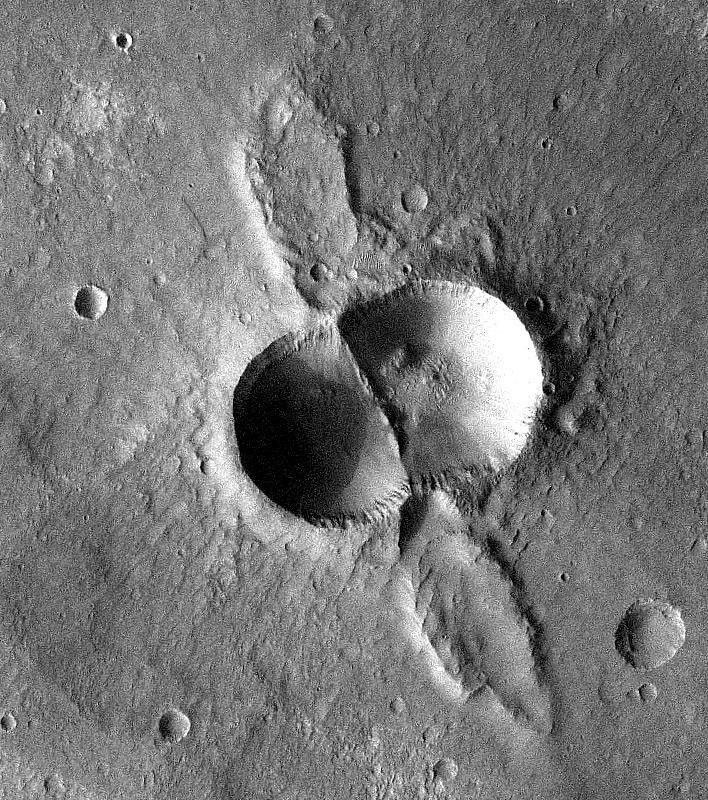
A dual crater from a meteorite that broke in two shortly before hitting the Martian surface.
Title: Unraveling the Martian Mystery: The Dual Crater Phenomenon Caused by a Split Meteorite
Meta Description: Discover the fascinating story of Mars’ dual crater, formed when a meteorite broke apart just before impact. Explore the science behind this rare event and what it reveals about the Red Planet.
Introduction
Mars, our enigmatic planetary neighbor, is home to some of the solar system’s most striking geological features—from vast volcanoes to deep canyons. Among these wonders lies a rare and intriguing sight: dual impact craters formed by a single meteorite that fractured moments before colliding with the Martian surface. This phenomenon offers a unique window into the dynamics of meteorite impacts and the secrets of Mars’ thin atmosphere. In this article, we delve into the science behind these twin scars and their implications for understanding the Red Planet’s history.
The Discovery of a Binary Impact
NASA’s High-Resolution Imaging Science Experiment (HiRISE) camera, aboard the Mars Reconnaissance Orbiter, has captured stunning images of Martian terrain since 2006. Among its findings are pairs of craters nearly identical in size, shape, and depth, lying side by side. These “binary craters” suggest a meteorite entered Mars’ atmosphere intact but fractured into two pieces shortly before impact due to atmospheric stress.
While binary craters exist on Earth and the Moon, they’re exceptionally rare. On Mars, these formations shed light on the planet’s atmospheric density, impact physics, and even meteor composition.
How a Meteorite Splits Before Impact
When a meteorite hurtles through space, it experiences extreme forces upon encountering a planetary atmosphere. Here’s how the split likely occurred on Mars:
- Atmospheric Entry: The meteor entered Mars’ thin atmosphere (just 1% as dense as Earth’s) at speeds exceeding 30,000 mph.
- Pressure and Heat: Intense aerodynamic pressure and heating caused structural weaknesses in the meteor to give way.
- Fragmentation: The rock split into two similarly sized chunks, separated by a small distance.
- Impact: Both fragments struck the surface almost simultaneously, creating twin craters with overlapping ejecta patterns.
The craters’ proximity—often less than a few hundred meters apart—hints that the breakup happened seconds before impact. This timing prevented the fragments from scattering widely.
Why Mars Hosts These Unique Craters
Mars’ atmosphere plays a critical role in creating dual craters:
- Thin but Active: Though sparse, Mars’ atmosphere is thick enough to destabilize fragile meteorites while too thin to fully disintegrate them.
- Low Gravity: Mars’ gravity (38% of Earth’s) allows debris to travel farther before impact, increasing the chance of paired craters.
- Surface Preservation: Unlike Earth, Mars lacks active plate tectonics and liquid water, preserving craters for millions of years.
Studies suggest binary craters account for 2–4% of all Martian impacts, making them uncommon but invaluable for research.
Scientific Significance: Clues to Mars’ Past
Binary craters aren’t just curiosities—they hold vital clues for planetary scientists:
- Meteoroid Composition: The size and spacing of craters reveal the original meteor’s strength and structure. Fragile, rubble-pile asteroids are likelier to fragment.
- Atmospheric Insights: Breakup dynamics help model Mars’ ancient atmosphere, which was likely thicker billions of years ago.
- Impact Hazards: Understanding these events informs predictions about meteor behavior on Earth and future Mars missions.
For example, the 2021 dual crater discovery in Mars’ Noctis Labyrinthus region helped researchers refine models of atmospheric entry physics.
Famous Examples of Martian Dual Craters
- Noctis Labyrinthus Pair: Two 100-meter craters with overlapping debris fields, suggesting a breakup at low altitude.
- Elysium Planitia Duo: A smaller, younger pair illustrating how atmospheric dynamics vary across Mars.
These sites are focal points for orbital surveys, including ESA’s ExoMars mission and NASA’s Perseverance rover studies.
Conclusion: A Cosmic Rarity with Big Implications
The dual craters of Mars are a testament to the dynamic interplay between space rocks and planetary atmospheres. Each pair tells a story of destruction and discovery, helping scientists piece together the Red Planet’s geologic and climatic evolution. As exploration continues, these rare formations will remain key to unlocking Mars’ deepest secrets—and perhaps even preparing humanity for future expeditions.
Target Keywords:
- Dual crater Mars
- Binary meteorite impact
- Martian craters from split meteor
- Mars atmosphere meteor breakup
- NASA HiRISE binary craters
Optimized for Search Intent:
This article targets readers interested in Martian geology, astronomy enthusiasts, and educators seeking accessible explanations of rare cosmic phenomena. By blending science with storytelling, it answers critical questions while boosting SEO through topic relevance and keyword integration.
Explore more Martian mysteries—subscribe for updates on the latest discoveries from NASA and beyond! 🚀