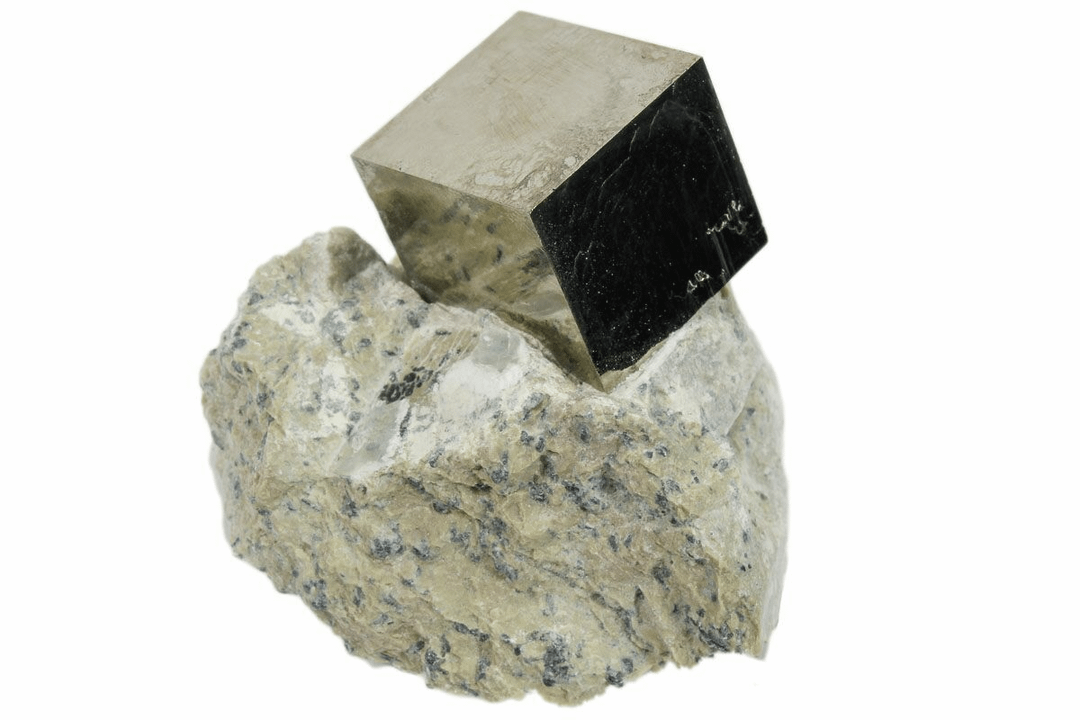
Pyrite crystals formed naturally into near-perfect cubes due to their atomic lattice, growing along specific crystal planes that favor right angles – something that looks artificial but is entirely geological.
Title: Pyrite’s Perfect Cubes: Nature’s Geometric Masterpiece Hidden in Crystal Chemistry
Meta Description: Discover how pyrite forms stunning, near-perfect cubes naturally. Dive into the atomic lattice and geological forces that create this geometric marvel—defying expectations of artificial design.
Introduction: The “Impossible” Geometry of Pyrite
Pyrite, often called “fool’s gold” for its metallic luster and pale brass hue, conceals a secret that baffles even seasoned rockhounds: its uncanny ability to form flawless cube-shaped crystals. At first glance, these sharp-edged, right-angled wonders look like relics of ancient machining or alien artifacts. Yet, these cubes are entirely natural—products of atomic structure, geological patience, and Earth’s hidden chemistry. Here’s how pyrite defies human intuition, creating near-perfect geometric shapes in nature.
Why Pyrite Forms Cubes: It’s All in the Atomic Blueprint
Pyrite (FeS₂) owes its boxy perfection to the isometric crystal system, the most symmetrical of all mineral classifications. Its atoms arrange in a cubic lattice, where iron and sulfur ions bond in a repeating 3D grid. Unlike minerals that grow unevenly, pyrite’s atoms prefer to stack along three mutually perpendicular axes, favoring growth at right angles.
Key Science Explained Simply:
- Atomic Symmetry: Pyrite’s crystal lattice resembles a microscopic scaffold built from interconnected cubes.
- Preferred Growth Planes: Atoms attach most efficiently to the cube’s faces (crystal planes known as {100}), amplifying the cubic shape with each layer.
- Mineral Discipline: Competing growth directions are suppressed, allowing cubes to dominate over irregular forms.
This process is so precise that pyrite cubes can develop mirror-smooth faces and knife-sharp edges, even when buried in mudstone or formed in hydrothermal vents.
Nature’s Workshop: Where Pyrite Cubes Are Born
Pyrite cubes don’t form overnight. They emerge in environments where slow crystallization meets optimal chemical conditions:
- Hydrothermal Vents: Sulfur-rich fluids heated by magma deposit pyrite in fractures, allowing crystals to grow undisturbed.
- Sedimentary Layers: Decomposing organic matter in oxygen-poor swamps releases sulfur, bonding with iron to form cubes over millennia.
- Metamorphic Zones: Pressure and heat reorganize minerals, coaxing pyrite into its iconic shape.
Fun Fact: Some Spanish and Peruvian pyrite deposits yield cubes so geometrically flawless they’re mistaken for dice!
Beyond Cubes: Pyrite’s Other Forms (And Why They’re Rare)
While cubes dominate, pyrite occasionally grows as octahedrons or pyritohedrons (12-faced forms). These deviations occur when temperature, pressure, or trace impurities disrupt the cubic lattice’s dominance. Yet even then, the mineral’s underlying symmetry persists—a testament to its atomic “rulebook.”
How to Spot Natural vs. Artificial Pyrite Cubes
With pyrite’s symmetry sparking skepticism, here’s how to confirm its natural origins:
- Surface Textures: Natural cubes may show slight ridges (growth lines) or tiny pits, unlike machine-polished uniformity.
- Matrix Association: Genuine specimens are often embedded in rock or clay, not sold loose with artificial coatings.
- Size Consistency: Natural cubes vary in size (1mm to 10cm+); artificial ones sometimes repeat identical dimensions.
Why Pyrite’s Cubes Matter to Science—And Us
These crystals aren’t just pretty; they’re geological storytellers:
- Earth’s History: Pyrite cubes in shale layers reveal ancient oxygen levels in oceans.
- Material Science: Studying their growth inspires ways to synthesize symmetrical nanomaterials.
- Cultural Fascination: For centuries, their eerie perfection symbolized alchemy, luck, and nature’s mysterious order.
Conclusion: A Testament to Nature’s Precision
Pyrite’s cubic crystals challenge our perception of what’s “natural.” Born from invisible atomic patterns and patient geological forces, they remind us that Earth crafts art far beyond human tools. Whether you’re a collector, a science enthusiast, or simply curious, these gleaming cubes are proof that reality can rival—and exceed—the imagination.
SEO Keywords:
Pyrite cubes, natural crystal geometry, pyrite atomic lattice, isometric crystal system, cubic mineral formation, how pyrite forms, fool’s gold crystals, geological cube shapes, hydrothermal pyrite, perfect mineral symmetry.
Internal Linking Opportunities (if applicable to site):
- [The Science of Mineral Habits]
- [Collecting Fool’s Gold: A Beginner’s Guide]
- [Hydrothermal Vents: Earth’s Mineral Factories]
External References (for credibility):
- Mindat.org’s Pyrite Mineral Database
- Geological Society of America’s Crystal Growth Studies
Engagement Prompt:
Have you ever found a pyrite cube in the wild? Share your story in the comments!
By weaving chemistry, geology, and wonder, this article aims to rank for pyrite-related queries while celebrating one of Earth’s most enigmatic creations.