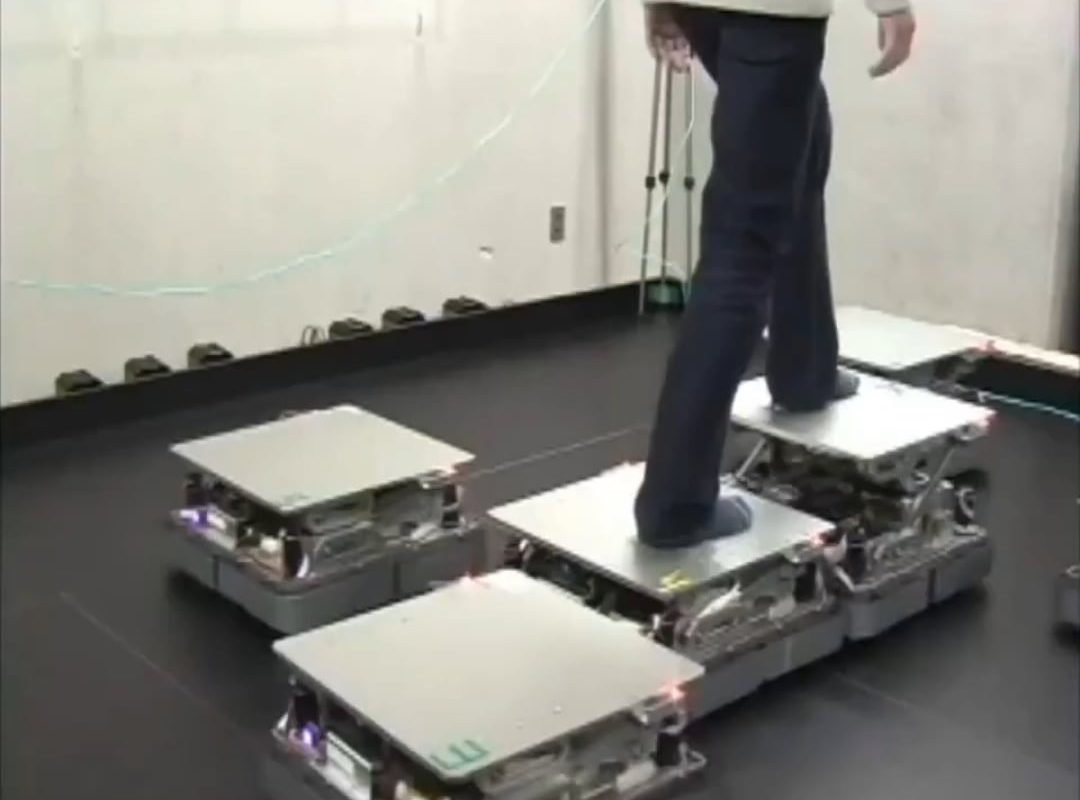
Japanese researchers at the University of Tsukuba created CirculaFloor, robotic tiles that let you walk infinitely in VR without ever leaving your spot.
Title: CirculaFloor by Japanese Researchers: Robotic Tiles Redefine VR Movement with Infinite Walking
Meta Description: Discover how University of Tsukuba’s CirculaFloor uses robotic tiles to enable infinite walking in VR. Explore the innovation, mechanics, and future of locomotion-free virtual reality.
Break Free from VR Limitations: CirculaFloor’s Infinite Walking Revolution
Virtual reality (VR) has long promised immersive worlds, but one major hurdle persists: physical movement. Users are confined by room-scale setups or forced to use joysticks, breaking immersion. Now, Japanese researchers at the University of Tsukuba have engineered a game-changing solution: CirculaFloor, a system of synchronized robotic tiles that lets users walk infinitely in VR—without ever leaving their spot.
What Is CirculaFloor?
CirculaFloor is an omnidirectional floor platform composed of modular, motorized tiles. As users walk forward in VR, the tiles glide beneath their feet in the opposite direction, effectively “resetting” their position in the real world while creating the illusion of endless virtual terrain. This eliminates the need for joysticks, treadmills, or dedicated physical spaces, blending real-world movement with boundless digital exploration.
How Does It Work?
-
Robotic Tile Coordination:
Each tile moves autonomously using proximity and pressure sensors. When a user steps onto a tile, the system detects their direction and speed, then shifts adjacent tiles to create a seamless, continuous walking experience. -
VR Synchronization:
The tiles integrate with VR headsets (like Meta Quest or HTC Vive), syncing their movement with the virtual environment. If you walk toward a mountain in VR, the tiles subtly reposition to keep you centered in the real world. -
Locomotion Algorithms:
Advanced algorithms predict user intent and adjust tile movement in real time, minimizing motion sickness by ensuring physical and visual cues align naturally.
Why CirculaFloor Is a Game-Changer
- Unlimited Exploration: Break free from room-scale boundaries—explore vast virtual landscapes for gaming, training, or virtual tourism.
- Enhanced Immersion: Physical walking replaces clunky controllers, making actions like running or sneaking feel intuitive.
- Safety & Accessibility: Ideal for small spaces; users avoid tripping hazards and maintain balance.
- Industrial Applications: Potential uses in architecture (virtual walkthroughs), healthcare (mobility rehab), and emergency response training.
The Team Behind the Innovation
Led by researchers at the University of Tsukuba’s Digital Nature Group, the project builds on Japan’s legacy of robotics and human-computer interaction breakthroughs. The team aims to refine CirculaFloor for consumer and enterprise markets, focusing on:
- Commercial Scalability: Reducing the system’s size, noise, and cost.
- Weight Capacity: Ensuring tiles support diverse body types.
- Energy Efficiency: Optimizing power consumption for prolonged use.
Future of VR Locomotion
While CirculaFloor isn’t the first VR treadmill, its tile-based design solves critical flaws:
- No Harnesses or Restraints: Users walk naturally, unencumbered by bulky equipment.
- Multi-User Support: Future iterations could enable collaborative VR experiences.
- Extended Realism: Integrating haptic feedback for terrain textures (e.g., grass vs. gravel).
Challenges Ahead
Current limitations include the prototype’s noise level and the need for precise calibration. However, the team envisions a future where CirculaFloor tiles become as commonplace as gaming chairs—transforming homes, arcades, and workplaces into portals for infinite virtual worlds.
Key Takeaways
- Innovation: CirculaFloor merges robotics and VR for natural, unrestricted movement.
- Developers: University of Tsukuba’s Digital Nature Group pioneers the future of spatial computing.
- Impact: Revolutionizes gaming, training, therapeutic VR, and beyond.
Stay tuned— CirculaFloor could soon redefine how we move, learn, and play in virtual realms.
(Meta Tags: VR locomotion, robotic tiles, University of Tsukuba, CirculaFloor, infinite walking VR, virtual reality innovation, Japanese robotics)