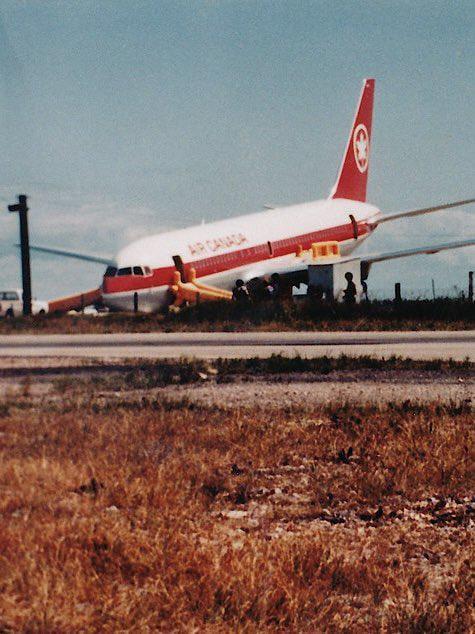
In the 23rd of July 1983, the flight of Air Canada 143 with 69 People on board ran out of fuel at an altitude of 41.000ft.The Pilots managed to glide the plane down safely.The jet had been loaded with 22,300 pounds of jet fuel instead of the required 22,300kg.
Title: The Gimli Glider: How Air Canada Flight 143 Defied Disaster After a Fuel Miscalculation
Meta Description: On July 23, 1983, Air Canada Flight 143 ran out of fuel at 41,000 feet due to a metric conversion error. Discover how the pilots glided the “Gimli Glider” to safety in one of aviation’s most legendary feats.
Introduction: A Near-Catastrophe in the Skies
On July 23, 1983, Air Canada Flight 143 departed Montreal for Edmonton with 69 people on board. What should’ve been a routine flight became an unparalleled aviation drama when the Boeing 767 ran out of fuel mid-air. Only the skill and calm of its pilots turned a looming tragedy into a story of survival. This incident, famously known as the “Gimli Glider,” remains a textbook case of crisis management and human error—and a miracle of aviation history.
The Fatal Error: Pounds vs. Kilograms
The root cause of Flight 143’s fuel crisis was shockingly simple: a metric conversion mistake.
- The Error:
The plane’s fuel system used kilograms, but ground staff calculated the required fuel in pounds. The aircraft needed 22,300 kilograms for the journey, but it was loaded with just 22,300 pounds (roughly 10,100 kg)—less than half the required amount. - Why It Happened:
Canada had recently transitioned to the metric system, and procedures were still adapting. A faulty fuel gauge compounded the error, leading pilots to rely on manual calculations—which tragically missed the unit discrepancy.
At 41,000 feet over Red Lake, Ontario, the engines flamed out, leaving the jet powerless.
“We’re Gliding”: The Unthinkable Challenge
With both engines dead, Captain Bob Pearson and First Officer Maurice Quintal faced every pilot’s nightmare: a total loss of power at cruising altitude. The 767 became the world’s heaviest glider.
Key Survival Tactics:
- The “Deadstick” Descent:
The pilots angled the plane into a controlled glide, aiming to lose altitude gradually while preserving airspeed. Without engine power, they had one shot at landing. - Improvised Navigation:
They used a handheld calculator (later dubbed the “Gimli Calculator”) to estimate glide ratios and locate the nearest airstrip: a decommissioned Air Force base at Gimli, Manitoba. - Critical Decision-Making:
Flight attendants prepared passengers for an emergency landing, while the crew manually lowered the landing gear via a gravity-driven system—a risky procedure never tested in real-world conditions.
The Miracle Landing at Gimli
As the plane descended toward Gimli, new dangers emerged:
- The runway was now a public drag-racing strip, crowded with cars and families for “Family Day.”
- The aircraft’s nose gear failed to lock, risking a belly landing.
Against all odds, Pearson executed a flawless sideslip maneuver to slow the plane, touching down hard but safely. The nose gear collapsed, but the fuselage remained intact. All 61 passengers and 8 crew survived, with only 10 minor injuries.
Legacy & Lessons Learned
The Gimli Glider incident spurred critical reforms in aviation:
- Standardized Fuel Measurements:
Airlines globally adopted stricter protocols for fuel unit conversions and cross-verification. - Crew Training Enhancements:
Pilots now train for “glide landings” and emergencies involving total power loss. - Culture of Teamwork:
The incident showcased the value of cockpit coordination, even in high-pressure scenarios.
Flight 143’s pilots were initially disciplined but later hailed as heroes. Their actions are studied in aviation schools to this day.
Conclusion: Why the Gimli Glider Still Matters
Air Canada Flight 143 wasn’t just a lucky break—it was a triumph of skill, communication, and composure under pressure. The Gimli Glider reminds us that human error can lead to disaster, but human ingenuity can avert it.
For aviation enthusiasts, safety professionals, or anyone inspired by real-world resilience, this story endures as a testament to the power of calm in chaos.
Keywords for SEO:
Air Canada Flight 143, Gimli Glider, aviation disaster, fuel miscalculation, metric conversion error, deadstick landing, emergency landing, aviation safety, Boeing 767, Bob Pearson, July 23 1983.
Engagement Prompt:
What other aviation mysteries or heroics fascinate you? Share your thoughts in the comments—or explore more incredible survival stories [link to related content].