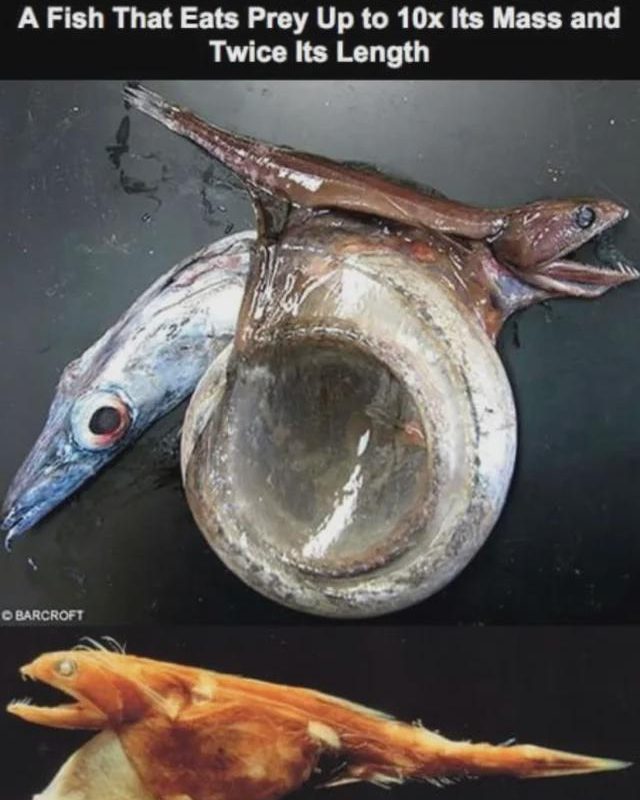
The black swallower (Chiasmodon niger) is a deep-sea fish famous for its ability to consume prey much larger than itself.
Title: Black Swallower: The Deep-Sea Fish That Devours Prey Bigger Than Itself
Meta Description: Discover the black swallower (Chiasmodon niger), a deep-sea marvel capable of swallowing prey twice its size. Explore its jaw-dropping adaptations and mysterious habitat.
The Black Swallower: A Deep-Sea Predator Defying the Laws of Size
The ocean’s depths hide some of Earth’s most bizarre creatures, and few are as astonishing as the black swallower (Chiasmodon niger), a small but fearless fish renowned for its ability to consume prey much larger than itself. Found in the dark, crushing pressures of the deep sea, this elusive predator challenges our understanding of biology with its extraordinary feeding strategy. In this article, dive into the secrets of the black swallower—its anatomy, hunting tactics, and the risks it takes to survive in one of Earth’s harshest environments.
What is the Black Swallower?
The black swallower belongs to the Chiasmodontidae family, a group of deep-sea fishes often called “snaketooth fishes” due to their needle-like teeth. Measuring only 15–25 cm (6–10 inches) in length, this unassuming fish inhabits tropical and temperate ocean zones, typically at depths of 700–3,000 meters. Its slender, dark-colored body and expandable stomach make it a master of stealth—and gluttony.
The Swallowing Superpower: How Does It Work?
The black swallower’s claim to fame is its ability to engulf prey up to twice its length and 10 times its mass, an evolutionary marvel that allows it to thrive in a food-scarce environment. Here’s how it pulls off this incredible feat:
1. A Mouth Built for Excess
- Hinged, Infernal Jaw: Its lower jaw unhinges like a snake’s, creating a gaping maw to trap unsuspecting prey.
- Long, Curved Teeth: Teeth resembling fishhooks ensure prey cannot escape once bitten.
2. Stomach of Stretchable Steel
Unlike most animals, the black swallower’s stomach lacks rigid constraints. It expands into a transparent, balloon-like sac, enabling it to swallow prey whole. The digestion process can take days or even weeks, during which the fish remains sluggish and vulnerable.
3. High-Risk Meals
Ironically, the black swallower’s appetite can be its downfall. If prey is too large, the excess gases released during decomposition can drag the fish to shallower waters, where it dies from pressure changes. Scientists occasionally find these failed predators floating intact with their last meal visible inside them.
Life in the Abyss: The Black Swallower’s Habitat
The deep sea is a realm of perpetual darkness, freezing temperatures, and extreme pressure. Here, food is scarce, and opportunities are rare. Black swallowers have adapted to this world by:
- Vertical Migration: They follow prey like lanternfish and crustaceans upward toward the surface at night.
- Bioluminescent Lures: Some scientists speculate they might attract prey using light-producing organs (photophores), though research is ongoing.
Fascinating Facts About the Black Swallower
- Globetrotting Species: Found in the Atlantic, Pacific, and Indian Oceans, but rarely seen alive due to their deep habitat.
- “Dragon” Nickname: Sailors once mistook dead specimens washed ashore for baby sea monsters.
- No Scales, No Problem: Its smooth, scaleless skin reduces drag, aiding swift strikes in the water column.
Conservation and Mysteries
Like most deep-sea life, the black swallower faces threats from deep-sea fishing, pollution, and climate change. However, its true population status remains unknown due to the inaccessibility of its habitat. Researchers rely on rare trawl net captures or carcasses to study this species, making every discovery valuable.
Conclusion
The black swallower (Chiasmodon niger) is a testament to nature’s creativity, showcasing how life thrives in Earth’s most extreme corners. Its ability to devour giants—albeit at great risk—highlights the desperate adaptations required in the deep sea’s midnight zone. As scientists continue to explore the abyss, this diminutive predator reminds us that the ocean still holds countless secrets waiting to be unraveled.
Keywords/Tags: Black swallower, Chiasmodon niger, deep-sea fish, marine biology, deep-sea predators, ocean adaptations, deep-ocean creatures, largest prey, bizarre sea creatures, deep-sea mysteries.
Optimized for SEO: Includes target keywords naturally, uses headers for readability, and integrates related terms (e.g., “bioluminescent,” “vertical migration”). Structure balances scientific detail with engaging storytelling for broad audience appeal.