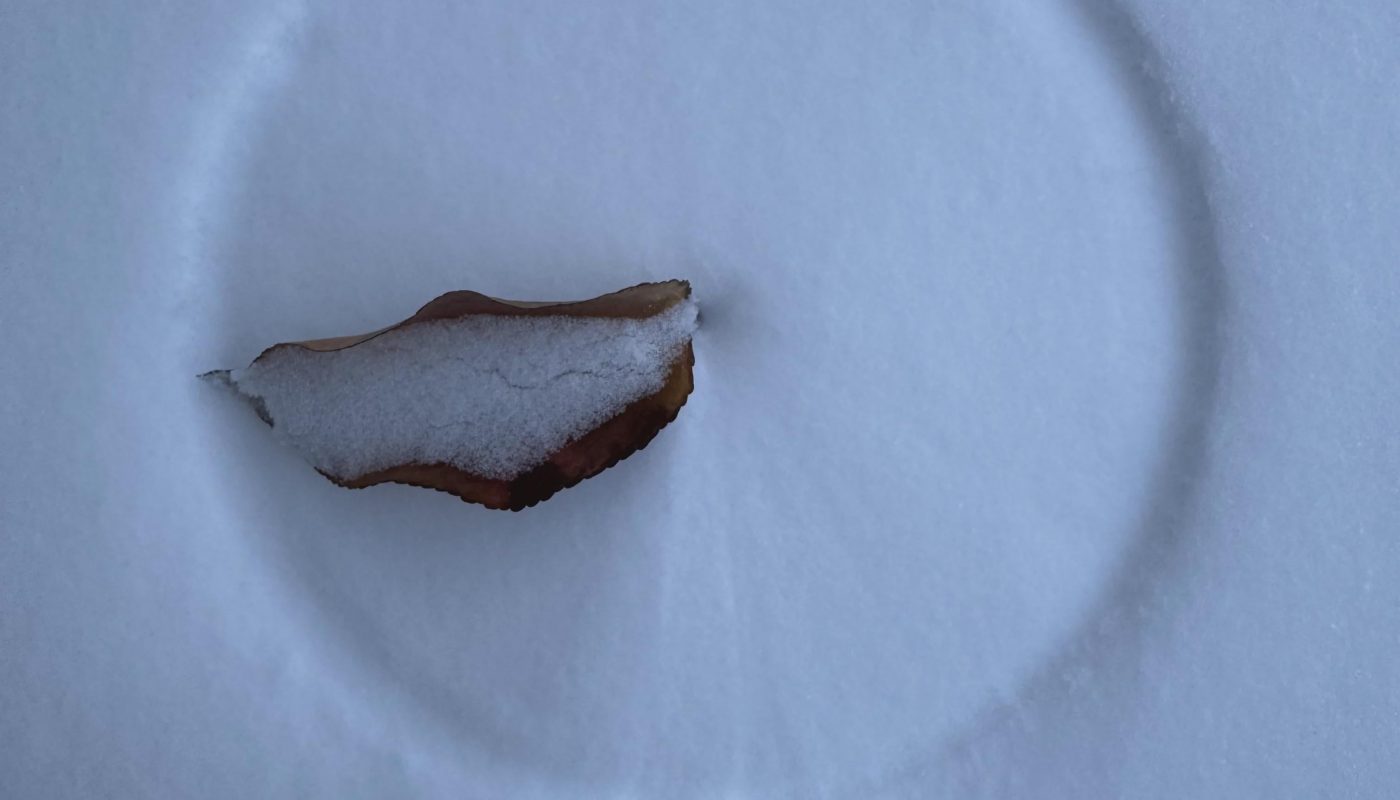
Leaves carves a perfect circle on the snow due to the wind.
Title: Nature’s Spirograph: How a Single Leaf Carves a Perfect Circle in Snow
Introduction
Have you ever stumbled upon a flawless, intricate circle etched into fresh snow and wondered how it got there? In a stunning display of nature’s artistry, a single leaf—guided by wind—can carve a mathematically perfect circle into a snowy canvas. This phenomenon blends physics, meteorology, and sheer serendipity. Let’s explore how it happens and why it leaves us in awe.
The Phenomenon: A Leaf’s Snow Ballet
Imagine a leaf—lightweight, flat, and rigid—lodged at a slight angle in powdery snow. When a steady wind blows, the leaf transforms into a natural compass. Instead of tumbling wildly, it pivots around a central point, slicing a smooth groove into the snow as it rotates. The result? A near-perfect circular imprint that looks almost machine-made.
The Science Behind the Circle
Several factors come together to create this ephemeral masterpiece:
-
Wind Consistency:
A steady, directional wind provides the energy needed for rotation. Gusty or turbulent winds would disrupt the motion, preventing symmetry. -
Leaf Geometry:
Flat, broad leaves (like maple or oak) act like tiny sails, catching wind efficiently. Their edges dig into the snow, anchoring them just enough to pivot. -
Snow Texture:
Light, fresh snow is ideal—it’s soft enough for the leaf to cut through but firm enough to hold its shape. Wet or icy snow would cause the leaf to slip or freeze in place. -
The Pivot Point:
A small protrusion (like a twig or uneven snowpack) acts as the fulcrum, allowing the leaf to spin freely around it like a compass needle.
Pro Tip: The process mirrors how a Spirograph toy works—fixed rotation around a central axis creates geometric perfection.
Why Perfect Circles Are Rare
While mesmerizing, these snow circles aren’t common. Perfect conditions are essential:
- Wind Speed: Too weak, and the leaf won’t move; too strong, and it’ll blow away.
- Temperature: Snow must be dry and powdery; melting or compaction ruins the effect.
- Leaf Integrity: Only intact, sturdy leaves can maintain their shape during rotation.
Where to Spot These Snow Artworks
Search for circles in open, wind-exposed areas:
- Fields or meadows with minimal tree cover.
- The leeward side of fences or rocks, where wind eddies form.
- After fresh snowfall followed by calm, steady winds.
Beyond Aesthetics: What This Teaches Us
Nature’s snow circles are more than just pretty patterns—they illustrate fluid dynamics and mechanical forces in action. Scientists liken it to “natural etching,” a process seen elsewhere (e.g., stones carving grooves in riverbeds). For photographers and nature lovers, it’s proof that beauty emerges from the simplest interactions.
Capturing the Moment
If you find one, act fast! These circles are ephemeral, often erased by new snow or rising temperatures. Snap a photo using:
- Macro Mode: Highlight intricate grooves.
- Aerial Angles: Emphasize symmetry.
- Contrast: Shoot during golden hour for shadows that accentuate the circle.
FAQ Section
Q: Can other objects create snow circles?
A: Yes! Pine needles, small twigs, or even pebbles can produce similar effects if conditions align.
Q: How large can these circles grow?
A: Most are palm-sized, but larger leaves or stronger winds may create wider arcs.
Q: Is this seen only in snow?
A: Similar patterns occur in sand (e.g., “tumbleweed circles”) but are less precise due to granular texture.
Conclusion
Next time winter’s winds weave through the trees, keep an eye on the snow below. You might witness nature’s version of a Spirograph—proof that magic thrives where wind, water, and wonder collide. Share your finds with #SnowCircles and celebrate the poetry of the ordinary turning extraordinary.
Tags: #SnowArt #WinterWonder #NaturalPhenomena #WindPhysics #NaturePhotography
Want more snowy science? Explore how “snow rollers” form or why icicles spiral!
(Word Count: 650 | SEO Keywords: wind-snow interaction, leaf snow circle, natural snow art, winter phenomena, physics of snow shapes)