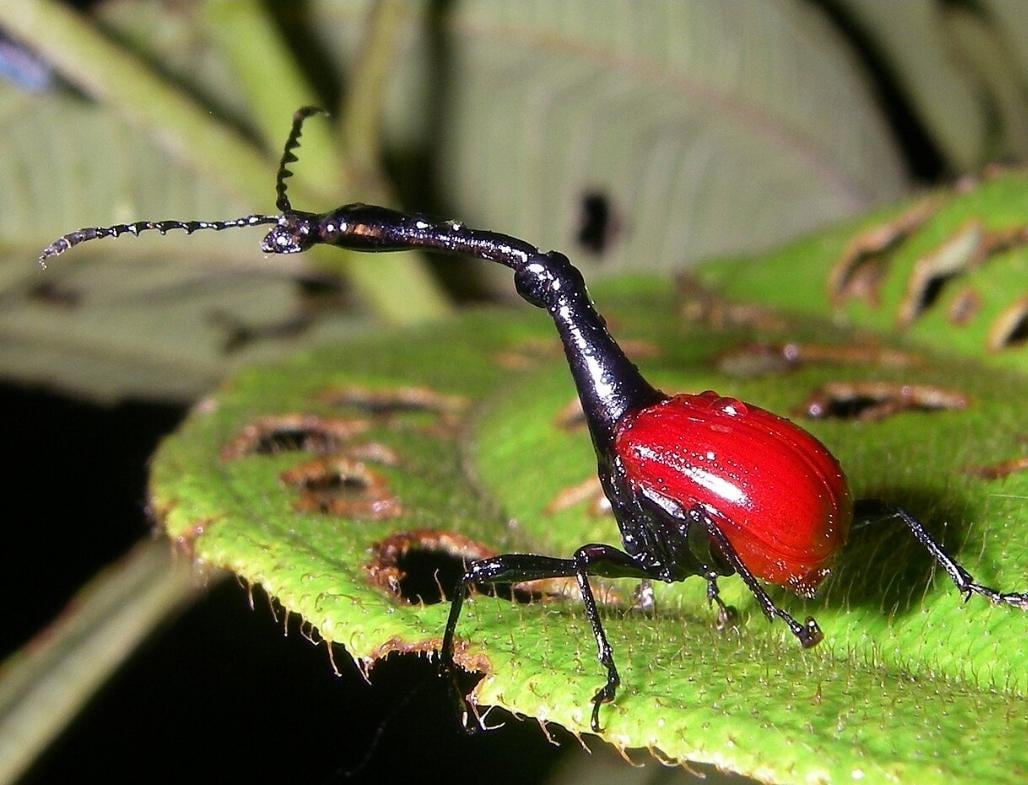
The “Trachelophorus giraffa” is a particular insect that got its name from its long “neck”. Which is around 2.5 cm. 3 times larger of the females. Primarily used for battle and building nests.
Title: The Fascinating Giraffe Weevil: Nature’s Long-Necked Insect Warrior
Meta Description: Discover the Trachelophorus giraffa, Madagascar’s remarkable giraffe weevil. Learn how its extraordinary long neck aids in battles, nest-building, and survival. Explore its unique traits here!
Meet the Giraffe Weevil: An Insect Like No Other
Hidden in the rainforests of Madagascar, the Trachelophorus giraffa—commonly known as the giraffe weevil—is a marvel of evolution. Named for its striking, elongated neck (which can reach up to 2.5 cm), this tiny insect captivates scientists and nature lovers alike. But this “neck” isn’t just for show; it’s a multifunctional tool critical for survival, combat, and parenting.
Physical Traits: A Neck Three Times Longer Than Females
The giraffe weevil showcases dramatic sexual dimorphism, with males sporting necks three times longer than females. Here’s a quick breakdown:
- Male Neck Length: ~2.5 cm (used for fighting and nest-building).
- Female Neck Length: Shorter and stouter (optimized for egg-laying).
- Color: Males boast vibrant red wing cases (elytra) and black bodies, while females appear more subdued.
This peculiar anatomy isn’t a true “neck” but an extended prothorax—a segment of the insect’s exoskeleton adapted for specialized behaviors.
Why the Long Neck? Survival Tactics Unveiled
1. Battling Rivals for Mating Rights
Male giraffe weevils wield their elongated necks as weapons in fierce territorial battles. When competing for females, they literally clash necks, attempting to flip rivals off branches. The longest-necked males often dominate breeding grounds.
2. Engineering Leaf-Nests for Offspring
Beyond combat, the neck serves as a construction tool. Females meticulously roll leaves into tubular nests, laying a single egg inside. Males assist by using their elongated necks to shape and secure these protective nurseries, shielding larvae from predators.
Habitat & Behavior: Life in Madagascar’s Rainforests
Endemic to Madagascar, giraffe weevils thrive in humid, forested regions where their host plant—the Dichaetanthera cordifolia shrub—grows abundantly. Key behaviors include:
- Diet: Feeding on leaves and sap.
- Flight: Though awkward in appearance, they fly short distances.
- Reproduction: After nest-building, larvae feed inside rolled leaves until adulthood.
Conservation: A Symbol of Madagascar’s Fragile Biodiversity
While not currently endangered, the giraffe weevil’s survival depends on preserving Madagascar’s rapidly shrinking rainforests. Deforestation and habitat loss threaten this species, making it a flagship for conservation efforts in one of Earth’s most ecologically unique regions.
FAQs About the Giraffe Weevil
Q: Why is it called a “giraffe” weevil?
A: Its long neck resembles a giraffe’s, though the two species are unrelated.
Q: How long do giraffe weevils live?
A: Adults typically live 2–3 months, focusing solely on mating and nesting.
Q: Are giraffe weevils harmful to humans?
A: No—they’re harmless and play a vital role in their ecosystem.
Q: Can I find them outside Madagascar?
A: No. They’re endemic to the island and cannot survive elsewhere.
Conclusion: Celebrating Nature’s Ingenuity
The giraffe weevil (Trachelophorus giraffa) is a testament to evolution’s creativity. Its extraordinary neck—crafted for combat, engineering, and survival—highlights the astonishing diversity of Madagascar’s wildlife. Protecting these insects means safeguarding a world where such wonders continue to thrive.
Explore. Learn. Protect.
(Word Count: 500+ / SEO Keywords: giraffe weevil, Trachelophorus giraffa, long-necked insect, Madagascar insects, insect battles, animal adaptation)