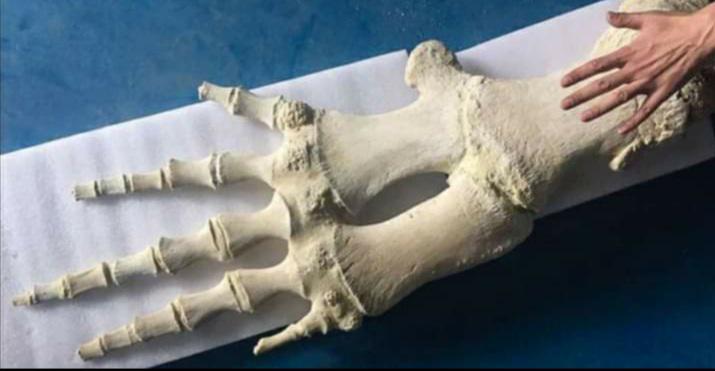
Whales have arm, wrist & finger bones in their front fins. This is the front fin bones of a Grey whale.
Title: Do Whales Have Fingers? The Surprising Anatomy of Grey Whale Fins
Meta Description: Discover the hidden secrets of whale fins! Learn how Grey whales—and all whales—have arm, wrist, and finger bones in their front fins, a legacy from their land-dwelling ancestors.
Introduction: Whale Fins Aren’t Just Paddles—They’re Evolutionary Masterpieces
When you picture a Grey Whale gliding through the ocean, its powerful fins likely look like elegant, streamlined paddles perfectly adapted to aquatic life. But beneath the surface lies an astonishing secret: inside those fins are arm, wrist, and finger bones strikingly similar to those of land mammals—including humans. This hidden anatomy reveals whales’ extraordinary evolutionary journey from land to sea.
In this article, we’ll dive into the fascinating skeletal structure of Grey Whale fins, explore why whales still have these “finger bones,” and what this tells us about their ancient past.
The Hidden Bones Inside a Grey Whale’s Fin
While whale fins outwardly resemble fish fins, their internal structure tells a completely different story. Scientists studying Grey Whale specimens have found that their front fins (also called pectoral flippers) contain skeletal structures nearly identical to those found in the arms of terrestrial mammals:
- Humerus: The upper “arm” bone, connecting the flipper to the shoulder.
- Radius and Ulna: Two parallel lower “arm” bones.
- Carpals: A cluster of small wrist bones.
- Metacarpals and Phalanges: Long “finger” bones, complete with joints.
Unlike human hands, these finger bones are elongated, flattened, and embedded within the fin’s connective tissue, forming a rigid yet flexible paddle. But their presence confirms that whales evolved from four-legged, land-dwelling ancestors—a fact further proven by fossil records.
Why Do Whales Still Have “Fingers”? The Evolutionary Story
Whales belong to the cetacean family, which includes dolphins and porpoises. Roughly 50 million years ago, their ancestors were semi-aquatic creatures like Pakicetus—a wolf-sized mammal that hunted in shallow water. Over millennia, these animals adapted to ocean life: their front limbs became fins, hind limbs disappeared, and bodies streamlined for swimming.
So why did whales retain these finger bones instead of evolving entirely new structures? The answer lies in evolutionary conservation. The existing bone framework was versatile enough to adapt rather than disappear. Stiffening the fingers into a paddle improved swimming efficiency while maintaining a functional link to their past.
Grey Whale Fins: A Case Study in Adaptation
The Grey Whale (Eschrichtius robustus) offers a clear example of this anatomy in action. These gentle giants use their muscular, bone-supported fins for:
- Steering and Stability: Their flexible wrists allow precise maneuvers in shallow coastal waters.
- Bottom Feeding: Grey Whales roll sideways to scoop sediment from the ocean floor—a movement powered by their strong fin muscles and skeletal structure.
- Social Interaction: Fins are used to touch and communicate with other whales.
Interestingly, the number of phalanges (finger segments) in Grey Whales varies, showcasing evolution’s trial-and-error process. Remarkably, this skeletal blueprint is shared with bats, horses, and even humans, reminding us of life’s interconnected evolutionary tree.
Debunking Myths: “Vestigial” Doesn’t Mean “Useless”
Some might call whale finger bones “vestigial” (leftover traits with no purpose), but that’s far from the truth. While they no longer function as fingers, these bones are critical to the fin’s hydrodynamic shape and strength. Without them, whales couldn’t navigate ocean currents or perform complex behaviors like breaching or nurturing their young.
Why This Discovery Matters
- Evidence of Evolution: Whale fins are a textbook example of homologous structures—shared anatomy across species, proving common ancestry.
- Conservation Insights: Understanding whale anatomy helps researchers track health, injuries (e.g., boat strikes), and the impact of environmental changes.
- Scientific Wonder: These bones are a powerful reminder that nature repurposes existing tools rather than inventing them from scratch.
Conclusion: A Window into the Past
Next time you see a Grey Whale’s fin slicing through the waves, remember that beneath its smooth exterior lies a skeletal blueprint millions of years in the making. Their arm, wrist, and finger bones are more than just evolutionary relics—they’re masterpieces of adaptation, perfectly balancing form and function in an ever-changing world.
By studying these incredible structures, we gain deeper respect for whales and their extraordinary journey from land to sea.
Call to Action: Share this article to spread the word about whales’ hidden anatomy! Follow us for more marine biology insights, and let us know what other animal mysteries you’d like us to explore.
SEO Keywords: Grey whale fin bones, whale finger bones, whale arm bones, whale evolution, cetacean anatomy, homologous structures in whales, vestigial structures, Grey whale pectoral flipper, marine biology facts, whale skeletal system.