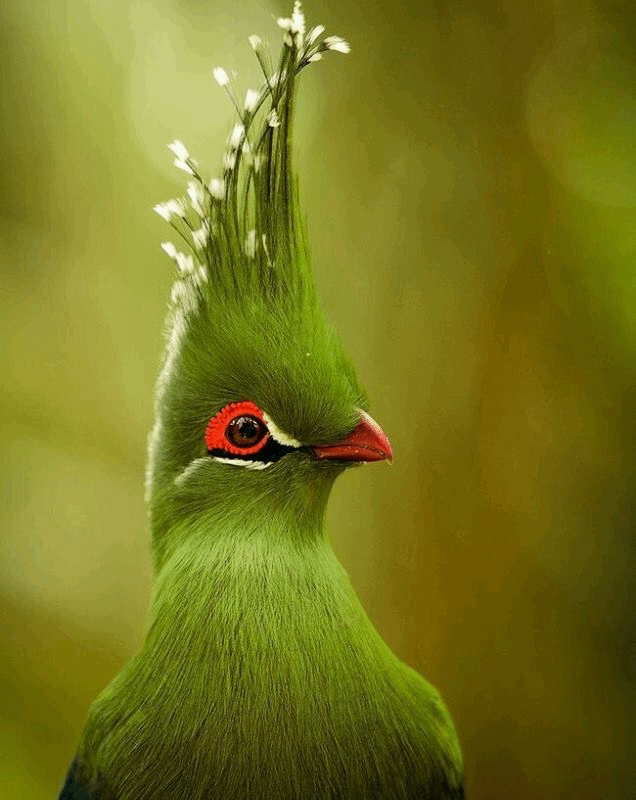
Livingstone’s turaco (Tauraco livingstonii) is a species of bird distributed throughout the subtropical lowlands of southeastern Africa. It is easily identified by its red, white and black eye patches, dark red beak, and a bold green crest sporting white floral flourishes. It mostly eats fruits.
Livingstone’s Turaco: A Vibrant Jewel of Southeastern Africa’s Forests
In the lush subtropical lowlands of southeastern Africa, a flash of emerald, crimson, and white signals the presence of one of the region’s most striking birds: Livingstone’s turaco (Tauraco livingstonii). Known for its kaleidoscopic plumage and melodic calls, this fruit-loving bird is a sought-after sight for birdwatchers and a vital contributor to its forest ecosystem. Let’s explore the unique traits, habitat, and ecological role of this avian gem.
Identification: A Burst of Color in the Canopy
Livingstone’s turaco is impossible to miss, thanks to its bold, contrasting features:
- Crest & Head: A vibrant green crest, tipped with delicate white accents, crowns its head, while striking red, white, and black eye patches frame its eyes.
- Beak & Body: Its deep red beak stands out against predominantly green and blue-tinged plumage on the body and wings. When in flight, crimson wing feathers flash brightly.
- Size: Measuring around 40–45 cm (16–18 inches) long, it’s a medium-sized bird with a long tail and a graceful profile.
This unmistakable appearance helps distinguish it from other turaco species in its range, such as the similar-looking Knysna turaco (Tauraco corythaix) in South Africa.
Habitat & Distribution
Livingstone’s turaco thrives in the subtropical lowland forests and coastal woodlands of southeastern Africa, including:
- Countries: Southern Tanzania, Malawi, Mozambique, Zimbabwe, eastern Zambia, and northern South Africa (KwaZulu-Natal).
- Preferred Habitat: Dense evergreen forests, riverine woodlands, and lush gardens, where fruit-bearing trees abound.
- Altitude: Typically found from sea level up to 1,800 meters (5,900 feet).
Unlike some forest birds, this adaptable species tolerates fragmented habitats, often venturing into cultivated areas or urban green spaces with fruiting trees.
Diet: The Fruit Specialist
True to its turaco lineage, Tauraco livingstonii is primarily frugivorous, meaning its diet centers on fruit:
- Preferred Foods: Feeds on wild figs, berries, and other soft fruits, plucking them deftly with its strong beak.
- Ecological Role: By consuming fruits whole and dispersing seeds through droppings, this bird acts as a critical seed disperser, aiding forest regeneration.
- Occasional Supplements: Rarely eats insects, flowers, or leaves, especially during fruit scarcity.
Its foraging habits keep it high in the canopy, where it moves agilely through branches.
Behavior & Social Habits
- Vocalizations: Livingstone’s turaco is highly vocal, emitting a series of loud, croaking “kweh” or “kow” calls (listen here). These sounds help pairs defend territory and maintain contact in dense foliage.
- Social Structure: Often seen in pairs or small family groups. Monogamous pairs work together to defend nesting sites.
- Nesting: Builds flimsy stick nests in tall trees, where females lay 2–3 eggs. Both parents share incubation and chick-rearing duties.
Unlike many birds, turacos lack strong flight muscles. Instead, they excel at hopping and gliding between trees with short, rounded wings.
Conservation Status
The IUCN lists Livingstone’s turaco as Least Concern, with populations appearing stable for now. However, threats loom:
- Habitat Loss: Logging, agriculture, and urban expansion degrade forests.
- Climate Change: Alters fruiting seasons, potentially disrupting food supplies.
- Pet Trade: Occasionally captured for the exotic bird market, though less trafficked than other turacos.
Protected areas like Malawi’s Lengwe National Park and Mozambique’s Gorongosa National Park offer vital refuges.
Birdwatching Tips: How & Where to Spot It
For birders hoping to glimpse this turaco:
- Prime Locations: Visit lowland forests in Malawi’s Zomba Plateau, South Africa’s iSimangaliso Wetland Park, or Zimbabwe’s Eastern Highlands.
- Timing: Active at dawn and dusk—listen for their raucous calls echoing through the canopy.
- Look Up: Scan treetops with binoculars; watch for flashes of red during short flights.
- Baiting Tip: Some lodges attract turacos with fruit feeders—inquire locally!
Why This Bird Matters
Livingstone’s turaco isn’t just a visual marvel—it’s a keystone species. By spreading seeds, it sustains forest biodiversity, supporting countless insects, mammals, and other birds. Its resilience in human-altered landscapes also makes it an ambassador for conserving Africa’s subtropical forests.
Final Thoughts
From its fiery crest to its forest-friendly diet, Livingstone’s turaco embodies the wild beauty of southeastern Africa. Whether you’re a seasoned birder or a nature enthusiast, encountering this living rainbow in the wild is an unforgettable experience—and a reminder to protect the habitats that make such wonders possible.
Plan your birdwatching adventure today, and keep your eyes peeled for the green-and-crimson flash of the treetops!
SEO Keywords: Livingstone’s turaco, Tauraco livingstonii, African bird species, green crested bird, birdwatching Africa, fruit-eating birds, birds of Malawi, birds of Mozambique, forest birds, turaco conservation.