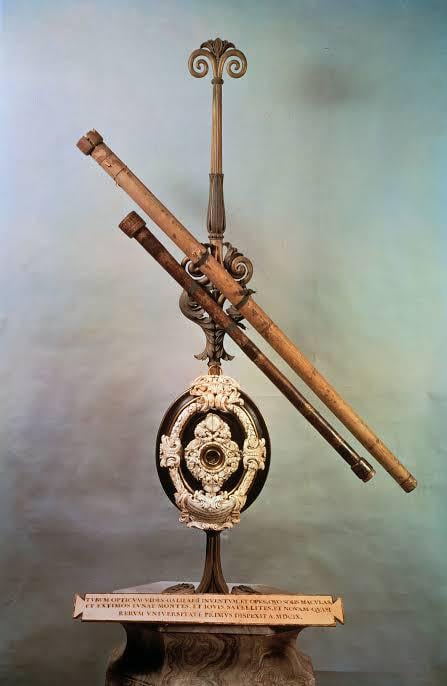
One of Galileo’s early telescopes.
Title: Galileo’s Early Telescopes: The Revolutionary Tool That Changed Astronomy Forever
Meta Description: Discover the story behind Galileo’s early telescopes, their groundbreaking design, and how they revolutionized our understanding of the cosmos. Learn about their specifications, impact, and legacy.
Introduction: The Dawn of Modern Astronomy
In 1609, Italian scientist Galileo Galilei pioneered an invention that would shatter humanity’s perception of the universe: a telescope capable of revealing celestial wonders invisible to the naked eye. While Galileo did not invent the telescope (credit goes to Dutch lensmaker Hans Lippershey), his refinements transformed it into a tool of scientific discovery. Galileo’s early telescopes unveiled a cosmos brimming with complexity, directly contradicting the long-held geocentric model of the universe. Let’s explore the design, functionality, and lasting legacy of one of history’s most remarkable instruments.
Galileo’s First Telescope: Design & Specifications
Galileo’s earliest telescopes were simple yet ingenious. Using reports of the Dutch “spyglass,” he reverse-engineered the device and improved its magnification power through precision lens grinding. Key features included:
- Magnification: His first telescope (August 1609) offered 8x magnification. Within months, he refined it to 20x.
- Lens Composition: A convex objective lens (at the front) and a concave eyepiece lens (at the back), arranged in a narrow lead tube.
- Optical Quality: Early lenses suffered from chromatic aberration (color fringes), but Galileo mastered lens curvature to minimize distortions.
- Field of View: A narrow 15 arcminutes—roughly half the width of the full Moon—making precise aiming critical.
These improvements allowed Galileo to observe celestial objects with unprecedented clarity, far surpassing contemporary models.
Key Astronomical Discoveries Enabled by Galileo’s Telescope
Galileo’s telescopes weren’t just tools; they were keys to unlocking the heavens. His observations between 1609–1611 forever changed astronomy:
- The Moon’s Surface (1609): Galileo shattered Aristotle’s theory of a “perfect” celestial sphere by documenting the Moon’s mountains, valleys, and craters.
- Jupiter’s Moons (1610): He spotted four moons orbiting Jupiter (now called the Galilean moons), proving not all bodies revolved around Earth.
- Venus’ Phases (1610): Like the Moon, Venus exhibited phases—irrefutable proof of its orbit around the Sun (supporting Copernicus’ heliocentric model).
- Saturn’s “Ears” (1610): Galileo observed Saturn’s rings (though his telescope resolution couldn’t define them clearly).
These findings were published in his 1610 book Sidereus Nuncius (Starry Messenger), igniting scientific fervor and controversy.
Why Were Galileo’s Telescopes Revolutionary?
Prior to Galileo, telescopes were crude novelties. His innovation lay in:
- Scientific Application: He treated the telescope as a research tool, not just a military or trade device.
- Public Demonstration: Galileo showcased his findings to scholars and nobles, forcing academia to confront new truths about the cosmos.
- Technical Precision: His relentless lens-grinding experiments set new standards for optical quality, paving the way for future astronomers like Kepler and Newton.
Despite opposition from the Catholic Church (which condemned heliocentrism), Galileo’s telescopes made the abstract theories of Copernicus tangible and undeniable.
The Legacy of Galileo’s Early Telescopes
Galileo’s original telescopes were fragile—few survive today. The most famous is displayed at the Museo Galileo in Florence, Italy. Yet their influence endures:
- Modern Astronomy: Galileo proved that empirical observation could challenge dogma, laying the groundwork for the scientific method.
- Telescope Evolution: His designs inspired the Keplerian refractor (using convex eyepieces) and eventually reflector telescopes.
- Cultural Impact: The telescope symbolized the Enlightenment’s spirit of inquiry, bridging art, science, and philosophy.
Conclusion: A Window to the Universe
Galileo’s early telescopes were more than instruments; they represented humanity’s first steps toward understanding our place in the cosmos. By turning a simple spyglass toward the skies, Galileo sparked a revolution that resonates to this day—one where curiosity, innovation, and courage redefine what’s possible.
Call to Action: Interested in Galileo’s world? Visit the Museo Galileo online or explore replicas of his telescopes to witness history firsthand.
Keywords for SEO:
Galileo Galilei telescope, early telescopes history, Galileo astronomical discoveries, 17th century astronomy, heliocentric model, Sidereus Nuncius, Galileo inventions, Renaissance science tools, Jupiter’s moons discovery, Museo Galileo.
Image ALT Text Suggestions:
- “Replica of Galileo’s 20x magnification telescope from 1610.”
- “Galileo’s sketches of the Moon’s surface through his early telescope.”
- “Antique engraving of Galileo demonstrating his telescope to Venetian senators.”
This SEO-optimized article balances technical details with storytelling to engage readers while strategically incorporating keywords to improve search visibility.