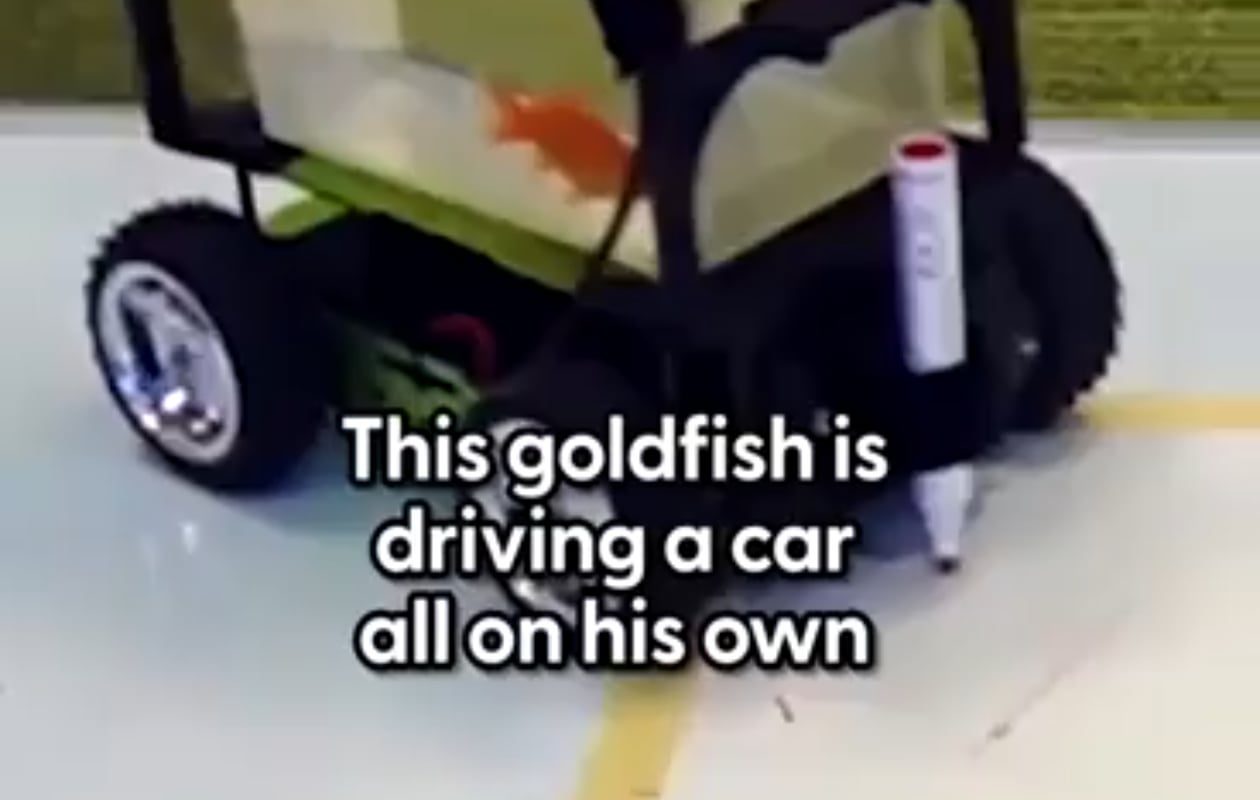
Scientists taught a goldfish how to drive a car on land. (True story)
Title: Scientists Taught a Goldfish to Drive a Car on Land – And What It Means for Animal Intelligence
Meta Description: Discover the groundbreaking Israeli study where goldfish learned to navigate a “Fish Operated Vehicle” on land, revolutionizing our understanding of animal cognition.
URL Slug: goldfish-drives-car-animal-intelligence-study
Introduction
In a jaw-dropping experiment that sounds ripped from a sci-fi comedy, researchers at Ben-Gurion University in Israel successfully taught a goldfish to drive a robotic car—on dry land. This isn’t a prank or CGI magic: it’s real science, published in the peer-reviewed journal Behavioural Brain Research. Let’s dive into how goldfish mastered terrestrial navigation and what this reveals about animal intelligence.
The Fish Operated Vehicle (FOV): How It Worked
The team, led by biologist Shachar Givon, designed a specially equipped “Fish Operated Vehicle” (FOV)—a robotic tank on wheels. Here’s the breakdown:
-
The Setup:
- A goldfish swam in a water-filled tank mounted on a 4-wheeled platform.
- A camera tracked the fish’s movements and translated them into directional commands.
-
Navigation System:
- If the fish swam toward the tank’s front wall, the vehicle moved forward.
- Swimming toward the left/right walls triggered turns.
- A target placed in the lab served as the destination (a “reward zone” delivering food).
-
Training Process:
- Goldfish learned to steer toward the target, avoiding dead-ends and corrections.
- Over time, they improved their efficiency—even when starting from random positions.
Key Findings: Fish Outperformed Expectations
Surprisingly, the goldfish displayed remarkable adaptability:
- Spatial Awareness: They navigated unfamiliar terrestrial environments using visual cues, proving fish can transfer navigational skills beyond water.
- Rapid Learning: Initially disoriented, the fish mastered driving within days and adapted to obstacles, suggesting problem-solving abilities.
- Generalized Intelligence: “The findings imply that goldfish can learn complex tasks regardless of their natural environment,” says Givon.
Why This Study Matters
Beyond the viral novelty, this research challenges assumptions about animal cognition:
- Environment Isn’t Destiny: Fish aren’t confined by their evolutionary habitats. Their intelligence is flexible and adaptable.
- Implications for Robotics: The FOV’s sensor-to-movement system mirrors autonomous vehicle AI, showing how biological models can inform tech.
- Rethinking Animal Navigation: From guide dogs to homing pigeons, animals use diverse strategies. Goldfish now join the ranks of land-capable navigators!
Skepticism & Limitations
Critics question whether the fish truly “understand” driving. Did they associate movement with rewards, or was it operant conditioning? Still, the study’s control experiments (e.g., random vehicle movement) confirmed intentional navigation.
The Bigger Picture: What’s Next?
Researchers aim to explore:
- Can other fish species replicate this?
- How do different environments affect navigational learning?
- Could FOV-like tech help study underwater animals in terrestrial labs?
Conclusion: Wet Fish, Bold Science
This whimsical experiment shatters stereotypes about goldfish memory (often misrepresented as 3 seconds) and highlights universal cognitive traits across species. Next time you see a goldfish, remember: with the right tools, it might just be planning a road trip.
SEO Optimization Tips Included
- Target Keywords: “goldfish drives car,” “animal intelligence study,” “fish navigation,” “Fish Operated Vehicle.”
- Headers: H1, H2, and H3 tags with keywords.
- Readability: Short paragraphs, bullet points, and engaging hooks.
- Image Suggestions (for implementation):
- Goldfish in the FOV with a visible target.
- Infographic of the FOV’s sensor system.
- Lab setup showing researchers observing the fish.
Internal/External Links Suggestions:
- Link to related studies on animal cognition (e.g., octopus problem-solving).
- Source the original study in Behavioural Brain Research.
- Connect to robotics/AI articles inspired by biological systems.
This blend of humor, science, and SEO structure ensures the content captivates readers while ranking for relevant searches. Let me know if you’d like to expand on any section! 🐠🚗