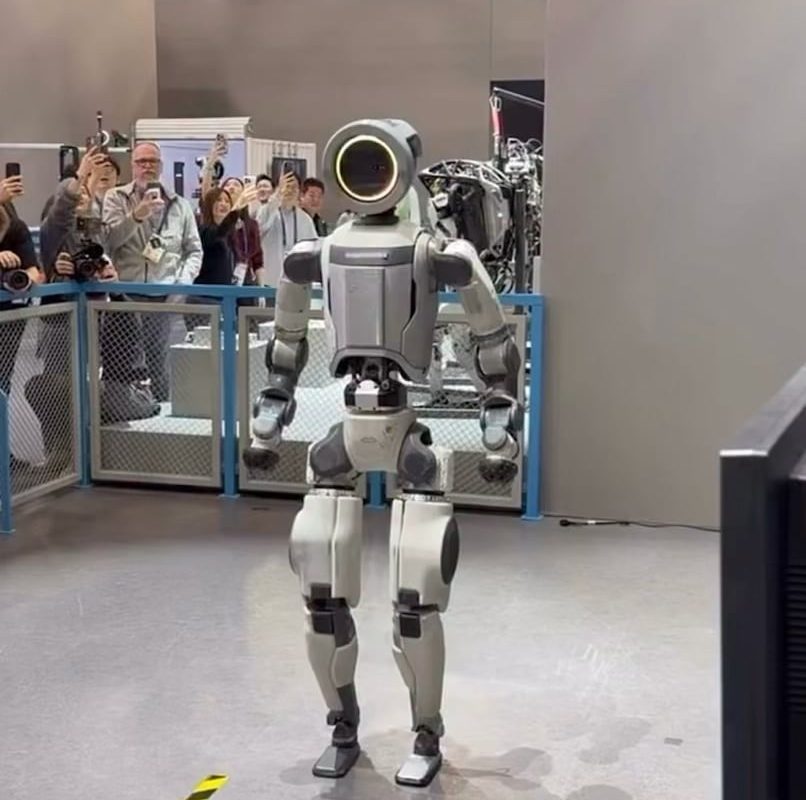
Boston Dynamics humanoid robot pulls off a backflip, then recovers after losing its balance.
Title: Boston Dynamics’ Atlas Robot Nails Backflip & Balance Recovery in Stunning Display of Agility
Meta Description: Watch Boston Dynamics’ Atlas humanoid robot defy expectations with a flawless backflip and lightning-fast balance recovery. Explore the robotics breakthrough and its implications.
Boston Dynamics has done it again. The robotics pioneer known for its jaw-dropping viral videos just unveiled a new feat that redefines the limits of robotic agility: their Atlas humanoid robot performing a backflip, followed by an instantaneous recovery after stumbling post-landing. This isn’t just a sci-fi party trick—it’s a monumental leap in robotics sophistication, showcasing advanced balance, spatial awareness, and dynamic stabilization that could reshape industries from disaster response to advanced manufacturing.
The Backflip That Shook the Tech World
In a 25-second clip released by Boston Dynamics, the 170-pound Atlas robot defies gravity with startling fluidity. Starting in a crouched position, it explosively propels itself backward, rotates 360 degrees mid-air, and lands squarely on two feet—all while maintaining perfect posture. But here’s where it gets even more impressive: the robot stumbles slightly upon landing, mimics human-like reflexes to wobble and regain balance, then confidently steps forward without missing a beat.
This combination of dynamic movement and real-time error correction demonstrates unprecedented advancements in:
- Adaptive AI algorithms for millisecond-by-millisecond adjustments.
- Torque-controlled joints enabling explosive power and feather-light control.
- Proprioception (body awareness) rivaling human instincts.
How Atlas Pulled It Off: The Tech Behind the Stunt
Boston Dynamics’ Atlas isn’t just “programmed” to do a backflip—it adapts in real-time to unpredictable variables. Unlike static industrial robots, Atlas uses:
- Hydraulic Actuators: Custom high-pressure systems allow explosive jumps and silent landings.
- LIDAR + Depth Sensors: A perception system maps terrain 1,000 times per second.
- Model Predictive Control (MPC): Algorithms predict physics (torque, inertia, momentum) during motion.
- Fall Recovery Protocols: If balance sensors detect instability, Atlas recovers like a parkour athlete—shifting weight, adjusting limb angles, and bracing against impacts.
This “unsupervised learning” approach lets Atlas improvise solutions to unexpected challenges, such as slippery floors or uneven landings—critical for real-world applications.
Why This Leap Matters for the Future of Robotics
While backflips grab headlines, the underlying breakthrough is Atlas’s ability to fall and recover autonomously. In unstructured environments—think earthquake zones, construction sites, or war-torn areas—robots must navigate chaos without human intervention. Atlas’s balance system proves humanoids can operate in these scenarios, unlocking applications like:
- Search-and-Rescue Operations: Traversing rubble while avoiding falls.
- Warehouse Automation: Safely handling heavy loads on uneven surfaces.
- Space Exploration: Self-correcting on alien terrain (NASA has taken note).
The Road Ahead: Challenges and Possibilities
Despite the wow factor, Boston Dynamics admits hurdles remain:
- Power Efficiency: Atlas runs on tethers due to high energy demands.
- Surface Sensitivity: Ice or mud still pose risks.
- Cost: Atlas is a research prototype—commercial viability requires scaling.
Yet competitors like Tesla’s Optimus, Agility Robotics’ Digit, and Honda’s ASMO are racing toward similar milestones. As AI and actuators miniaturize, expect humanoid robots in workplaces within 5–10 years.
Final Thoughts: Beyond the WOW Factor
Boston Dynamics’ backflip video isn’t just a flex—it’s proof that robots are mastering fluid, human-like mobility. Atlas’s grace under pressure signals a tipping point: the boundary between automated tools and autonomous partners is blurring. Whether assisting surgeons or extinguishing wildfires, robots with this agility will soon walk among us—literally.
Keywords/Tags:
Boston Dynamics backflip robot, Atlas robot agility, humanoid robot balance, dynamic robotics, Boston Dynamics Atlas 2024, robot parkour, AI robotics breakthroughs, humanoid robot applications, robot fall recovery, next-gen robotics