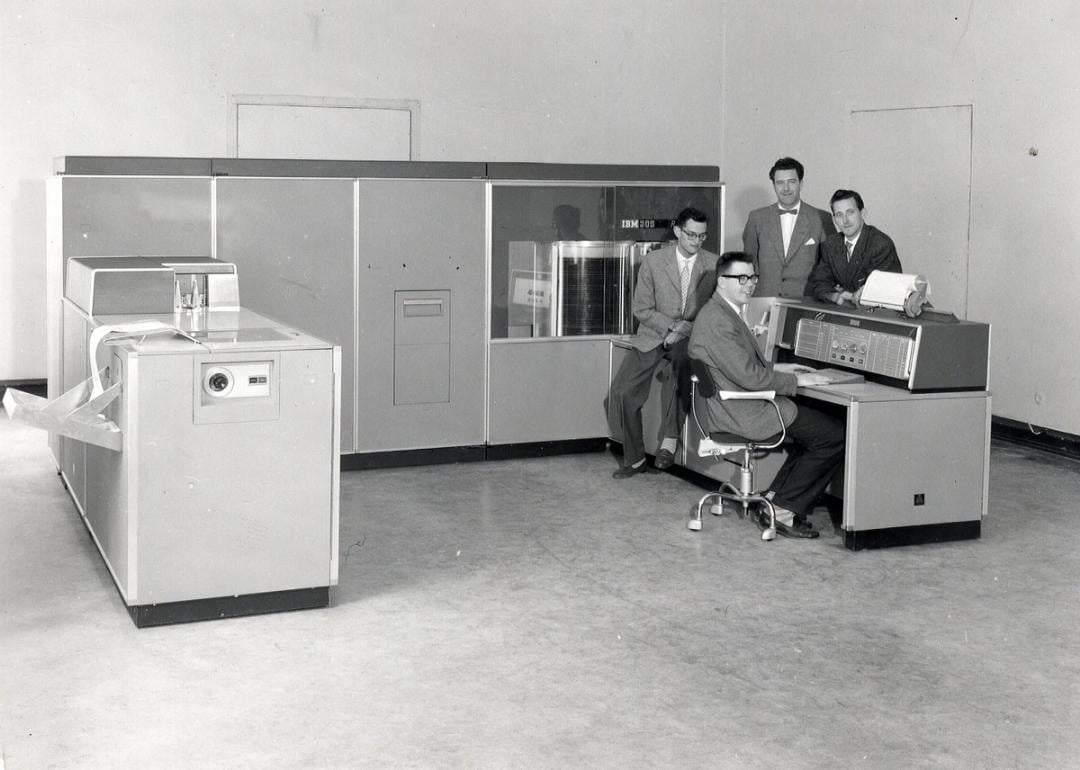
IBM RAMAC (1956) — the world’s first hard drive, storing just 5 MB of data, weighing over a ton, and taking up an entire room, yet laying the foundation for today’s modern data storage.
The Birth of Data Storage: How IBM’s RAMAC (1956) Revolutionized Computing Forever
In 1956, IBM unveiled a machine that seemed like science fiction at the time: the IBM 305 RAMAC, the world’s first commercial computer with a hard disk drive. This groundbreaking invention, which stored just 5 megabytes (MB) of data and weighed over a ton, laid the foundation for today’s terabyte-scale storage, cloud computing, and the entire digital revolution. Let’s explore the remarkable story of the RAMAC and why its legacy remains vital seven decades later.
What Was the IBM RAMAC?
The Random Access Method of Accounting and Control (RAMAC) was a room-sized computer system developed by IBM engineers in San Jose, California. Its defining feature? The IBM 350 Disk Storage Unit, the first-ever hard disk drive (HDD).
- Capacity: 5 MB (enough to store one MP3 song today).
- Physical Size: 50 magnetic disks (24 inches in diameter) stacked vertically.
- Weight: Over 1 ton (2,000+ pounds).
- Cost: Roughly $10,000 per month to lease ($100,000+ in today’s dollars).
Unlike punch cards or tape reels, RAMAC’s disk drive allowed random access to data—meaning files could be retrieved in seconds instead of minutes or hours. This was revolutionary for businesses needing fast data processing.
Engineering Marvel: How the RAMAC Worked
The RAMAC’s IBM 350 Disk Storage Unit was a feat of mechanical engineering:
- Magnetic Disks: 50 double-sided platters coated with magnetic iron oxide, spinning at 1,200 RPM.
- Moving Arm: A single read/write head on a mechanical arm that physically moved between disks to locate data (average access time: 600 milliseconds).
- Data Transfer Rate: 8.8 KB per second—painfully slow by today’s standards, but blazingly fast in 1956!
Fun Fact: The system’s air compressor helped cushion the moving arm to prevent damage—meaning the RAMAC literally hissed while running.
Why the RAMAC Changed Everything
Before RAMAC, businesses relied on punch cards or magnetic tape, which required sequential access (like rewinding a cassette tape). The RAMAC introduced three game-changing innovations:
- Random Access: Instant data retrieval transformed payroll, inventory, and accounting systems.
- High Density: 5 MB was massive for the era—equivalent to 64,000 punch cards.
- Scalability: IBM’s magnetic disk concept became the blueprint for all future HDDs.
While the RAMAC was leased primarily to governments and large corporations, it proved that digital storage could drive business efficiency. Early adopters included airlines (for reservations) and factories (for inventory tracking).
From Room-Sized to Pocket-Sized: RAMAC’s Legacy
The RAMAC’s influence cascaded through computing history:
- 1960s: IBM’s “Winchester” drives (8 MB) became smaller and cheaper.
- 1980s: The first consumer HDDs (5–10 MB) arrived in personal computers.
- 2020s: A 2TB microSD card (400,000x more storage than RAMAC) fits in your fingertip.
Modern cloud storage, SSDs, and even DNA data storage all trace their roots to this pioneering 1956 system.
Beyond RAMAC: The Evolution of Storage
The RAMAC ignited an exponential growth curve in storage tech, defined by Moore’s Law and Kryder’s Law:
- Cost: RAMAC stored data at $10,000 per MB. Today, it’s less than $0.00002 per MB.
- Size: From 5 MB per ton (1956) to 20 TB per 2.5-gram drive (2024).
- Speed: Modern NVMe SSDs are 10 million times faster than the RAMAC’s 8.8 KB/s transfer rate.
Yet the RAMAC’s core principle—magnetic disks storing retrievable data—remains embedded in everything from data centers to smartphones.
Conclusion: The Humble Giant That Started It All
The IBM RAMAC may seem comically primitive today, but it was the big bang of data storage. Without its invention, the digital economy—from streaming services to AI—simply wouldn’t exist. Next time you save a file to your pocket-sized 1TB SSD, remember the room-filling, hissing behemoth that started it all.
IBM’s RAMAC taught the world one thing: the future would be built on the ability to store, access, and scale data. And it was right.
Optimized Keywords: IBM RAMAC, first hard drive, IBM 350 Disk Storage Unit, history of data storage, evolution of HDD, random access storage, 1956 computer technology, Kryder’s Law, magnetic disk drive.