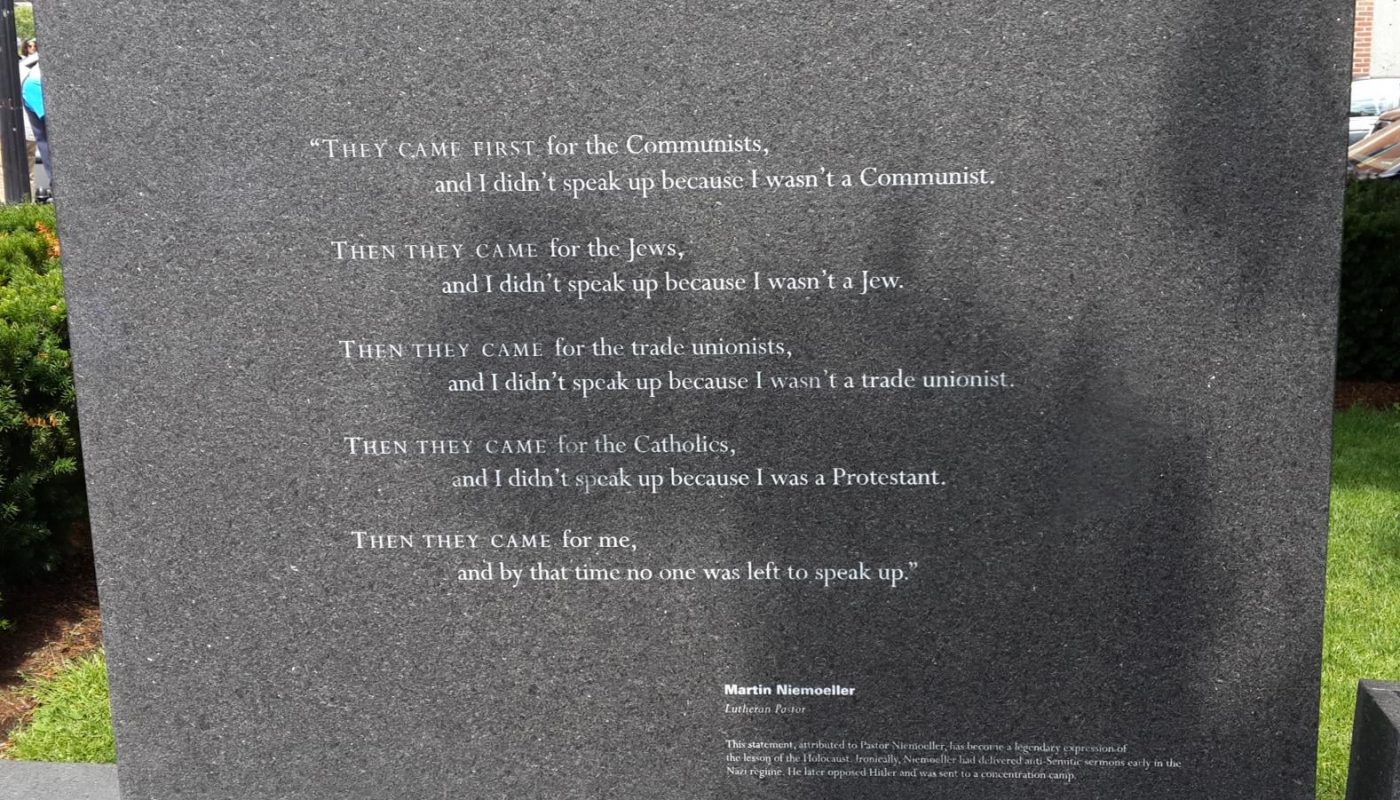
Poem engraved at the Holcaust Memorial in Boston, Massachusetts, about the silent complicity of germans following the Nazis’ rise of power
Title: “Then They Came For Me”: The Haunting Poem at Boston’s Holocaust Memorial & the Lesson of Silent Complicity
Meta Description: Explore the powerful Martin Niemöller poem at Boston’s Holocaust Memorial—a stark reminder of silence in the face of injustice—and its enduring call to moral courage.
Introduction
In the heart of Boston, Massachusetts, the New England Holocaust Memorial stands as a solemn monument to the six million Jewish victims of the Nazi genocide—and a warning for future generations. Among its haunting glass towers, one inscription strikes visitors with particular force: the poem “First they came…” by German pastor Martin Niemöller. This piece dissects the theme of silent complicity in Nazi Germany, urging us to confront the consequences of bystander inaction.
The Poem: “First they came…” – A Rebuke of Silent Complicity
Engraved on granite at the memorial, the poem (often titled “Then They Came For Me”) reads:
First they came for the socialists, and I did not speak out—
Because I was not a socialist.
Then they came for the trade unionists, and I did not speak out—
Because I was not a trade unionist.
Then they came for the Jews, and I did not speak out—
Because I was not a Jew.
Then they came for me—
and there was no one left to speak for me.
Written by Pastor Martin Niemöller, a former Nazi supporter turned dissident, the poem reflects his remorse over his initial silence as Hitler’s regime systematically stripped rights from marginalized groups.
Historical Context: How Ordinary Germans Enabled Nazi Atrocities
Niemöller’s words encapsulate the “bystander effect” that allowed the Holocaust to unfold. After Hitler’s 1933 rise to power:
- Fear and Apathy: Many Germans ignored early persecution—of Communists, disabled people, Roma, and LGBTQ+ individuals—believing it didn’t affect them.
- Propaganda & Dehumanization: Nazis framed minority groups as threats, normalizing hatred.
- Incremental Tyranny: Rights were eroded slowly, making opposition seem futile or risky.
Niemöller, once an anti-Semitic nationalist, later opposed Nazi policies and was imprisoned in Dachau concentration camp. His poem is a confession: silence in the face of others’ oppression ultimately endangers everyone.
Why This Poem Resonates at Boston’s Holocaust Memorial
The New England Holocaust Memorial, inaugurated in 1995, uses architecture and text to evoke introspection. Its six luminous glass towers symbolize the six million murdered Jews, while quotes from survivors and witnesses—like Niemöller’s poem—challenge visitors to reflect on complicity.
Key Themes Highlighted:
- Individual Responsibility: The poem implicates not just Nazis, but everyday citizens who looked away.
- Universality of Human Rights: Injustice against one group threatens all.
- A Call to Vigilance: The memorial urges action against modern bigotry and genocide.
Silence as Complicity: Lessons for Today
Niemöller’s verse is tragically timeless. From Rwanda to Myanmar, history repeats when societies normalize hatred or prioritize comfort over conscience. The poem asks:
- Would I speak up for others, even at personal cost?
- How do I respond to rising authoritarianism today?
Visitor Reactions:
Many leave the memorial shaken, scribbling reflections in guestbooks: “This could happen again.” “We must never forget.” The poem’s simplicity forces introspection about our role in sustaining democracy.
Visiting the New England Holocaust Memorial in Boston
Location: Carmen Park, near Faneuil Hall (Freedom Trail)
Hours: Open daily, illuminated at night for solemn impact.
Experience: Walk through the glass towers, where steam rises from darkness—symbolizing the camps’ chimneys—and read inscriptions like Niemöller’s, Elie Wiesel’s quotes, and historical timelines.
Conclusion: “Never Again” Starts With Us
Martin Niemöller’s poem at Boston’s Holocaust Memorial is more than history—it’s a warning. In an age of rising nationalism and hate crimes, it demands that we reject complicity, defend the vulnerable, and honor the memorial’s pledge: “Thou shalt not be a victim. Thou shalt not be a perpetrator. Above all, thou shalt not be a bystander.”
Keywords for SEO:
Holocaust Memorial Boston, Martin Niemöller poem, silent complicity Holocaust, Boston Holocaust Memorial inscription, Nazi Germany bystander effect, New England Holocaust Memorial, First they came poem, lessons from the Holocaust.
Image Alt-Text Suggestions:
- “Martin Niemöller’s ‘First They Came’ poem engraved at Boston’s Holocaust Memorial”
- “Glass towers of the New England Holocaust Memorial at night, Boston”
This article merges historical context, thematic analysis, and practical visitor info to optimize for search queries related to Boston’s memorial and Niemöller’s timeless warning against indifference.