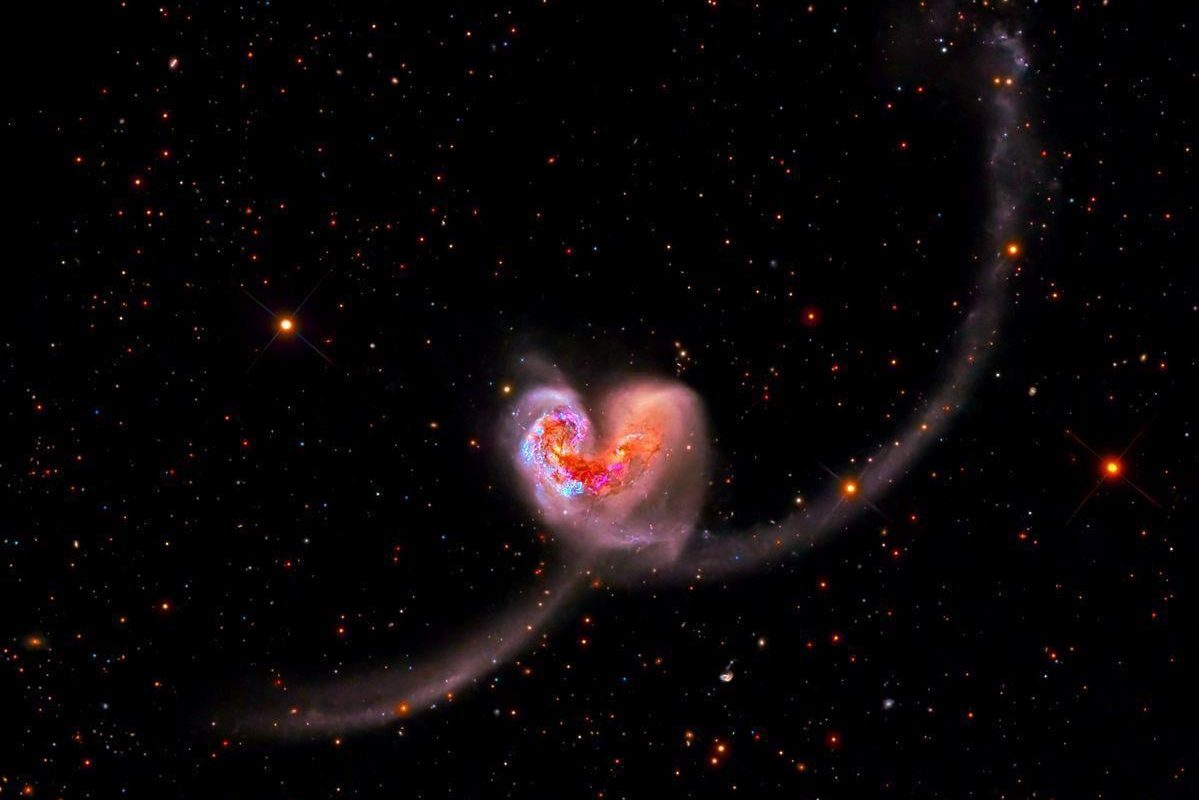
Interacting galaxies NGC 4038 and NGC 4039 in the Corvus constellation
Title: Cosmic Collision: Exploring the Interacting Galaxies NGC 4038 and NGC 4039 in Corvus
Meta Description: Discover the Antennae Galaxies (NGC 4038 & NGC 4039), a stunning pair of colliding galaxies in the Corvus constellation. Learn about their structure, evolution, and how to observe them.
Introduction to the Antennae Galaxies
NGC 4038 and NGC 4039, collectively known as the Antennae Galaxies, are among the most dramatic examples of interacting galaxies in our cosmic neighborhood. Located approximately 45 million light-years away in the constellation Corvus (the Crow), this celestial duo offers astronomers a front-row seat to the violent yet beautiful process of galactic mergers. Their nickname derives from the long, antenna-like tidal tails of gas and dust ejected during their collision—a spectacle visible only through advanced telescopes.
In this guide, we’ll delve into the science, history, and significance of these colliding galaxies, along with tips for observing them yourself.
Discovery and Key Characteristics
Historical Context
- Discovered by astronomer William Herschel in 1785, the pair was initially cataloged as a single “nebula.”
- Modern telescopes later revealed their true nature: two spiral galaxies in the process of merging.
Morphology and Features
- Current Stage: The galaxies are in an advanced phase of collision, having begun interacting 300–400 million years ago.
- Tidal Tails: Stretching over 360,000 light-years, these luminous streams of stars and gas form the iconic “antennae” structure.
- Star Formation: Intense gravitational forces trigger massive starburst regions, birthing millions of young stars and glowing nebulae.
- Supernova Activity: The Antennae host frequent supernovae, making them a hotspot for studying stellar explosions.
Scientific Significance of NGC 4038 & NGC 4039
A Galactic Laboratory
The Antennae Galaxies serve as a critical natural laboratory for understanding:
- Galaxy Evolution: How mergers reshape galaxies and fuel star formation.
- Starburst Phenomena: The link between collisions and rapid star birth.
- Black Hole Dynamics: Supermassive black holes in both galaxies are expected to merge billions of years from now.
Key Discoveries
- Hubble Space Telescope imaging revealed over 1,000 bright star clusters formed during the collision.
- Chandra X-ray Observatory detected vast clouds of hot gas and neutron stars scattered across the merging cores.
Observing the Antennae Galaxies: A Stargazer’s Guide
Location in the Sky
- Constellation: Corvus, near the border with Crater.
- Best Viewing Time: Visible in the Northern Hemisphere during spring (April–June).
- Coordinates: Right Ascension 12h 01m 53s | Declination -18° 52′ 10″.
How to Spot Them
- Telescope Required: Due to their distance and magnitude (NGC 4038: ~11.2), a 6-inch+ telescope is ideal.
- Look For: A faint, fuzzy patch near the stars γ and δ Corvi. Long-exposure astrophotography highlights their tidal tails.
Pro Tip:
For amateur astronomers, dark-sky locations enhance visibility. Apps like Stellarium can help pinpoint their position.
The Future of NGC 4038 & NGC 4039
Over the next billion years, the Antennae Galaxies will fully coalesce into a single elliptical galaxy, littered with aging stars and shrouded in gas. Their merger mirrors the fate awaiting the Milky Way and Andromeda galaxies in 4.5 billion years.
Why Study Galactic Collisions?
Interacting galaxies like the Antennae remind us that the universe is dynamic and ever-changing. They offer insights into:
- The origins of globular clusters
- The role of dark matter in galactic interactions
- The lifecycle of stars in extreme environments
Conclusion
NGC 4038 and NGC 4039 are cosmic storytellers, revealing the power and chaos of galactic collisions. Whether you’re an astronomer or an avid stargazer, the Antennae Galaxies invite us all to ponder the universe’s grand, transformative dances.
🔭 Further Reading: Explore other colliding galaxies, such as the Mice Galaxies (NGC 4676) or the Milky Way’s future fate with Andromeda!
Keywords for SEO:
Antennae Galaxies, NGC 4038, NGC 4039, interacting galaxies, Corvus constellation, galaxy collision, starburst galaxies, observing Antennae Galaxies, Hubble Space Telescope, galactic mergers, astronomy guide.
![[BBC] A bite from a Brazilian Wandering Spider may lead to a 4-hour erection for men (but also subsequently require amputation)](https://www.smartplusmedia.com/wp-content/uploads/2025/12/BBC-A-bite-from-a-Brazilian-Wandering-Spider-may-lead-445x265.png)