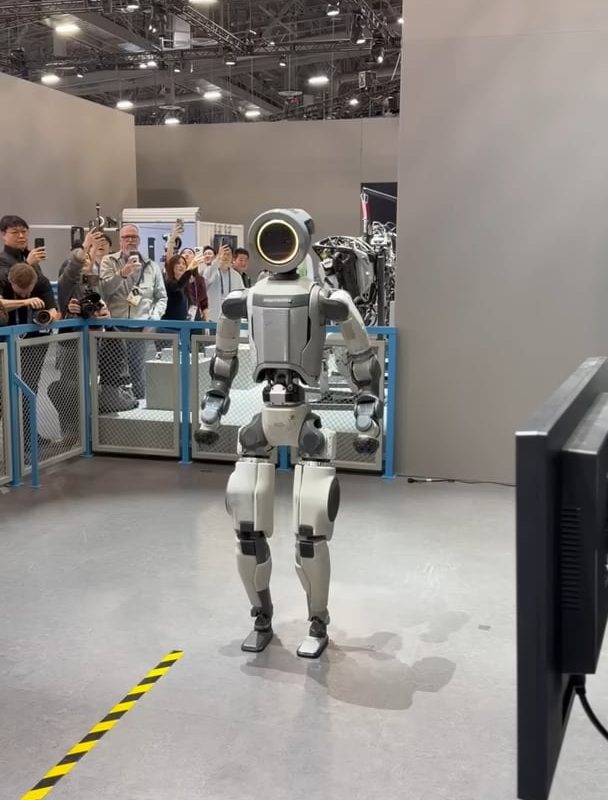
The recovery by far was more impressive than the backflip itself! Atlas messed up the backflip, but calculated the correction in less than a second.
Title: Atlas Robot’s Recovery Steals the Show: Why Its Backflip Fail Highlights AI’s Greatest Triumph
When Boston Dynamics’ humanoid robot, Atlas, attempted a backflip in a viral video, the internet braced for a cringe-worthy fail. Instead, viewers witnessed a jaw-dropping moment of robotic brilliance: Atlas’s recovery was more impressive than the backflip itself. While the robot stumbled mid-maneuver, it flawlessly recalculated its trajectory, rebalanced, and stuck the landing—all in less than a second. This wasn’t just a saved stunt; it was a masterclass in real-time robotics, proving that AI’s ability to “fail forward” is reshaping the future of automation.
The Backflip That Went (Almost) Wrong
The video clip begins like many of Atlas’s awe-inspiring demos: the robot takes a running start, leaps into the air, and initiates a textbook backflip. But halfway through, something goes awry. Its rotation falters, its center of gravity tilts dangerously, and for a split second, a crash seems inevitable.
What happens next is where the magic unfolds.
The 0.8-Second Miracle: How Atlas Engineered a Perfect Save
While humans would need minutes (or therapy) to recover from such a blunder, Atlas’s AI-powered systems leapt into action:
- Instant Diagnostics: Advanced sensors detected the misalignment mid-air, assessing balance, momentum, and limb positioning.
- Real-Time Recalculation: Atlas’s software processed terabytes of spatial data to generate a new landing strategy—adjusting its legs, arms, and torso to counteract the error.
- Dynamic Stabilization: Hydraulic actuators and joints responded with precision, redistributing weight to absorb impact and stabilize the bot upright.
The entire correction took less time than a human blink. Boston Dynamics later confirmed the save was 100% autonomous—no human intervention.
Why the Recovery Outshines the Stunt
While backflips are crowd-pleasers, Atlas’s save demonstrates transformative advances in robotics:
- Resilient AI: Unlike pre-programmed routines, Atlas used machine learning to adapt to unpredictability—a skill critical for real-world deployment.
- Perception Under Pressure: Its sensors and algorithms processed chaos (wind, torque, instability) faster than any human pilot.
- Grace Under Fire: The ability to “fall with style” mirrors human-like agility, making robots viable for high-risk scenarios like disaster response.
The Bigger Picture: What This Means for Robotics
Atlas’s stumble-turned-triumph foreshadows a future where robots:
- Operate safely in dynamic environments (construction sites, war zones).
- Learn from failures in real-time, accelerating autonomy.
- Collaborate seamlessly with humans, thanks to split-second decision-making.
As one researcher noted: “Falling is inevitable. It’s how you recover that defines intelligence.”
Final Thought: The Rise of Self-Correcting Machines
Atlas’s backflip fail wasn’t a setback—it was a milestone. By solving a physics nightmare in milliseconds, Boston Dynamics showcased AI’s untapped potential to turn errors into innovation. For the robotics world, recovery isn’t just a feature; it’s the ultimate goal.
Target Keywords: Atlas robot backflip fail, Boston Dynamics AI recovery, real-time robotics correction, self-balancing humanoid robot, AI adaptability in robotics.
Meta Description: When Atlas botched a backflip, its AI-powered recovery in less than a second stole the show. Discover how Boston Dynamics turned a fail into a robotics milestone and why adaptability matters more than perfection.