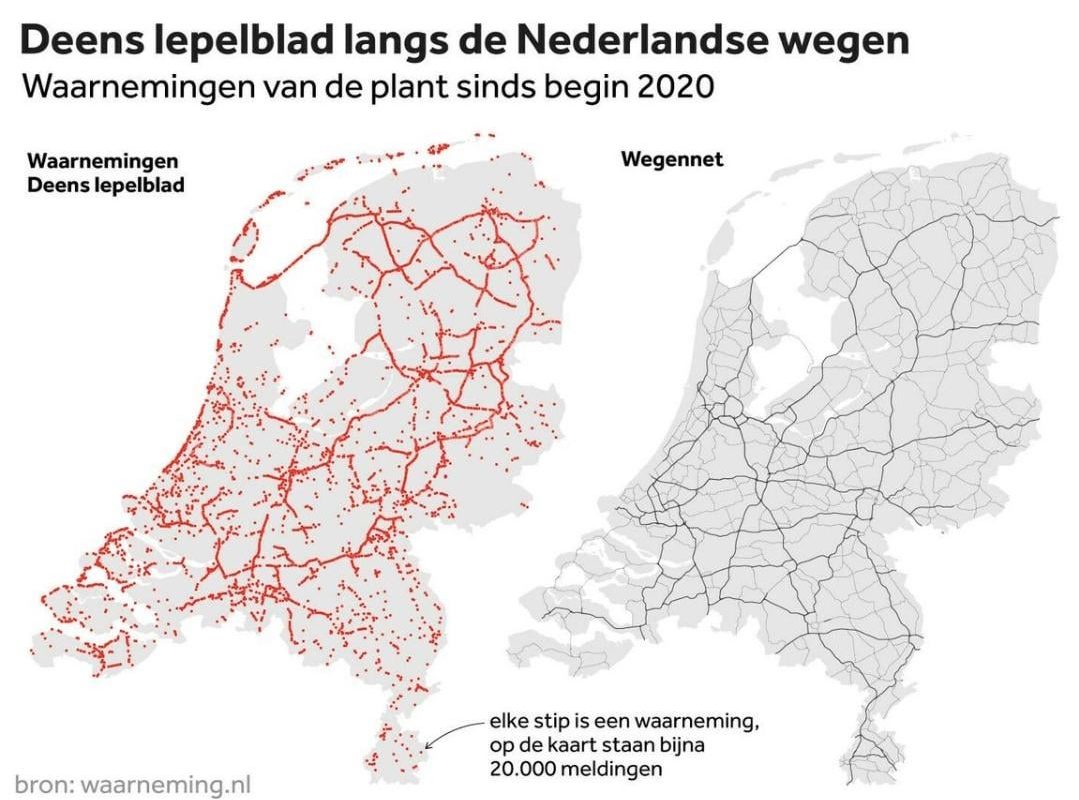
The distribution of Danish scurvygrass (Cochlearia danica; left), a salt-tolerant coastal plant, overlaps almost perfectly with the Dutch road network (right), due to salt gritting on the roads in winter time
Title: How Road Salt Helped Danish Scurvygrass Conquer Dutch Highways
Meta Description: Discover the fascinating link between Dutch winter road gritting and the spread of Danish scurvygrass (Cochlearia danica), a salt-tolerant coastal plant now thriving along highways.
Introduction
In a striking display of nature’s adaptability, Danish scurvygrass (Cochlearia danica), a tiny coastal wildflower, has unexpectedly colonized the Netherlands’ road network. This peculiar overlap isn’t a coincidence—it’s a direct consequence of winter road maintenance. As salt gritting transforms highways into artificial coastal habitats, this resilient plant has seized the opportunity to expand its territory inland. Here’s how human activity unintentionally reshaped the distribution of a native species.
What is Danish Scurvygrass?
Danish scurvygrass is a low-growing, salt-tolerant perennial native to Europe’s coastlines. Recognizable by its small white flowers and spoon-shaped leaves, it thrives in salty, nutrient-poor soils where few competitors survive. Historically, it was used by sailors to prevent scurvy due to its high vitamin C content. But in recent decades, it’s gained a new title: the “motorway plant.”
Key Traits:
- Salt Tolerance: Thrives in saline environments.
- Pioneer Species: Quickly colonizes disturbed or harsh habitats.
- Flowering Season: Blooms early (March–May), blanketing roadsides with white.
The Salt Connection: From Coastlines to Highways
The secret to Danish scurvygrass’s inland expansion lies in winter road gritting. To combat icy conditions, Dutch authorities apply salt (NaCl) to roads. When snow melts, the runoff creates saline soils along verges—mimicking the plant’s natural coastal habitat.
How It Spread:
- Seed Dispersal: Vehicle tires and wind carry seeds from coastal areas to roadsides.
- Habitat Match: Salt-rich roadsides act as “mini-coasts,” allowing the plant to establish.
- Adaptive Edge: With minimal competition from salt-sensitive plants, scurvygrass dominates.
Studies show its distribution now overlaps almost perfectly with major Dutch highways, including the A1, A2, and A12 corridors.
Ecological Implications: A Double-Edged Sword
While Danish scurvygrass’s spread highlights nature’s resilience, it also underscores human impact on ecosystems:
- Positive Adaptation: The plant capitalizes on human-altered landscapes without harming native biodiversity.
- Salt Pollution Concerns: Road gritting can damage freshwater ecosystems and soils, affecting less-tolerant species.
- Climate Change Link: Milder winters may reduce road salting, potentially reversing its spread.
Why This Matters Beyond the Netherlands
Similar patterns are emerging globally. In the UK, Germany, and Scandinavia, salt-tolerant plants like scurvygrass and oysterplant (Mertensia maritima) are advancing along highways. This phenomenon serves as a living laboratory for studying:
- Urban Ecology: How infrastructure shapes flora.
- Evolutionary Biology: Rapid adaptation to anthropogenic habitats.
- Sustainable Road Management: Balancing safety with ecosystem health.
Spotting Danish Scurvygrass in the Wild
Next time you drive through the Netherlands in spring, look for:
- Clusters of white flowers on grassy verges.
- Spoon-shaped leaves forming dense mats.
- Saline soils near exits or bridges, where salt accumulates.
Conclusion
The story of Danish scurvygrass and Dutch highways is a testament to nature’s ingenuity. What began as a coastal survivor has become an unlikely symbol of human-environment interaction—thriving not despite our actions, but because of them. As road networks expand and climates shift, this tiny pioneer reminds us that even small changes can rewrite ecological maps.
Keywords for SEO: Danish scurvygrass, Cochlearia danica, salt-tolerant plants, Dutch road network, road gritting effects, winter road salting, urban ecology, plant adaptation, Netherlands highways, coastal plants.
Explore more about how human infrastructure shapes nature—subscribe for updates on urban ecology and climate adaptation!