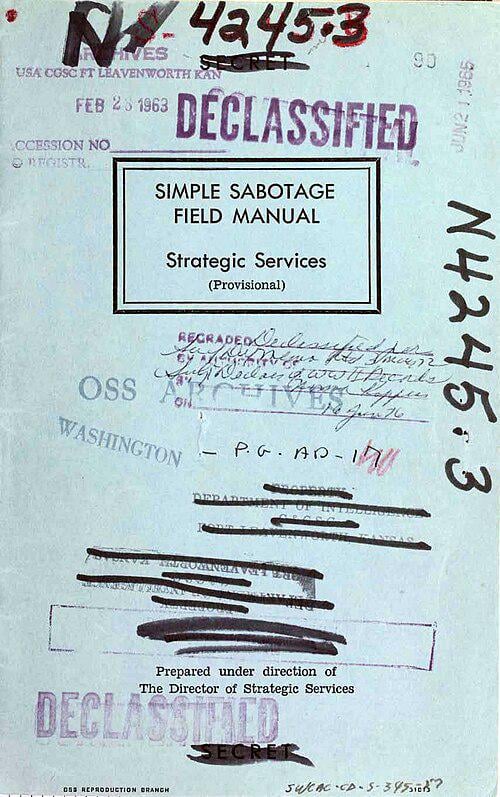
In the 1940’s the CIA adopted the Simple Sabotage Field Manual as a tool to combat fascist regimes. It details the peaceful and harmless inefficiencies that can, over time, weaken an occupying system by eroding output, coordination, and morale.
The CIA’s Simple Sabotage Field Manual: How to Combat Oppression with Paperwork and Inefficiency
During World War II, as Allied forces fought to dismantle fascist regimes, the CIA’s predecessor—the Office of Strategic Services (OSS)—devised a surprisingly low-tech weapon: bureaucratic chaos. In 1944, the OSS (later the CIA) published the Simple Sabotage Field Manual, a guidebook teaching civilians under occupation how to cripple hostile systems without violence, weapons, or obvious defiance. Instead, it weaponized inefficiency, subtlety, and the universal frustrations of bad meetings.
The Genesis of Peaceful Sabotage
With fascist powers occupying much of Europe, the OSS recognized that overt resistance often led to brutal reprisals. Their solution? Subtle subversion. The 32-page Simple Sabotage Field Manual (declassified in 2008) instructed ordinary citizens—factory workers, clerks, train conductors—on how to erode productivity, communication, and morale within authoritarian systems. The goal: make the gears of oppression grind to a halt through seemingly harmless acts of incompetence.
Key Tactics: How to Sabotage a System Quietly
The manual outlined dozens of methods to foster dysfunction, many of which feel eerily familiar in modern workplaces:
-
Meetings as Weapons:
- “Insist on doing everything through ‘channels.’ Never permit shortcuts.”
- “Haggle over precise wordings of communications, minutes, resolutions.”
- “Discuss irrelevant subjects at length.”
-
Bureaucratic Atrophy:
- Lose or misfile important paperwork.
- Misplace tools, delay repairs, and “forget” to lubricate machinery.
- Create redundant approvals for simple tasks.
-
Social Sabotage:
- Spread gossip to fuel distrust.
- Magnify minor disagreements into open conflicts.
- Encourage pessimism: “It’ll never work anyway.”
-
Universal Connector: The Power of Slow:
- Drive trains slowly. Delay shipments. Take excessive breaks.
- Work “to rule” (following every regulation literally to stall progress).
The brilliance lay in plausible deniability. None of these acts were prosecutable, yet collectively, they throttled efficiency and destabilized systems dependent on order.
Why This Manual Still Resonates Today
Beyond its wartime context, the Simple Sabotage Field Manual is a prescient study of organizational psychology. Its tactics exploit universal friction points in hierarchical systems:
- Bureaucracy: Even well-intentioned rules can be misused to stall progress.
- Group Dynamics: Passive aggression and miscommunication are toxic multipliers.
- Morale Erosion: Small frustrations, repeated daily, degrade trust and motivation.
From Espionage to Modern Management
Ironically, the manual now serves as both a corporate cautionary tale and a tool for activists. Managers spot its tactics in toxic workplaces (e.g., endless meetings, territorialism), while modern resistors adapt its principles for non-violent protest against oppressive regimes or exploitative corporations.
Even unintentionally, the manual reminds us: Systems are fragile. Apathy, rigidity, and inertia can collapse empires—or companies—faster than bombs.
How to Find the Manual Today
Declassified by the CIA, the Simple Sabotage Field Manual is available online as a PDF—a piece of history that’s equal parts chilling and insightful. Modern readers might laugh at its analog advice (e.g., sabotaging coal shovels), but its core truth endures:
Sometimes, the most effective resistance isn’t an uprising.
It’s a thousand tiny acts of not caring.
Meta Description: Discover how the CIA’s 1944 Simple Sabotage Field Manual taught civilians to undermine fascism using bureaucracy, slow workflows, and bad meetings—tactics eerily relevant today.
Keywords: Simple Sabotage Field Manual, CIA sabotage tactics, OSS history, non-violent resistance, workplace inefficiency, bureaucratic sabotage, WWII espionage.