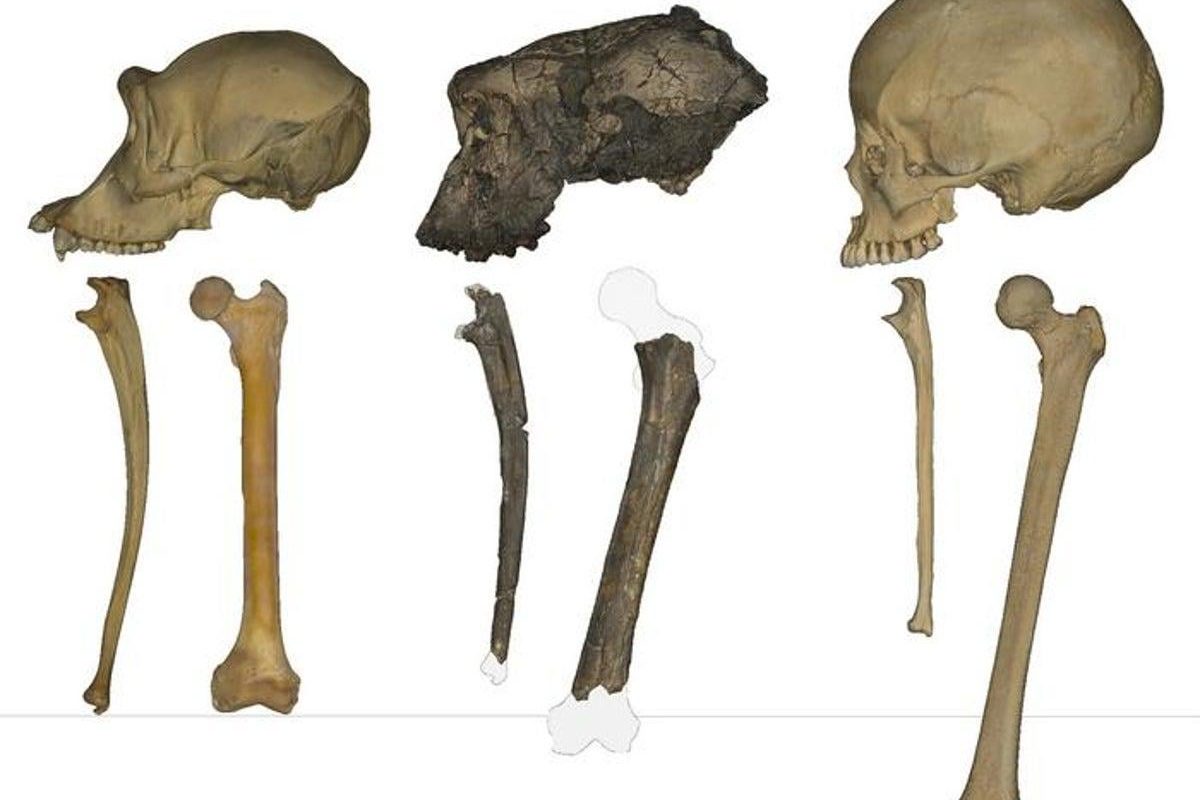
Earliest Human Ancestor May Have Walked on Two Legs
Title: Earliest Human Ancestor May Have Walked on Two Legs: Rethinking the Dawn of Bipedalism
Introduction
The question of when humans began walking upright is one of the most pivotal in evolutionary biology. For decades, scientists believed bipedalism—walking on two legs—emerged with Australopithecus afarensis (famously represented by the fossil “Lucy”) around 3.7 million years ago. However, groundbreaking fossil discoveries and advanced analytical techniques now suggest bipedality may stretch back 7 million years, challenging our understanding of human origins.
🔍 The Fossil That Rewrote History: Sahelanthropus tchadensis
In 2001, a team of researchers unearthed a skull, jaw fragments, and teeth in Chad’s Djurab Desert. Dubbed Sahelanthropus tchadensis (nicknamed Toumai, meaning “hope of life” in the local Goran language), this fossil dates to 6.8–7.2 million years ago, making it the oldest known candidate for the human lineage after the split from chimpanzees.
Evidence for Bipedalism
- The Foramen Magnum Position: The skull’s opening for the spinal cord (foramen magnum) is positioned beneath the skull, not toward the back—suggesting Toumai held its head upright like humans, not forward like quadrupedal apes.
- Postcranial Clues: Though incomplete, femur and forearm bones hint at a mix of tree-climbing and ground-walking adaptations.
🧠 The Bipedalism Debate: Skepticism and Support
Toumai ignited fierce debate. Critics argue:
- Incomplete Evidence: Without a full skeleton, conclusions rely heavily on the skull.
- Alternative Interpretations: Could the foramen magnum indicate posture during climbing, not walking?
But proponents counter:
- Biomechanical Models: Digital reconstructions of the skull’s balance align with bipedal motion.
- Contextual Data: Fossils of animals found nearby (like grazing mammals) imply Toumai lived in mixed woodland-grassland—a habitat favoring upright walking to see predators or carry food.
🌍 Why Bipedalism Matters in Human Evolution
Walking upright is considered a foundational trait of humanity. It:
- Freed hands for tool use, food gathering, and child-rearing.
- Enabled long-distance travel across open landscapes.
- Sparked physiological changes (pelvis structure, spine curvature, limb proportions).
If Toumai was bipedal, it pushes the origin of this trait millions of years earlier than previously thought—closer to the human-chimp divergence (~7–8 million years ago).
What About Older Candidates?
Before Toumai, Orrorin tugenensis (6 million years old, Kenya) showed femur adaptations to bipedality. But Toumai’s older age makes it the earliest potential biped. If confirmed, this reshapes the “timeline” of human evolution:
| Species | Age (Million Years) | Bipedal Evidence |
|---|---|---|
| Sahelanthropus tchadensis | 7.2–6.8 | Skull/foramen magnum, partial limbs |
| Orrorin tugenensis | 6.0–5.7 | Femur structure |
| Ardipithecus ramidus | 4.4–4.2 | Pelvis and feet |
| Australopithecus afarensis | 3.9–2.9 | Full skeletal evidence (Lucy) |
❓ FAQs: Unraveling the Mystery
Q: Could Toumai be a chimp ancestor instead?
A: Its human-like teeth and face suggest closeness to our lineage, but some argue it could belong to a “dead-end” branch.
Q: How do scientists infer walking from bones?
A: Tools like CT scans analyze bone density, joint angles, and muscle attachment points. A thighbone (femur) angled inward, for example, supports weight on one leg—key for walking upright.
Q: What’s next in this research?
A: Finding more Sahelanthropus fossils—especially legs, feet, or pelvis—would settle the debate. Advances in AI and 3D modeling may also reveal new insights from existing fragments.
Conclusion: A Step Closer to Our Origins
While the case for Sahelanthropus as a bipedal pioneer isn’t closed, mounting evidence suggests the roots of humanity’s defining trait run deeper than we imagined. As paleoanthropologist Michel Brunet (discoverer of Toumai) stated: “This isn’t just about walking—it’s about the moment we began to become human.”
The quest continues, reminding us that every fossil shake-up brings us closer to understanding our extraordinary evolutionary journey—one step at a time.
SEO Keywords:
Earliest human ancestor, Sahelanthropus tchadensis, bipedalism evolution, Toumai fossil, human-chimp divergence, walking upright, origins of bipedality, oldest hominin, foramen magnum, human evolutionary timeline.
Meta Description:
Discover how Sahelanthropus tchadensis, a 7-million-year-old fossil, may rewrite human evolution by suggesting bipedalism began earlier than believed. Explore the evidence and debates.