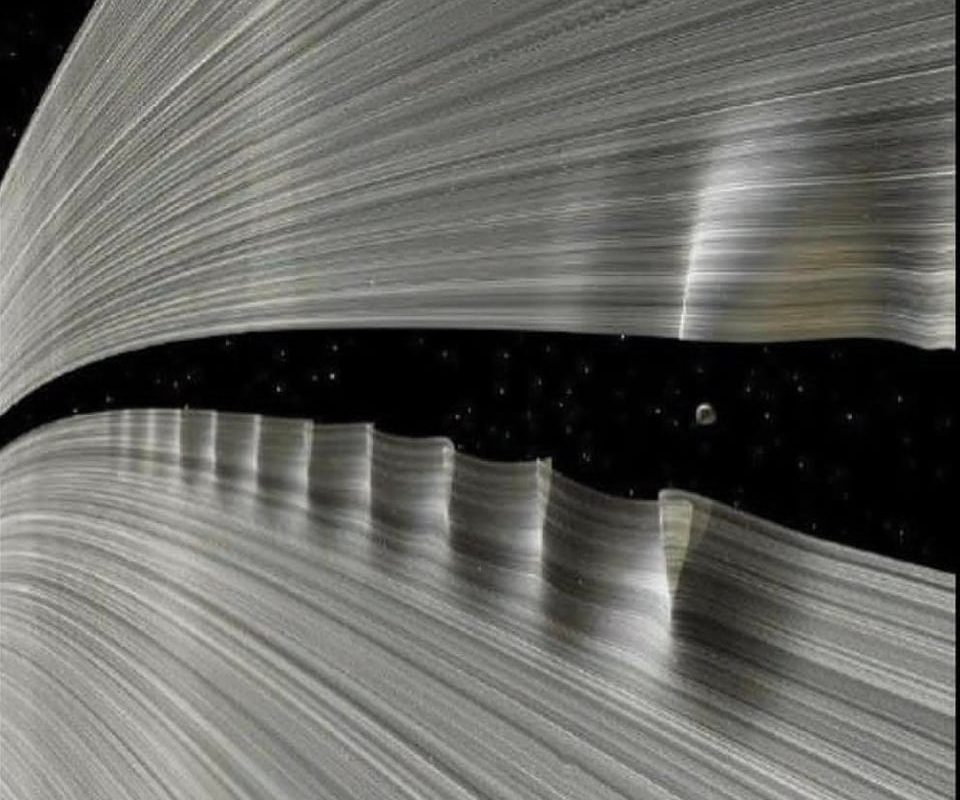
Saturn’s A ring being shaped by the moon Daphnis
Discover Daphnis: The Tiny Moon Sculpting Saturn’s A Ring
Introduction
Saturn’s dazzling rings are one of the solar system’s most iconic wonders, but few realize these cosmic bands are dynamic masterpieces shaped by hidden forces. Among them is Daphnis, a small moon no larger than a city, whose gravitational dance carves ripples, waves, and structures into Saturn’s A ring. In this article, explore how this underappreciated celestial body transforms its surroundings and what it reveals about the physics of planetary rings.
The Mysterious Moon Daphnis: Saturn’s Ring Sculptor
Daphnis, discovered in 2005 by NASA’s Cassini spacecraft, is a 5-mile (8-km) wide moon nestled in the Keeler Gap—a 26-mile (42-km) wide division in Saturn’s outermost major ring, the A ring. Despite its modest size, Daphnis wields immense influence. Its gravity tugs on the fine particles of ice and dust that make up the rings, creating mesmerizing patterns that reveal the hidden laws of orbital mechanics.
Key Facts About Daphnis:
- Orbit: Daphnis resides in the Keeler Gap, maintaining a delicate balance that prevents the gap from closing.
- Size: Roughly 5 miles (8 km) across—smaller than Manhattan.
- Discovery: Found in Cassini mission images on May 1, 2005.
- Role: A “shepherd moon” that herds ring particles and shapes the ring’s edges.
How Daphnis Shapes the A Ring: Gravity in Motion
Daphnis’s gravitational pull doesn’t just clear a path—it generates waves in the ring material. These structures manifest in three distinct ways:
-
Edge Waves
Daphnis’s orbit is slightly inclined relative to Saturn’s rings. As it moves, the moon’s gravity lifts ring particles above and below the equatorial plane. This creates ripples along the edges of the Keeler Gap that resemble towering ridges—some stretching up to 0.5 miles (0.8 km) high. -
Spiral Density Waves
As Daphnis orbits Saturn, it triggers spiral waves in the A ring. These corrugated patterns resemble grooves on a vinyl record and are caused by periodic gravitational nudges that compress ring particles into tightly wound spirals. -
Wake Patterns
Just as a boat leaves a wake in water, Daphnis creates vertical undulations in the ring plane. Cassini’s images revealed these structures cresting like frozen tsunamis, born from the interplay of Daphnis’s gravity and the orbital motion of ring particles.
Caption: Daphnis sculpting waves at the edge of Saturn’s A ring (NASA/JPL-Caltech).
Why Daphnis Matters: A Laboratory for Cosmic Physics
Daphnis serves as a natural laboratory for studying orbital resonance, shepherding moons, and ring dynamics. Its small size contrasts starkly with its outsized impact, proving that even tiny celestial bodies can reshape vast cosmic structures.
Key Scientific Insights:
- Gravitational Amplification: Daphnis magnifies the effects of vertical resonances, allowing astronomers to study how gravity propagates disturbances in disk-like systems.
- Keeler Gap Stability: The moon’s mass ensures the Keeler Gap remains open, preventing ring particles from drifting inward.
- Model for Protoplanetary Disks: Similar physics might explain how planets form in dusty disks around young stars.
Observing Daphnis and Saturn’s Rings
While too faint for most backyard telescopes, Saturn’s rings (including the A ring) are visible with modest equipment. The Cassini mission, however, provided unprecedented close-ups:
- 2017 close-flyby images showed Daphnis casting shadows over the rippled ring edges.
- Time-lapse footage captured waves oscillating in sync with the moon’s 14-hour orbit around Saturn.
Fun Fact: Daphnis’s waves inspired its nickname—“Saturn’s wave-maker moon.”
The Future of Ring Research
Though Cassini’s mission ended in 2017, its legacy lives on. Scientists continue analyzing its data, piecing together how Daphnis and other shepherd moons influence Saturn’s rings over millennia. Future missions, like the Enceladus Orbilander, could bring even sharper insights.
Conclusion: A Tiny Moon with Cosmic Influence
Daphnis may be small, but its impact is writ large across Saturn’s A ring. Through gravitational artistry, it sculpts waves, maintains gaps, and teaches us about the delicate balance of forces governing our solar system. As we uncover more mysteries of Saturn’s rings, Daphnis stands as a testament to the hidden power of even the smallest celestial actors.
Explore Further:
- NASA’s Cassini Mission Archive: [Website Link]
- “The Rings of Saturn” by James Clerk Maxwell (theoretical foundations).
Have thoughts or questions about Daphnis? Share them below!
Keywords: Saturn A ring, Daphnis moon, Keeler Gap, Saturn’s rings, ring waves, shepherd moon, Cassini mission, orbital resonance.