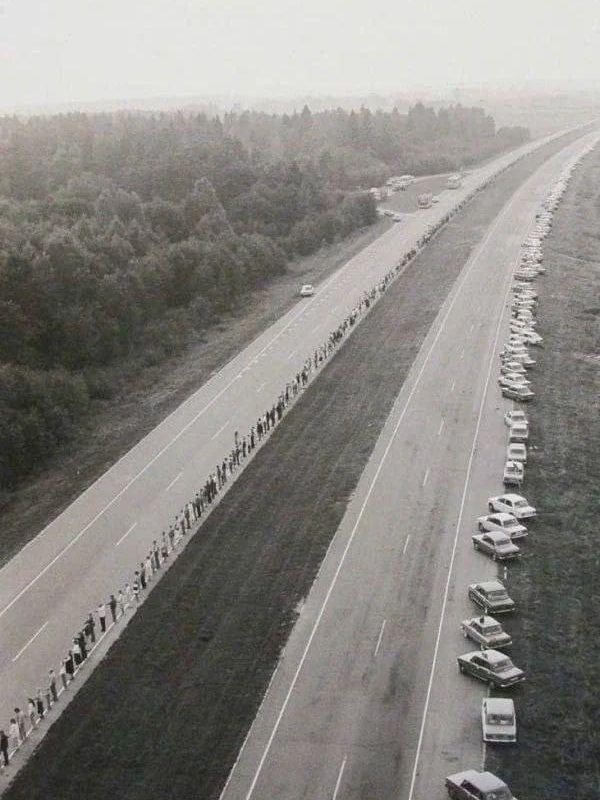
From @fasc1nate on X. On 23 August 1989, about 2 million people from Latvia, Estonia and Lithuania formed a human chain that united all 3 countries to show the world their desire to leave the Soviet Union.
Title: The Baltic Way: How 2 Million People Formed a Human Chain for Freedom in 1989
Meta Description: On August 23, 1989, nearly 2 million Latvians, Estonians, and Lithuanians joined hands in a 675 km human chain demanding independence from the Soviet Union. Explore the historic “Baltic Way” protest and its legacy.
Keywords: Baltic Way protest, human chain protest, Baltic independence from USSR, August 23 1989 protest, Singing Revolution, Soviet Union dissolution
The Baltic Way: The Human Chain That Shook the Soviet Union
On August 23, 1989, the world witnessed a protest unlike any other. In a bold act of peaceful defiance, approximately 2 million people from Latvia, Estonia, and Lithuania joined hands to create a 675-kilometer (420-mile) human chain stretching across all three nations. Known as the Baltic Way (or Balti kett in Estonian/Latvian, Baltijos kelias in Lithuanian), this extraordinary event became a defining moment in the fight for Baltic independence from the Soviet Union.
Historical Context: Why August 23?
The date was symbolic: August 23 marked the 50th anniversary of the Molotov-Ribbentrop Pact, a secret 1939 agreement between Nazi Germany and the Soviet Union that divided Eastern Europe into spheres of influence. The pact led to the Soviet annexation of the Baltics in 1940, a brutal occupation that brought deportations, repression, and cultural erasure. By 1989, as Soviet leader Mikhail Gorbachev’s reforms (glasnost and perestroika) loosened state control, Baltic activists seized the moment to demand freedom.
Organizing a Peaceful Revolution
The Baltic Way was orchestrated by pro-independence movements:
- Sąjūdis (Lithuania)
- Popular Front of Latvia
- Popular Front of Estonia
Participants were instructed to gather along highways and rural roads at 7 PM local time, forming an unbroken line from Tallinn (Estonia) through Riga (Latvia) to Vilnius (Lithuania) and singing patriotic hymns like “Pūt, vējiņi!” (Latvia) and “Tautiška giesmė” (Lithuania). Local radio stations coordinated timings, while churches and community groups distributed food, water, and candles.
A Message to the World
The human chain was a visual spectacle of unity:
- Families, students, farmers, and activists stood side by side for 15 minutes.
- Many held hands while carrying candles, flags, or signs condemning the Molotov-Ribbentrop Pact.
- Western media broadcasted aerial footage globally, countering Soviet propaganda that painted the Baltics as “loyal republics.”
The Baltic Way demonstrated three critical truths:
- The Baltic nations were not voluntary members of the USSR.
- Their independence movements were mass-supported, peaceful, and united.
- The Soviet empire’s grip was crumbling.
Immediate Impact and Legacy
Though Moscow dismissed the protest, the Baltic Way accelerated independence:
- 1990: Lithuania became the first Soviet republic to declare independence.
- 1991: All three nations gained full sovereignty after the failed August Coup in Moscow.
In 2009, UNESCO added the Baltic Way to its Memory of the World Register, calling it an “outstanding example of non-violence.” To this day, it inspires movements worldwide—from Hong Kong’s 2019 “Hand-in-Hand” protest to Taiwan’s human chains advocating democracy.
Lessons from the Baltic Way
- Peaceful resistance works: Without violence, 2 million people exposed Soviet injustice.
- Unity is power: Three distinct cultures merged into one voice for freedom.
- Symbolism matters: The date, songs, and imagery turned trauma into triumph.
Conclusion: A Chain That Broke an Empire
The Baltic Way remains a landmark in 20th-century history—a testament to courage, creativity, and the human spirit’s yearning for self-determination. As one participant later said, “We weren’t just holding hands; we were holding hope.”
For history enthusiasts, activists, or anyone championing freedom, the Baltic Way proves that even the most oppressive regimes cannot silence a people united in purpose.
Sources:
- The Singing Revolution (documentary)
- Baltic Assembly archives
- UNESCO Memory of the World
- Interviews with 1989 protest participants
Ready to explore more freedom movements? Read about the Singing Revolution and Velvet Revolution next!
Optimize for SEO: Embed keywords naturally, link to authoritative sources, and use structured headers (H2/H3) for readability. For full SEO impact, pair this article with images of the 1989 protest and modern-day commemorations.*