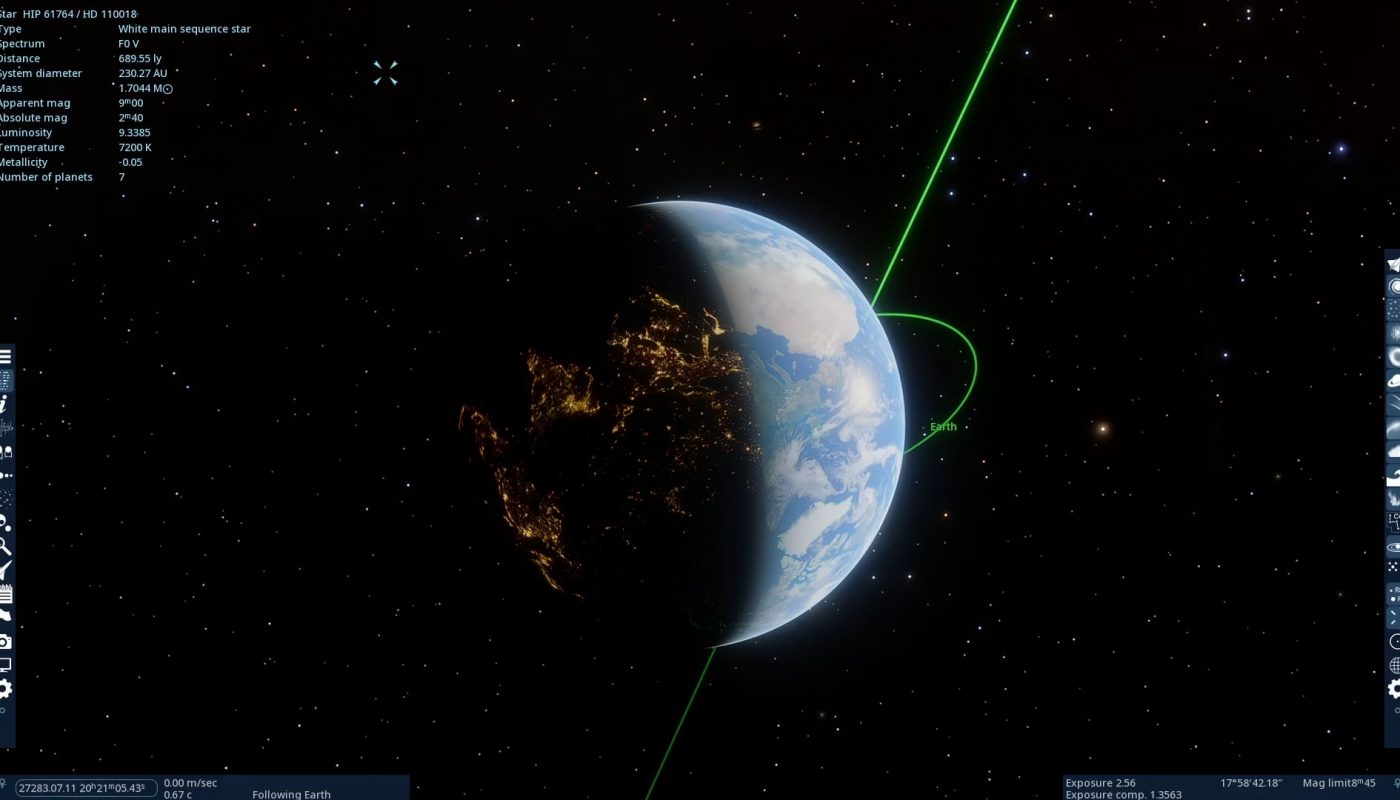
Scale of The Universe – Recorded in “Space Engine”
Meta Title:
Discover the Cosmic Scale: Explore the Universe in “Space Engine”
Meta Description:
Dive into the staggering scale of the universe with “Space Engine.” From quantum particles to galaxy superclusters, explore how this simulation captures the vastness of space.
The Scale of the Universe, Recorded in Space Engine: Exploring Cosmic Vastness from Quantum to Cosmic
Humanity has long been captivated by the sheer scale of the cosmos. From ancient star maps to modern telescopes, our quest to understand the universe’s grandeur continues. Today, Space Engine—a revolutionary astronomy simulation software—offers a digital portal to explore the universe in unprecedented depth. It combines real scientific data with procedural generation to model everything from subatomic particles to the observable universe. In this article, we’ll unravel how Space Engine captures the mind-bending scale of our reality and why it’s a must-experience tool for space enthusiasts, educators, and curious minds.
1. What is Space Engine?
Space Engine is a free, realistic 3D universe simulator that blends real astronomical catalogs (like the Hipparcos star database) with algorithmically generated galaxies, planets, and star systems. Users can seamlessly “fly” through billions of light-years of space, explore celestial bodies, and witness cosmic phenomena—all rendered in stunning visual fidelity.
2. The Universe’s Scale: From Planck Length to the Cosmic Web
Here’s how Space Engine quantifies the universe’s dizzying scales:
A. Quantum to Human Scale
- Planck Length (1.6×10⁻³⁵ meters): Start at the smallest meaningful unit in physics.
- Atoms & Molecules: Zoom into the microscopic world, rendered for scale.
- Human Perspective: Ground-level views of planets in our solar system, like Earth or Mars.
B. Planetary & Stellar Scales
- Planets: Compare rocky worlds like Mercury (4,880 km) to gas giants like Jupiter (139,820 km).
- Stars: From tiny red dwarfs to hypergiants like UY Scuti (1,700x larger than the Sun).
- Nebulas & Black Holes: Witness the violent beauty of supernova remnants and galaxy-center behemoths.
C. Galactic & Beyond
- Milky Way (100,000 light-years): Navigate our home galaxy’s spiral arms.
- Local Group: Explore Andromeda, Triangulum, and 50+ dwarf galaxies.
- Galaxy Clusters & Voids: Fly through the Virgo Supercluster or the Boötes Void—a “desert” spanning 330 million light-years.
- Observable Universe (93 billion light-years): Traverse to the cosmic horizon, where galaxies fade into primordial darkness.
3. Key Features That Bring Scale to Life
Space Engine’s power lies in its immersive tools:
A. Seamless Zooming
- Transition from a human’s-eye view to a galaxy-cluster panorama in seconds.
B. Real-Time Physics
- Experience time dilation near black holes.
- Witness planet orbits and star lifespans accelerated for observation.
C. Procedural Generation
- Scientifically plausible planets, stars, and galaxies fill gaps between known objects.
D. Educational Tools
- Distance, size, and velocity measurements in real units (km, AU, light-years).
- Labels for notable celestial bodies and phenomena.
4. Why Space Engine Matters: Education & Perspective
A. Making the Incomprehensible Tangible
Most astrophysical scales defy intuition. Space Engine bridges this gap by visualizing:
- Earth’s Insignificance: How our planet is a pale blue dot in a galaxy of 100 billion stars.
- Time Scales: Millions of years pass as galaxies collide or stars die.
B. A Tool for Educators
Teachers use Space Engine to:
- Demonstrate orbital mechanics and cosmology.
- Spark interest in STEM through interactive cosmic journeys.
5. Technical Marvel: How Space Engine Renders Infinity
The software uses procedural generation combined with real data to avoid overwhelming hardware. For example:
- Planet Textures: Created algorithmically as you approach.
- Galaxy Placement: Based on dark matter distribution models.
- Efficient Memory Use: Only loads objects within the user’s field of view.
6. Beyond Earth: The Future of Cosmic Exploration
Space Engine’s team continues to refine the simulation:
- Adding exoplanet data from missions like TESS and James Webb.
- Incorporating user-generated content (mods) for custom galaxies or spacecraft.
Conclusion: Expand Your Cosmic Horizon
Space Engine isn’t just software—it’s a digital universe atlas that democratizes cosmic exploration. By rendering everything from quantum foam to galaxy superclusters, it delivers the ultimate lesson in humility and wonder. As astrophysicist Carl Sagan famously noted, “The cosmos is within us,” and Space Engine makes this truth viscerally knowable.
Try it yourself: Download Space Engine (free or paid version) and begin your journey across space and time.
FAQ Section
Q: Is Space Engine scientifically accurate?
A: Yes! It combines real astronomical data with theoretical models for unknown regions.
Q: Can I visit black holes or neutron stars?
A: Absolutely—simulate time dilation and spaghettification near these extreme objects.
Q: Does it support VR?
A: Yes, VR mode offers a fully immersive experience.
Q: How large is the download?
A: ~2GB for the base version, with optional HD texture packs.
Suggested Multimedia for Article:
- Embedded YouTube video: “Space Engine – Zooming from Earth to the Cosmic Web.”
- Infographic: Scale comparison from Planck length to the observable universe.
By leveraging Space Engine, we’re no longer confined to Earth’s perspective—we become cosmic travelers, navigating the infinite. 🌌