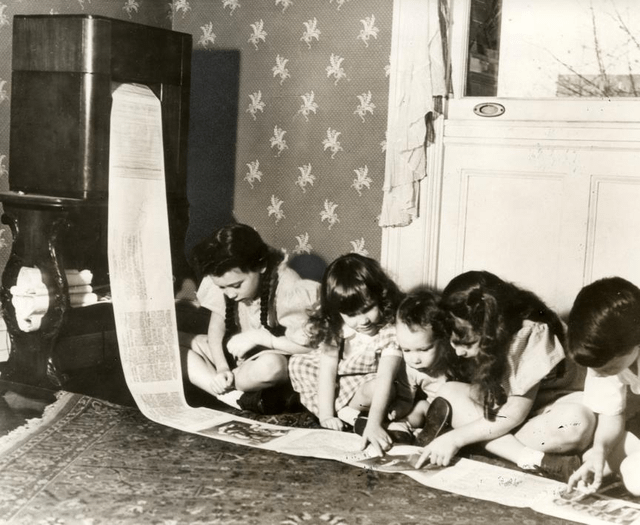
Children reading their fax newspaper (radio facsimile). Since 1938 there was the technology to recive one newspaper from other places in the comfort of home in various models.
The Future Was Here: How Children of the 1930s Read Fax Newspapers at Home
Imagine a time before smartphones, tablets, or even television—a world where families gathered around a cutting-edge machine that printed the morning newspaper overnight, beamed directly into their living rooms. This wasn’t science fiction; it was radio facsimile (fax) technology, a revolutionary innovation that allowed households, and even children, to receive newspapers from afar as early as 1938. Long before the internet, families experienced the magic of instant information delivery through fax newspaper machines.
The Dawn of Fax Newspapers: Bringing the World Home
Radio facsimile technology transformed radio waves into physical text and images, transmitted overnight to special receivers. Newspapers like The New York Times, The Chicago Tribune, and international publications collaborated with tech pioneers to broadcast editions via radio signals. By the late 1930s, companies like RCA (Radio Corporation of America) and Finch Telecommunications developed sleek, furniture-like consoles that printed newspapers on thermal or chemically treated paper. For children of this era, this wasn’t just a gadget—it was a “robot journalist” silently working while they slept.
Children & Fax Machines: A Glimpse into Retro Tech Literacy
For kids growing up in the 1940s, radio facsimile wasn’t just for adults. Here’s how this “ancient internet” shaped young minds:
- Morning Rituals: Children would wake up to find a freshly printed newspaper waiting—no paperboy required. Families gathered to read global headlines at breakfast.
- Educational Tool: Teachers celebrated fax tech as a way to expose students to real-time news, geography, and current events. Classroom discussions often started with, “Did your fax machine print the Berlin story?”
- Tech Curiosity: Operating the machine—loading paper, adjusting signals—became a family activity. Kids learned early engineering skills by troubleshooting signal drops or paper jams.
The Machines That Made It Happen
Notable fax newspaper receivers included:
- Finch Fax (1938): One of the earliest commercial models, popular in urban homes.
- RCA Radiogram (1940s): A stylish console doubling as a radio and fax printer.
- WeatherFax: Used by families in remote areas to receive weather reports alongside news.
These devices cost up to $250 ($5,400 today!), making them a luxury. Yet, for forward-thinking families, it was a window to the world.
Why Did Fax Newspapers Fade Away?
Despite its promise, radio facsimile faced hurdles:
- Slow Adoption: WWII halted consumer tech development.
- Technical Limits: Noisy printers, low-resolution images, and signal interference frustrated users.
- Rise of TV: By the 1950s, television’s instant visuals overshadowed fax’s clunky charm.
Still, fax newspapers paved the way for today’s digital news—proving that the craving for instant, at-home information is timeless.
The Legacy: Nostalgia Meets Modern Lessons
Decades later, radio facsimile feels like a quirky relic, but its ethos lives on. Modern parallels exist in kids reading news on tablets or smart speakers—a seamless evolution from the fax machines of 1938. It reminds us that every generation has its “high-tech” gateway to curiosity.
For vintage tech enthusiasts, original fax newspapers are collector’s items, symbolizing an era when children held tomorrow’s news today—quite literally, in their hands.
Keywords for SEO: radio facsimile, fax newspaper history, 1938 technology, vintage home tech, children reading newspaper, RCA radiogram, Finch Fax, retro media consumption, historical telecommunications.
This blend of nostalgia and innovation makes fax newspapers a fascinating footnote in media history—one where kids were the original digital natives, decoding the future one radio wave at a time. 🌐📰✨