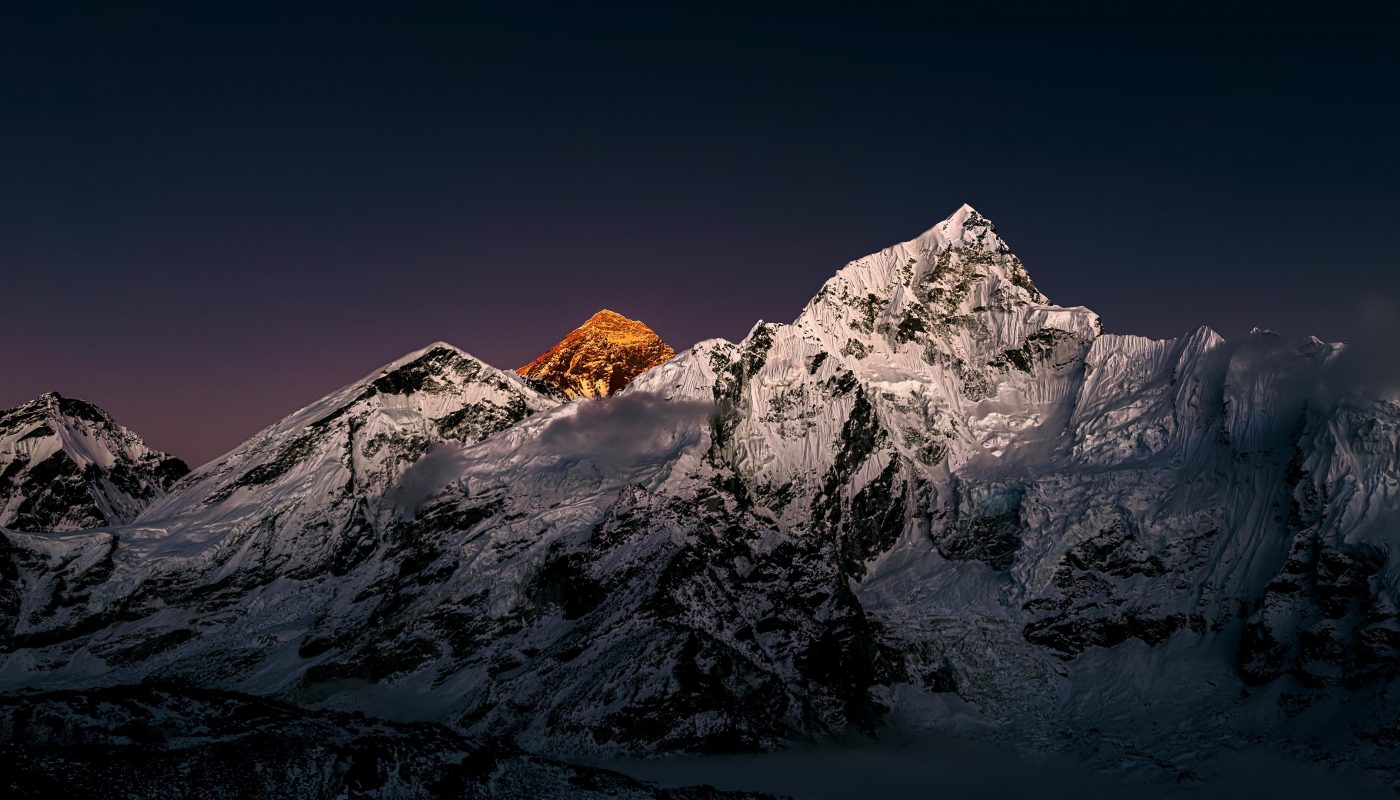
Sun setting over Everest with Nuptse in the foreground. Despite being almost 1000m (3300 ft.) shorter than Everest, Nuptse is a much more challenging mountain. Fewer than 40 people have successfully summited this 7861m / 25791ft peak since its first ascent on May 29 1961. [photo by me]
Sunset Over Everest: Nuptse’s Hidden Majesty in the Khumbu’s Golden Light [Photo by Me]
Witnessing the sun set behind Mount Everest is a bucket-list moment for many adventurers. But when the dying light paints the snow-capped face of Nuptse—Everest’s fierce neighbor—the scene transforms into a humbling reminder of the Himalayas’ raw beauty and hidden dangers. Few realize that Nuptse (7,861m/25,791ft), though dwarfed by Everest’s 8,849m height, remains one of the world’s most technically demanding and rarely conquered peaks.
[Photo: Sunset over Mount Everest, with Nuptse dominating the foreground. Golden hour light illuminates Nuptse’s jagged ridges and steep faces, while Everest glows in the distance. Photo by me.]
The Illusion of Scale: Why Nuptse Steals the Show
Nuptse’s proximity to Everest in Nepal’s Khumbu Valley creates a dramatic optical illusion. As the sun dips behind Everest, its sprawling South Face vanishes into shadow, but Nuptse’s towering wall—just 4km northwest—catches fiery alpenglow. This foreground prominence makes it appear deceptively dominant, even though it stands nearly 1,000 meters (3,300 ft) shorter than Everest.
For photographers and trekkers on the Everest Base Camp trail, Nuptse is an unforgettable sight. Its razor-sharp ridges and sheer ice-coated cliffs dominate the skyline, framing Everest like a colossal sentinel. Yet beyond its visual grandeur lies a darker truth: Nuptse is one of the deadliest “smaller” peaks in the Himalaya.
The Unforgiving Mountain: Nuptse’s Deadly Legacy
Nuptse (Tibetan for “West Peak”) is often overshadowed by Everest, but climbers know it as a far more perilous objective. Since its first ascent in 1961 by Dennis Davis and Sherpa Tashi—part of a British-Indian-Nepalese expedition—fewer than 40 climbers have stood atop this icy fortress. Key reasons for its lethality include:
- Vertical Ice & Avalanche Risk: Much of the standard route scales a 50-degree ice wall vulnerable to serac collapses.
- Technical Complexity: Unlike Everest’s “walk-up” routes, Nuptse demands expert mixed climbing on rock, ice, and snow.
- Weather Extremes: Its exposed ridges bear the brunt of high winds, often exceeding 100 km/h (60 mph).
- Limited Attempts: Everest’s commercial appeal diverts resources, leaving Nuptse to elite alpinists.
A Sunset Perspective: Beauty vs. Brutality
As daylight fades, Nuptse’s silhouette embodies Himalayan extremes. The mountain’s lower flanks glow amber, while its summit—often wreathed in plume clouds—fades into indigo twilight. This fleeting beauty contrasts sharply with its reputation as a “peak of no second chances.”
“Climbing Nuptse feels like scaling a frozen tidal wave,” says veteran guide Garrett Madison. “It’s steeper, icier, and objectively riskier than Everest’s standard routes. Many avoid it simply because there’s no glory in summiting a ‘side peak’—even if it might kill you.”
Why Few Will Ever Summit Nuptse
Everest sees over 600 summits yearly, but Nuptse’s summit ledger grows glacially. Only 15-20 expeditions have succeeded since 1961, with most ascents linked to Everest/Lhotse climbs via the shared South Col route. The mountain’s challenges ensure it remains exclusive:
- No Commercial Expeditions: Unlike Everest, no guiding companies offer “packaged” Nuptse climbs.
- Permit Hurdles: Nepal requires a $1,800 permit for Nuptse—often discouraging climbers already budgeting for Everest.
- No Escape Routes: Technical sections leave no margin for error; retreat is often impossible in storms.
How to Experience Nuptse’s Majesty (Safely)
For non-climbers, the Everest View Hotel in Tengboche or Kala Patthar (5,643m) offers iconic vistas of Nuptse bathed in sunset hues. Peak trekking seasons (April-May and October-November) provide the clearest views. Pro tip: Use a telephoto lens to compress the perspective, making Nuptse appear even more formidable against Everest.
Final Thought: Nuptse’s paradox—a “smaller” mountain that outstares Everest at sunset—captures the essence of the Himalayas. Its beauty masks a brutal reality: here, thin air and vertical ice render human ambition fragile. Yet as the sun sinks, painting Nuptse in gold, it reminds us that even the deadliest peaks can ignite awe without claiming a life.
[End of article. Photo by me.]
SEO Keywords: Nuptse mountain, Everest sunset, climbing Nuptse vs Everest, Khumbu Valley peaks, hardest Himalayan climbs, Nuptse summit history, Mount Everest view photography, Nepal trekking routes.
Alt Text for Photo: “Sunset view of Mount Everest (background) and Nuptse (foreground) from the Khumbu Valley, Nepal. Nuptse’s steep, icy face glows orange in alpine light.”