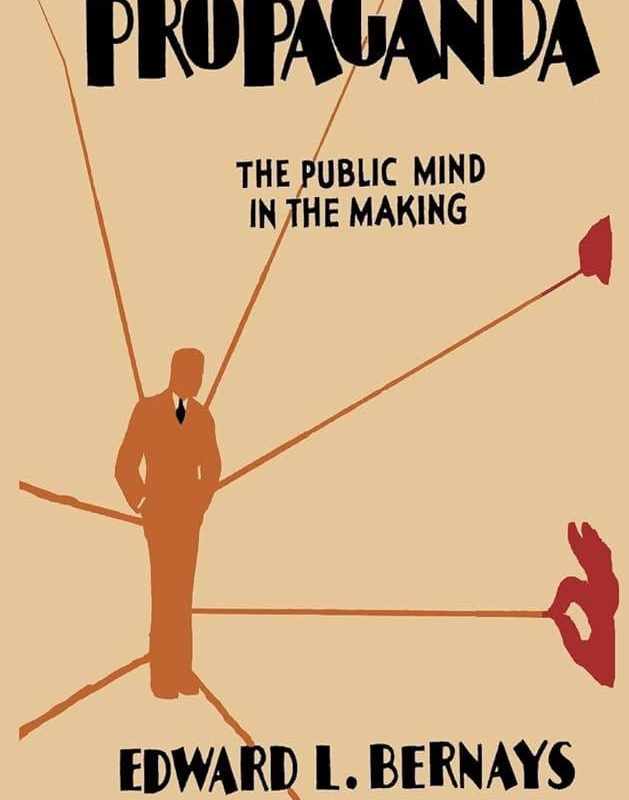
“public relations” aka “PR” began as a propaganda project created by Edward Bernays, who started his career running WWI propaganda before rebranding the same tactics under a friendlier name.
Title: The Dark Origins of PR: How Edward Bernays Rebranded Propaganda as “Public Relations”
Meta Description: Uncover the controversial roots of public relations (PR) in Edward Bernays’ propaganda campaigns during WWI. Learn how PR evolved from psychological manipulation into modern corporate storytelling.
Introduction: The Friendly Face of PR Hides a Troubled Past
When we hear “public relations” (PR), we envision press releases, crisis management, and brand reputation. But the origins of PR are far darker—rooted in propaganda, psychological warfare, and the deliberate engineering of public opinion. At the heart of this rebranding effort was Edward Bernays, the so-called “father of public relations,” who spent WWI crafting propaganda before repackaging the same tactics under a softer, corporate-friendly name.
In this article, we’ll explore:
- Bernays’ early propaganda work for the U.S. government during WWI.
- How he rebranded propaganda as “public relations” to manipulate mass behavior.
- The ethical questions still haunting PR today.
Part 1: Edward Bernays, WWI Propaganda, and the Birth of Modern PR
Edward Bernays wasn’t just a marketer—he was a pioneer in weaponizing psychology to control crowds. Born in 1891, Bernays was the nephew of Sigmund Freud and deeply influenced by his uncle’s theories about the unconscious mind. During World War I, he joined the U.S. Committee on Public Information (CPI), a government agency tasked with drumming up public support for the war.
Bernays’ team used emotional storytelling, fabricated threats, and censorship to:
- Demonize Germany as a barbaric enemy.
- Silence anti-war dissent (via the Espionage Act of 1917).
- Recruit soldiers and sell war bonds using fear-driven campaigns.
After the war, Bernays faced a problem: Propaganda had earned a sinister reputation. His solution? Rebrand it as “public relations”—a term that framed manipulation as a service to corporations and democracy alike.
Part 2: From War Propaganda to Corporate Manipulation
In his 1928 book Propaganda, Bernays wrote:
“The conscious and intelligent manipulation of the organized habits and opinions of the masses is an important element in democratic society.”
He argued that the public was irrational and needed to be guided by unseen “invisible governors”—a role PR experts gladly filled. Bernays’ early campaigns proved his theory:
- Torches of Freedom (1929): To help tobacco companies target women, he staged feminist protests where models smoked cigarettes as “torches of freedom,” linking smoking to liberation.
- Bacon for Breakfast (1920s): Hired by a pork producer, he convinced doctors to endorse heavy breakfasts, making bacon and eggs an American staple.
These campaigns weren’t about information—they were about manufacturing desire using wartime-grade psychological tactics.
Part 3: The Enduring Legacy—And Ethical Dilemmas—of PR
Bernays’ legacy lives on in every viral marketing campaign, political spin, and corporate greenwashing effort. Modern PR still relies on core tactics he perfected:
- Framing narratives to bypass critical thinking.
- Third-party endorsements (e.g., “experts” or influencers).
- Crisis management that prioritizes image over truth.
But critics argue PR often crosses into manipulation:
- Obfuscating Responsibility: Companies use PR to deflect blame (e.g., oil giants promoting “eco-friendly” initiatives while polluting).
- Manufacturing Consent: Governments and corporations sway public opinion to legitimize policies or products.
As journalist Chris Hedges noted:
“Public relations is to democracy what violence is to dictatorship.”
Part 4: Ethical PR in the 21st Century—Can Trust Be Restored?
While Bernays’ tactics were cynical, not all PR is propaganda. Ethical practitioners today focus on:
- Transparency (e.g., disclosing sponsorships).
- Authentic storytelling instead of manufactured crises.
- Accountability in correcting misinformation.
Still, the industry’s origins remind us to ask: Are we being informed—or engineered?
Conclusion: PR’s Past Forces Us to Question Its Future
Public relations began as propaganda in a trench coat—a tool to manipulate masses under the guise of democratic engagement. Edward Bernays’ work reveals a hard truth: Words like “PR” and “propaganda” are often separated only by who wields them.
As consumers, we must stay vigilant:
- Question narratives pushed by corporations or politicians.
- Demand transparency from brands and media.
- Recognize PR’s power to shape reality—for better or worse.
By understanding PR’s troubled origins, we reclaim our right to think critically in a world saturated with spin.
Keywords for SEO: Edward Bernays, public relations history, PR vs propaganda, Torches of Freedom, origins of PR, ethics in PR, WWI propaganda, Freud and PR, corporate manipulation, modern PR tactics.
Share if you learned something new! 🔍✨ Let us know in the comments: Do you think modern PR is still rooted in propaganda?