Viscous liquid spiralling
Title: Viscous Liquid Spiralling: The Science, Applications, and Fascinating Dynamics
Meta Description: Explore the mesmerizing phenomenon of viscous liquid spiralling. Learn how thick fluids form intricate spirals, their real-world applications, and the physics behind this dynamic process.
What is Viscous Liquid Spiralling?
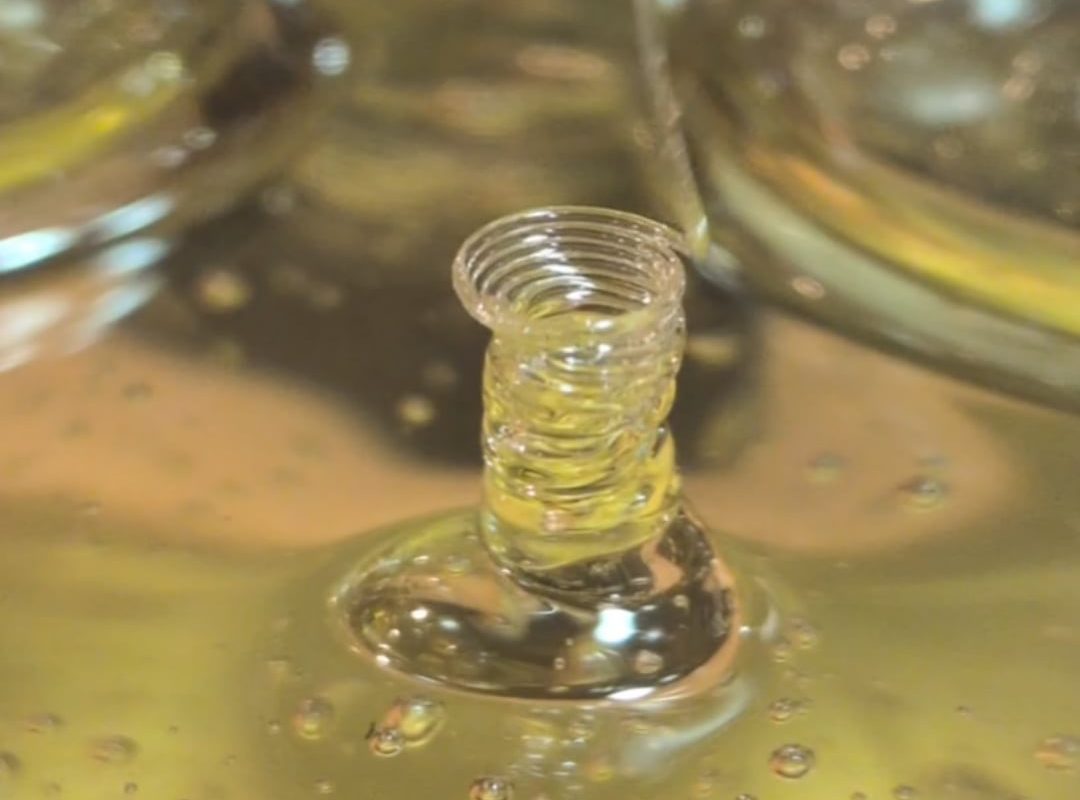
Viscous liquid spiralling is a captivating fluid dynamics phenomenon where thick, slow-flowing liquids form helical or coiled patterns as they descend, drip, or interact with surfaces. Think of honey slowly twisting as it pours from a spoon, or molten glass curling into artistic shapes during manufacturing. This behavior occurs due to the interplay of gravity, viscosity, surface tension, and rotational forces—a dance between fluid stickiness and motion that creates mesmerizing visual patterns.
The Science Behind Spiralling Viscous Liquids
When a viscous liquid flows, its high resistance to deformation (viscosity) dominates over inertial forces. Here’s how spiralling emerges:
-
Gravity vs. Viscosity: As gravity pulls the liquid downward, viscosity resists rapid flow. This creates a “coiling instability,” where the falling stream buckles into loops or spirals to release energy.
-
Surface Tension and Rotation: Surface tension pulls the liquid into cylindrical streams, while rotational forces—like those in industrial mixers or natural vortices—introduce swirls.
-
Non-Newtonian Effects: Many viscous liquids (e.g., polymers, ketchup, or lava) are non-Newtonian, meaning their viscosity changes under stress. This can amplify or alter spiralling patterns unpredictably.
Real-World Applications of Viscous Liquid Spiralling
Beyond its visual appeal, this phenomenon has critical industrial and scientific uses:
1. Manufacturing & 3D Printing
- Additive Manufacturing: Controlled spiralling allows precise deposition of viscous materials (like biopolymers or molten plastics) in 3D printers, reducing defects in intricate designs.
- Food Production: Chocolate or syrup spirals are engineered for consistency in candy-making and dessert decoration.
2. Geology & Environmental Science
- Lava Flow Analysis: Understanding how viscous magma coils helps predict volcanic eruption paths.
- Oil Spill Cleanup: Studying spiralling in thick oils informs containment strategies in marine environments.
3. Biomedical Engineering
- Drug Delivery: Spiralling behavior aids in designing viscous gels that release medication gradually in the body.
- Microfluidics: Engineers manipulate viscous spirals in lab-on-a-chip devices for diagnostic testing.
4. Natural Phenomena
- Tree Sap: Viscous sap spirals down bark to optimize nutrient distribution.
- Underwater Currents: Cold, dense brine spirals in polar oceans impact global water circulation.
Why Spiralling Matters in Fluid Dynamics
Spiralling is more than a curiosity—it’s a window into optimizing fluid behavior:
- Efficiency: In pipelines, unwanted spiralling can cause blockages or inefficiencies. Understanding it helps engineers design smoother transport systems.
- Energy Dissipation: Spirals naturally dissipate energy, which is harnessed in damping systems or shock absorbers.
- Art & Design: Architects and artists replicate spiralling patterns in installations, blending aesthetics with fluid mechanics.
Key Factors Influencing Viscous Spiralling
| Factor | Role | Example |
|---|---|---|
| Viscosity | Higher viscosity = slower, tighter spirals | Honey vs. water |
| Flow Rate | Faster flow reduces coiling instability | Industrial extrusion processes |
| Surface Interaction | Rough surfaces disrupt spirals; smooth ones enhance them | Glassblowing on polished rods |
| Temperature | Heating reduces viscosity, widening spirals | Molten wax in candle-making |
How to Observe Spiralling at Home
Try these simple experiments:
- Honey Drip Test: Slowly pour honey from a spoon and watch it coil as it hits a plate.
- Corn Syrup Art: Mix corn syrup with food coloring and pour it onto a tilted surface to create swirling patterns.
- DIY Non-Newtonian Fluid: Combine cornstarch and water, then drip it to see how shear-thickening alters spiralling.
FAQs: Viscous Liquid Spiralling Explained
Q: Is spiralling unique to viscous liquids?
A: Yes! Thin fluids (like water) lack the stickiness to form stable spirals—they break into droplets instead.
Q: Can spiralling be harmful in industry?
A: If uncontrolled, coiling can clog nozzles in manufacturing, leading to costly downtime.
Q: Why do some spirals look chaotic?
A: Turbulence, temperature gradients, or impurities disrupt symmetry—researchers call this the “liquid rope coil instability.”
Conclusion: The Art and Science of Fluids in Motion
Viscous liquid spiralling bridges physics, engineering, and creativity. Whether optimizing a factory line, predicting a volcanic disaster, or crafting culinary art, understanding this phenomenon unlocks innovation. By studying how fluids twist and turn, we harness nature’s patterns to solve real-world challenges—one spiral at a time.
Target Keywords:
- Viscous liquid spiralling
- Fluid dynamics coiling
- Non-Newtonian fluid patterns
- Applications of viscous spirals
- Liquid rope coil instability
Optimize This Article Further:
- Link to related content (e.g., “What Are Non-Newtonian Fluids?”).
- Embed videos demonstrating viscous spiralling experiments.
- Include authoritative sources like Journal of Fluid Mechanics or industry case studies.
By blending science with practical examples, this piece aims to rank for fluid dynamics enthusiasts, students, and engineers alike! 🌪️🔬