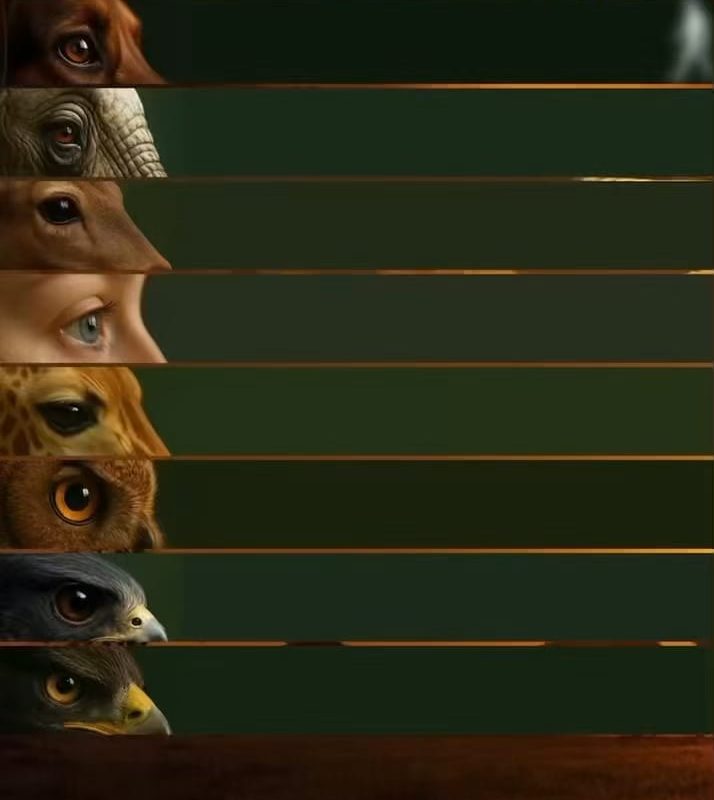
Visual recognition range of animals
Title: The Astonishing Visual Recognition Range of Animals: How Different Species See the World
Meta Description: Explore the fascinating visual recognition ranges of animals—how eagles spot prey from miles away, how dogs see colors, and how insects perceive UV light. Discover nature’s most incredible eyes!
Introduction
Vision is one of evolution’s most extraordinary adaptations. While humans rely heavily on sight, animals have evolved visual systems uniquely tailored to their survival needs—whether spotting prey from dizzying heights, navigating murky waters, or detecting ultraviolet patterns invisible to our eyes. In this article, we’ll dive into the visual recognition ranges of animals, uncovering how different species see the world in ways that defy human imagination.
How Vision Works: A Quick Primer
Before comparing animal vision, let’s understand the basics. Vision depends on:
- Light sensitivity: How well eyes detect light (e.g., low-light vision).
- Visual acuity: Clarity and sharpness of details (e.g., spotting prey from afar).
- Color perception: The range of colors an eye can detect.
- Field of view: The breadth of the visual scene (e.g., panoramic vs. binocular vision).
Now, let’s explore how these factors vary across the animal kingdom.
1. Distance & Acuity: The Masters of Long-Range Vision
Some animals see details miles away, giving them unparalleled hunting or survival advantages.
-
Eagles & Raptors:
With visual acuity 4–8 times sharper than humans, eagles spot prey like rabbits from 2–3 miles away. Their retinas are densely packed with photoreceptors called cones, and their eyes function like high-resolution telephoto lenses. -
Peregrine Falcons:
Capable of diving at 240 mph, these falcons see distant prey in crystal clarity while airborne, using their fovea (a retinal pit of concentrated cones) to lock onto targets. -
Mantis Shrimp:
Though best known for seeing polarized light, certain species also have remarkable distance vision in shallow waters.
2. Low-Light Vision: Nocturnal Superpowers
For animals active at night, detecting faint light is critical.
-
Cats:
A cat’s tapetum lucidum—a reflective eye layer—boosts light absorption by 50%, letting them see in 1/6th the light humans need. Their visual acuity drops, but motion detection is unmatched. -
Owls:
Their enormous eyes capture maximum light, while rod-dominated retinas allow them to detect mice in near-total darkness. -
Deep-Sea Fish:
Species like the barreleye fish use tubular eyes to focus bioluminescent light in pitch-black ocean depths.
3. Color Perception: Beyond the Human Spectrum
Humans see three primary colors (trichromatic vision). But some animals experience a rainbow we can’t imagine.
-
Birds (e.g., Pigeons & Parrots):
Many birds are tetrachromatic, detecting ultraviolet (UV) light. This helps them identify ripe fruit, mates, or predators camouflaged against foliage. -
Butterflies & Bees:
Insects see UV patterns on flowers—like hidden landing strips guiding them to nectar. -
Dogs & Cats:
Contrary to myth, dogs aren’t fully colorblind! They see blues and yellows but lack red-green receptors. Cats excel in low-light vision but have weaker color perception.
4. Ultra-Wide Fields of View: Seeing the Bigger Picture
Some animals sacrifice depth perception for panoramic awareness of threats.
-
Horses & Zebras:
Prey animals have eyes positioned sideways, granting a 350° field of view—perfect for detecting prowling predators. -
Chameleons:
Their bulbous eyes move independently, scanning 180° horizontally and 90° vertically! -
Dragonflies:
Nearly 360° vision lets them spot prey and mates while flying at 35 mph.
5. Motion Detection: The Art of Sensing Movement
For predators and prey alike, spotting motion can mean life or death.
-
Frogs:
Retinal “bug detectors” respond only to small, moving objects—perfect for snatching flies mid-air. -
Cheetahs:
Their eyes track fast-moving gazelles with extreme precision, aided by a specialized visual streak.
6. Beyond Visible Light: UV & Infrared Vision
Some species perceive spectrums invisible to humans:
-
Reindeer:
Adapted to the Arctic, they see UV light to detect lichen hidden under snow and wolves camouflaged in white landscapes. -
Snakes (Pit Vipers):
Infrared-sensitive pit organs let them “see” heat signatures of warm-blooded prey in complete darkness.
Comparing Animal Vision vs. Human Vision
| Feature | Humans | Animals (Examples) |
|---|---|---|
| Color Receptors | 3 (Red, Blue, Green) | Up to 16! (Mantis Shrimp) |
| Visual Acuity | 20/20 | 20/5 (Eagles) |
| Field of View | 180° | 360° (Dragonflies) |
| Low-Light Vision | Limited | Excellent (Owls, Cats) |
| UV Detection | No | Yes (Birds, Bees, Reindeer) |
Why Does Animal Vision Vary So Much?
Evolution sculpts vision for survival:
- Predators: Prioritize sharpness and depth perception.
- Prey: Focus on wide fields of view and motion detection.
- Niche Adaptations: Polarized vision for aquatic animals, UV for pollinators.
The Future of Animal Vision Research
Scientists are uncovering new wonders:
- How cephalopods (octopuses) see polarized light without color vision.
- Why mantis shrimp have 12–16 photoreceptors despite limited color-discrimination skills.
- Applications in robotics and camera tech inspired by animal optics.
FAQs About Animal Vision
Q: Do dogs really see in black and white?
A: No! They see blues and yellows but struggle with red-green hues.
Q: Which animal has the best vision?
A: Eagles and falcons win for long-range acuity, while mantis shrimp dominate color spectrum perception.
Q: Can any animal see in total darkness?
A: Snakes like pythons “see” heat via infrared, while some deep-sea fish detect bioluminescence.
Conclusion
The visual recognition range of animals is a testament to nature’s ingenuity. From eagles scouting prey kilometers away to bees navigating UV-marked flowers, each species sees the world in a way uniquely suited to thrive in its environment. As research advances, we continue unlocking secrets of animal vision—reminding us that our human perspective is just one small slice of life’s vibrant visual tapestry.
Keywords: Animal vision, visual recognition range, visual acuity in animals, animal eyesight, color perception animals, eagle vision vs human, low-light vision animals, UV vision animals, infrared vision snakes, comparative animal vision.
By understanding animal vision, we gain deeper insight into biodiversity and evolutionary marvels. Share this article to spread awe for the hidden visual worlds of Earth’s creatures! 🦅🐝🐍