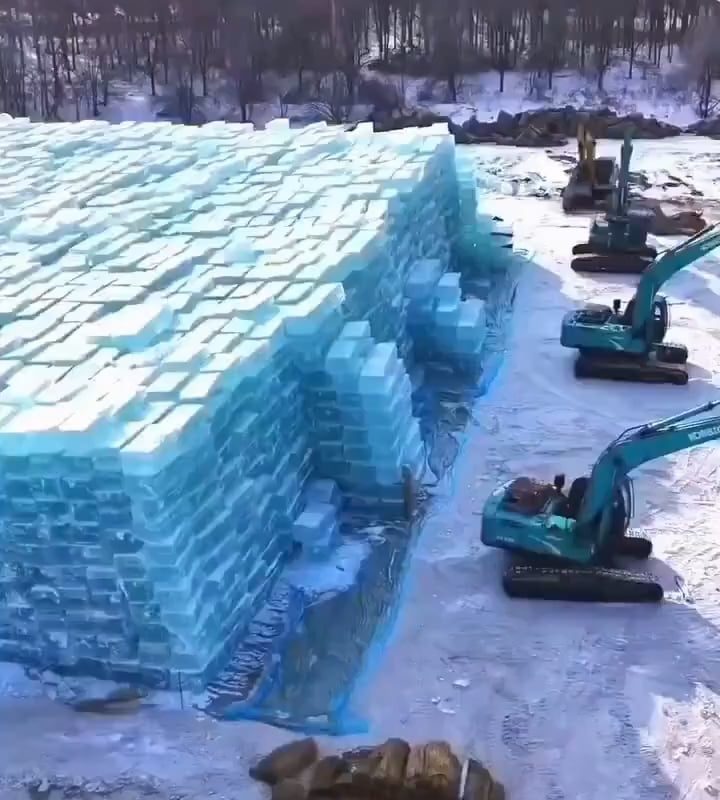
How China Farms Ice for the Harbin Snow Festival!
From River to Wonderland: How China “Farms” Ice for the World-Famous Harbin Snow Festival
Every winter, Harbin, China, transforms into a glittering kingdom of ice and snow, drawing millions of visitors to its acclaimed Harbin Ice and Snow Festival. But few realize the colossal effort behind sourcing its star material: ice. This isn’t ordinary ice—it’s precision-harvested, crystal-clear blocks carved from the frozen Songhua River. Here’s how China “farms” ice on an industrial scale to build this frozen spectacle.
Why the Songhua River? Nature’s Perfect Ice Factory
The Songhua River serves as the primary ice quarry for the festival, thanks to its frigid winter conditions and pristine water quality. Harbin’s temperatures plummet to -30°C (-22°F) in January, freezing the river into a thick, glassy sheet ideal for harvesting. Unlike artificial ice, river ice freezes slowly, forming dense, bubble-free blocks that refract light brilliantly—essential for creating the festival’s luminous sculptures.
The Ice Harvesting Process: A Choreographed Dance
Harvesting ice for the festival is a blend of ancient techniques and modern engineering. Here’s how the process unfolds:
-
Preparation & Safety Checks
- Teams survey the river in late December, measuring ice thickness (minimum 30-40 cm for safety).
- Grids are mapped on the frozen surface to plan extraction zones, ensuring no over-mining destabilizes the river.
-
The Cutting Begins: Industrial-Scale Precision
- Workers use modified chainsaws or specialized ice-cutting machines to score the ice into grids.
- Blocks are typically 1.6m long x 0.8m wide x 0.4m thick (5.2ft x 2.6ft x 1.3ft), weighing about 800-1,000 kg (1,760-2,200 lbs) each.
-
Extraction & Transportation
- Heavy machinery, like cranes and forklifts, lifts blocks from the river onto trucks.
- Ice is transported to Harbin’s festival sites at night or during overcast days to minimize melting.
-
Quality Control
- Only the clearest, purest ice is selected for sculptures. Cloudy or fractured blocks are discarded.
Why River Ice? The Science Behind the Sparkle
Artificial ice can’t compete with the Songhua’s natural harvest. Slow-freezing river ice forms larger crystals, creating a glass-like transparency that LEDs or colored lights penetrate effortlessly. This gives Harbin’s ice castles and statues their ethereal glow.
Sustainability & Environmental Care
While colossal, the harvest is designed to minimize ecological impact:
- Seasonal Timing: Ice is taken in mid-winter when the river is fully frozen and ecosystems are dormant.
- Strict Quotas: Only a fraction of the river’s ice volume is extracted.
- Natural Recycling: After the festival, melted ice returns to the Songhua River’s cycle.
From Ice Blocks to Artistic Marvels
Once delivered, artists from around the world carve the ice into towering pagodas, slides, and replicas of global landmarks. Sourced from nearby sources like the Songhua:
- Logistics: Ice arrives via 8,000+ truckloads for larger sculptures.
- Preservation: Blocks are stored in insulated yards or chilled warehouses until assembly.
- Artistry: Tools range from chisels and chainsaws to laser-guided cutters for intricate designs.
The Harbin Ice and Snow Festival by the Numbers
- Annual Ice Harvest: ≈ 200,000 cubic meters (equivalent to 80 Olympic pools!).
- Scale: Some sculptures stretch over 40 meters (130+ feet) tall.
- Economic Boost: The festival draws 15–20 million visitors yearly, energizing Harbin’s winter economy.
Conclusion: A Winter Miracle Born of Ice Farming
Behind Harbin’s dazzling ice city lies an extraordinary feat of nature and human ingenuity. By sustainably “farming” the Songhua River’s ice, China fuels an artistic tradition that celebrates winter’s beauty on a scale unmatched worldwide. For adventure-seekers and culture lovers, the festival remains a bucket-list testament to what frozen water—and human creativity—can achieve.
Experience it Yourself: The Harbin Ice and Snow Festival runs from late December to February. Bundle up and witness how river-born ice transforms into magic!
Keywords: Harbin Snow Festival, Ice Farming China, Harbin Ice Harvesting, Songhua River Ice, Ice Sculpture Process
![I will be watching this incoming storm from the warmth of my home [OC]](https://www.smartplusmedia.com/wp-content/uploads/2025/12/I-will-be-watching-this-incoming-storm-from-the-warmth-445x265.jpeg)