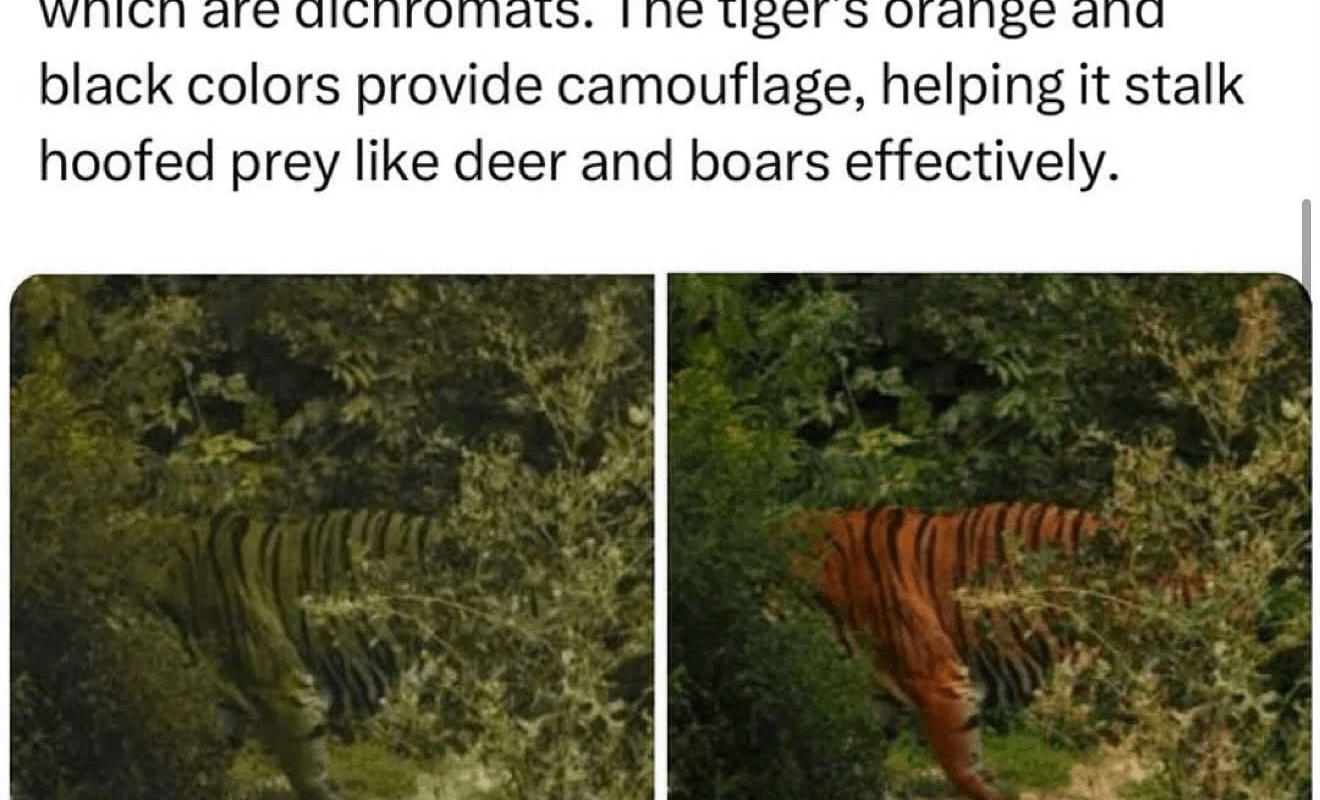
Tigers appear green to certain animals!
Title: “Why Tigers Appear Green to Their Prey: The Science Behind Their Stealthy Camouflage”
Meta Description: Discover how tigers master the art of camouflage by appearing green to certain animals, blending seamlessly into their forest habitats. Explore the science of animal vision and survival.
Introduction
Tigers are iconic for their fiery orange coats and bold black stripes—a striking appearance to human eyes. But did you know these apex predators seem almost invisible to their prey in the wild? Surprisingly, tigers appear green to many of the animals they hunt, thanks to a fascinating interplay of biology and evolution. In this article, we’ll unravel how tiger camouflage works, why deer and other prey perceive them as green, and what this reveals about the hidden world of animal vision.
How Do Animals See Color? The Science of Vision
To understand why tigers appear green to some animals, we must first explore how vision differs across species.
-
Human Vision (Trichromatic):
Humans possess three types of color-detecting cone cells, letting us see red, green, and blue. This allows us to distinguish tigers’ orange fur against green foliage. -
Dichromatic Vision in Prey Animals (e.g., Deer, Boar):
Many of tigers’ prey have only two types of cones, limiting their color perception. Deer, for example, lack red-sensitive cones and see blues and yellows more prominently. To them, orange wavelengths blend with green tones, making a tiger’s coat appear like dappled forest light.
Why Do Tigers Look Green to Deer?
Tigers thrive in forests where their orange-and-black stripes mimic shadows and foliage to human eyes. But for deer—whose vision resembles red-green color blindness—the tiger’s orange coat lacks the “contrast” humans see. Instead:
- Orange ≈ Green: Without red cones, deer perceive orange as a dull greenish-brown, camouflaging the tiger against vegetation.
- Stripes as Disruptors: The black stripes break up the tiger’s outline, resembling tree trunks or tall grass.
This illusion makes tigers nearly invisible to ungulates until it’s too late.
The Evolutionary Advantage of “Green” Camouflage
Tigers’ coloration is a perfect example of natural selection favoring stealth:
- Predator-Prey Dynamics: Over millennia, tigers with coats that confused prey survived and reproduced more successfully.
- Habitat-Specific Adaptations: In dense forests (like India’s jungles), the “orange = green” trick works best. In snowy habitats, white tigers (a rare variant) dominate for similar reasons.
Beyond Deer: How Other Animals Perceive Tigers
Not all creatures see tigers the same way:
- Birds (Tetrachromatic Vision): Raptors see ultraviolet light, potentially spotting tigers more easily.
- Insects (Polarized Vision): Bees and butterflies may detect tigers differently, but they’re not on the menu!
Tigers in Peril: Why Camouflage Isn’t Enough Today
Despite their evolutionary edge, tigers face extinction due to habitat loss and poaching. When forests shrink, their camouflage weakens—bright grasslands or barren landscapes expose them to prey and poachers alike. Conservation efforts must prioritize preserving their natural habitats to maintain this delicate balance.
Fascinating FAQs
Q: Are tigers actually green?
No! Their fur contains pigments for orange and black. The “green” effect is purely how prey animals visualize wavelengths.
Q: Do all big cats use similar camouflage?
Yes! Lions’ tawny coats blend into savannah grasses, while leopards’ rosettes mimic dappled sunlight.
Q: Can humans replicate this effect?
Military camouflage often mimics animal strategies, using color and patterns to disrupt silhouettes.
Conclusion: Nature’s Master Illusionists
Tigers’ “green disguise” is a testament to nature’s ingenuity. By exploiting gaps in prey animals’ vision, they’ve perfected an art of invisibility that has fueled their reign as jungle royalty. Yet, as human activities threaten their habitats, understanding these marvels becomes key to ensuring tigers don’t vanish from the wild—and from our collective imagination.
Call to Action:
Share this article to spread awareness about tiger conservation! Support organizations like the World Wildlife Fund (WWF) to help protect these majestic creatures and their habitats.
SEO Keywords: tiger camouflage, animal color vision, dichromatic vision, predator-prey dynamics, tiger conservation, why tigers appear green, deer vision vs human, tiger stripes, wildlife adaptation.
Image suggestion for publishers: Side-by-side visuals showing how a tiger appears in human vision vs. prey vision.
(Word Count: 600)