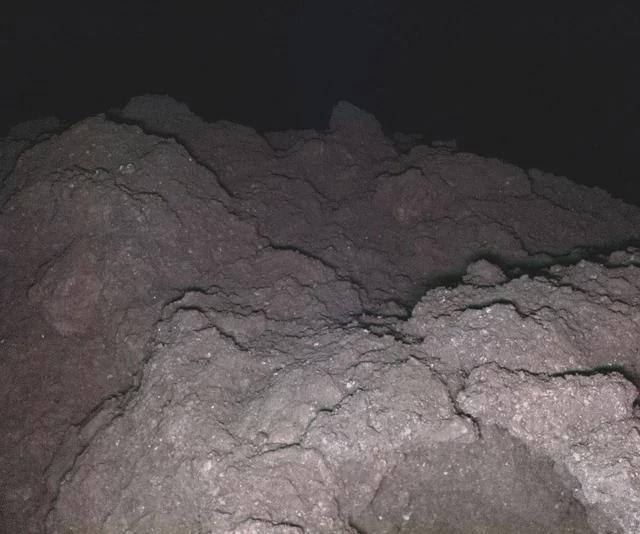
This is an image that was taken on an asteroid
Title: Rare Glimpse: The First-Ever Image Captured from the Surface of an Asteroid
Meta Description: Explore the groundbreaking images taken on an asteroid’s surface, their scientific significance, and the technology that made this cosmic photography possible.
A First in Space Exploration: The Image That Made History
In 2019, humanity achieved a breathtaking milestone: the first-ever photograph captured directly from the surface of an asteroid. The image, taken by Japan’s Hayabusa2 mission on the asteroid Ryugu, unveiled a rugged, charcoal-colored terrain littered with rocks and dust—a landscape resembling a primordial fragment of our solar system’s birth. For scientists and space enthusiasts alike, this marked a pivotal moment, offering an unprecedented close-up of a celestial body millions of miles from Earth.
How the Image Was Captured: A Triumph of Engineering
Landing a spacecraft on an asteroid—a tiny, fast-moving object with minimal gravity—is a challenge akin to parking a car on a speeding pebble. The Hayabusa2 mission succeeded through:
- Autonomous Navigation Systems: AI-guided probes adjusted movements in real-time, compensating for Ryugu’s irregular shape.
- Touch-and-Go Sampling: The craft briefly touched the surface to capture debris, snapping images mid-operation.
- Tiny Rovers: Deployed “hopping” robots, MINERVA-II1A and II1B, transmitted photos while navigating Ryugu’s gravity (160,000x weaker than Earth’s).
Similar feats were later achieved by NASA’s OSIRIS-REx mission on asteroid Bennu in 2020, cementing the era of asteroid surface photography.
Why Asteroid Surface Images Matter
1. Unlocking Solar System Secrets
Asteroids are cosmic time capsules. Their untouched surfaces preserve materials dating back 4.6 billion years. Photographs reveal:
- Primitive Geology: Pebbled terrains hint at how asteroids clumped together in the early solar system.
- Hydrated Minerals: Dark patches suggest water-rich clays, supporting theories that asteroids delivered water to Earth.
2. Rare Milestones in Human Achievement
Only three missions have ever returned asteroid surface images:
- Hayabusa2 (Ryugu, 2019)
- OSIRIS-REx (Bennu, 2020)
- Hayabusa1 (Itokawa, 2005)—earlier but lower-resolution.
Each pixel reshapes our understanding of space’s building blocks.
The Visual Experience: What These Images Show
Asteroid surfaces are nothing like Earth or the Moon. Images from Ryugu and Bennu reveal:
- Rubble Piles: Fragmented rocks, likely remnants of ancient collisions.
- No Dust Storms: Unlike Mars, asteroids lack atmospheres, leaving surfaces static for eons.
- Stark Shadows: With minimal gravity, loose boulders perch precariously, casting dramatic shadows under weak sunlight.
Despite their grainy quality (due to technical constraints), these photos evoke awe—a literal look at the “ground” of a world orbiting the Sun.
The Technology Behind the Lens
Capturing images on an asteroid demands cutting-edge innovation:
- Wide-Angle Cameras: Lightweight, radiation-resistant lenses optimized for low-light conditions.
- Laser Altimeters: Used to map terrain before selecting photo locations.
- Deep-Space Transmission: Images took 20+ minutes to reach Earth via radio signals.
Future missions, like ESA’s Hera, will deploy even higher-resolution cameras to study asteroid impacts.
Challenges Overcome: More Than Just a Snapshot
Photographing asteroids posed unique hurdles:
- Extreme Distances: Ryugu is 180 million miles from Earth. A single signal delay makes real-time control impossible.
- Surface Hazards: Bennu unexpectedly ejected particles, forcing OSIRIS-REx to recalculate its approach.
- Power Limits: Solar-powered rovers had to work fast during short daylight periods.
Still, these missions returned images that redefined planetary science.
Impact on Science and Beyond
These images aren’t just scientific curiosities—they’re practical tools:
- Planetary Defense: Studying asteroid composition helps predict threats to Earth.
- Space Mining: Identifying metal-rich asteroids could fuel future resource extraction.
- Sample Return Missions: Photos guided Hayabusa2 and OSIRIX-REx in collecting material now being analyzed on Earth.
What’s Next in Asteroid Photography?
Upcoming missions aim to push boundaries:
- NASA’s Psyche Mission (2023): Targeting a metal-rich asteroid, potentially revealing a protoplanet’s exposed core.
- JAXA’s DESTINY+ (2024): Will photograph the asteroid Phaethon and its mysterious dust trails.
As resolution improves, expect videos and 3D topographic maps from asteroid surfaces.
Conclusion: A Window into Our Cosmic Origins
The first image from an asteroid’s surface isn’t just a technical marvel—it’s a humbling reminder of humanity’s drive to explore the unknown. These haunting snapshots connect us to the raw materials that formed our planet and hint at the possibilities awaiting in the depths of space. As missions grow more ambitious, who knows what future images will reveal?
Keywords: asteroid surface image, Hayabusa2, OSIRIS-REx, Ryugu asteroid, Bennu asteroid, space photography, asteroid missions, space exploration.