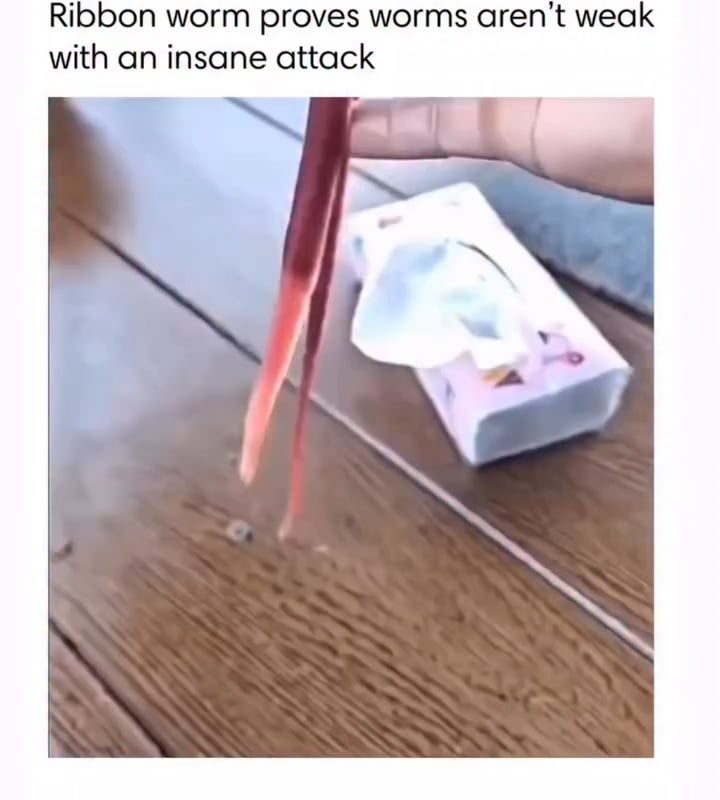
Ribbon Worm’s Secret Attack 😱🪱
Title: The Ribbon Worm’s Secret Attack: Nature’s Most Bizarre and Terrifying Predator
Meta Description: Discover the shocking truth about the ribbon worm’s secret weapon—a lightning-fast, venomous proboscis that makes it one of the ocean’s most efficient hunters. 😱🪱
Introduction: The Ocean’s Nightmarish Hunter Lurking in Plain Sight
Deep in the ocean’s murky depths and along tidal shores, a creature straight out of a horror movie lies in wait: the ribbon worm. With over 1,300 species, these soft-bodied invertebrates might look like harmless strands of spaghetti or discarded rope, but beneath their unassuming appearance lies a secret attack so fast and brutal, it will leave you stunned.
In this article, we’ll unravel the ribbon worm’s terrifying hunting tactic, explore its unique biology, and reveal why scientists call it one of nature’s most “alien” predators.
What Is a Ribbon Worm?
Ribbon worms (Nemertea) are unsegmented marine worms found worldwide, ranging from microscopic species to the giant Lineus longissimus, which can stretch up to 180 feet (55 meters)—making it the longest animal on Earth! They thrive in mudflats, coral reefs, and sandy seabeds, often camouflaged by their muted colors (though some tropical species are neon-bright).
But it’s not their size or looks that make them infamous—it’s their secret weapon.
The Secret Attack: A Proboscis Like No Other 😱
Ribbon worms are ambush predators, and their hunting strategy hinges on a specialized organ called the proboscis. Here’s how this nightmarish tool works:
1. Hidden Arsenal
- The proboscis is a long, hollow tube stored inside the worm’s body, coiled like a loaded spring.
- When prey (like crabs, snails, or small fish) gets too close, the worm explodes its proboscis outward in a fraction of a second.
2. Venomous Hook or Sticky Net
- In some species, the proboscis tip is armed with a venomous barb (stylet) to paralyze prey. Others secrete mucus to entangle victims.
- The strike is so rapid, the prey rarely escapes. Scientists have filmed attacks at 1,000 frames per second to capture the action!
3. Dragging Prey into a Nightmare
Once impaled or glued, the ribbon worm retracts its proboscis—dragging the helpless victim toward its mouth, where digestive enzymes liquefy it for consumption.
Why This Attack Is So Terrifying (and Effective)
- Speed: The proboscis can extend up to 10 times the worm’s body length in milliseconds.
- Stealth: Ribbon worms often burrow or mimic debris, making their ambush nearly invisible.
- Flexibility: Some species even detach their proboscis to tether prey while swimming away, surviving regrowth later.
This makes them apex micro-predators, maintaining ecological balance by controlling crustacean and mollusk populations.
Debunking Myths: Are Ribbon Worms Dangerous to Humans? 🪱
Despite their horror-movie tactics, ribbon worms pose no threat to humans. Most species are too small or lack venom potent enough to harm us. However, a few larger worms (like Gorgonorhynchus) can cause minor irritation if handled—so it’s best to admire them from a distance!
Evolutionary Marvel: How the Proboscis Changed Science
Biologists study ribbon worms to understand:
- Extreme elasticity: Their ability to stretch without tearing could inspire new surgical materials.
- Prey-predator arms races: How venom and proboscis designs evolved across species.
- Regeneration: Some species regrow entire body parts, including the proboscis!
FAQs About Ribbon Worms
Q: Can ribbon worms really grow longer than a blue whale?
A: Yes! The bootlace worm (Lineus longissimus) holds the record for the longest animal at 180+ feet.
Q: Do they only live in saltwater?
A: Most do, but a few species inhabit freshwater or damp soil.
Q: How do they reproduce?
A: Some split into fragments (regeneration), while others release eggs/sperm into the water.
Conclusion: Nature’s Perfect (and Terrifying) Ambush Predator
The ribbon worm’s secret attack is a dazzling reminder of nature’s creativity—and brutality. While they might haunt your next beach walk, these worms play a vital role in marine ecosystems. Next time you spot a “harmless” strand in the sand, remember: it’s likely a stealthy hunter armed with one of evolution’s wildest weapons.
📌 Call to Action: Share this article to reveal the ocean’s hidden horrors! Follow us for more shocking nature facts.
SEO Keywords: Ribbon worm attack, ocean predators, proboscis worm, venomous marine animals, nemertea, Lineus longissimus, how ribbon worms hunt, scary deep-sea creatures, ribbon worm facts.
Image Alt Text: Close-up of a ribbon worm extending its proboscis to attack prey.