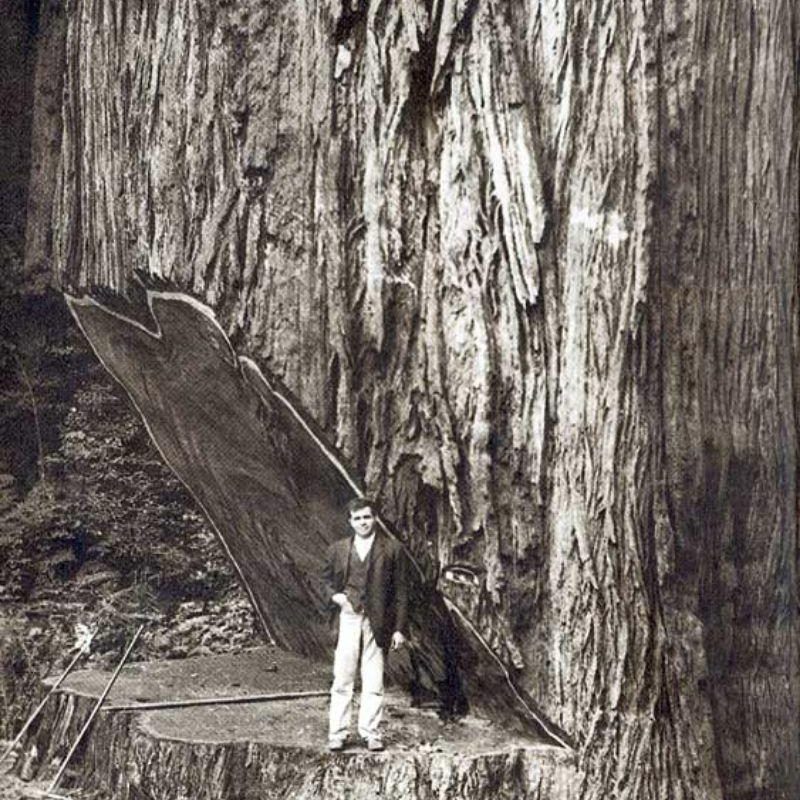
Man poses inside the opening to fell a huge tree (possible redwood), circa 1899
Title: Inside the Giants: The Story Behind an 1899 Photo of a Man Posing in a Felled Redwood
Meta Description: Uncover the history behind a haunting 1899 image of a man inside the notch of a felled redwood tree. Explore the logging boom, environmental impact, and legacy of these giants.
The Iconic 1899 Photo: A Snapshot of Deforestation’s Golden Age
In the late 19th century, as America’s Industrial Revolution surged, a now-viral photograph captured a striking—and controversial—moment: a man standing confidently inside a massive notch carved into the base of a towering redwood tree. Taken around 1899, this image symbolizes both the awe-inspiring scale of ancient forests and the unchecked logging practices that nearly destroyed them.
For historians, environmentalists, and photo enthusiasts alike, this snapshot offers a window into an era when redwoods were seen not as ecological treasures but as limitless lumber. Let’s explore the story behind this haunting image and its enduring significance.
The Photo Breakdown: Logging, Labor, and Legacy
The black-and-white image, likely taken in California’s Humboldt or Mendocino counties (hotspots of the redwood logging boom), shows a man in workwear posing inside a wedge-shaped cut at the base of a tree. The tree’s diameter dwarfs him, suggesting it was a centuries-old giant, possibly over 300 feet tall. Key details to note:
- The Pose: Workers often posed inside cuts to showcase the tree’s enormity. These photos doubled as postcards and propaganda for timber companies.
- The Tools: Crosscut saws and axes were used to create these notches. Larger trees required “springboard notches,” where loggers inserted wooden planks to stand on while cutting higher up the trunk.
- The Aftermath: Trees like this one likely became telegraph poles, railway ties, or building materials during San Francisco’s rapid urbanization.
Historical Context: The Redwood Gold Rush
By 1899, California’s redwood forests were under siege. With the spread of railroads and demand for cheap lumber, loggers targeted coastal redwoods (Sequoia sempervirens)—some over 2,000 years old.
Why Were Redwoods So Valuable?
- Resilience: Resistant to rot, fire, and insects.
- Size: A single tree could yield thousands of board feet of lumber.
- Accessibility: Growing near waterways eased transport to sawmills.
By the Numbers:
- Over 95% of old-growth redwoods were felled between 1850–1920.
- Lumber was so plentiful, redwoods were used for mundane items like fences and sidewalks.
The Environmental Cost: From Exploitation to Conservation
The 1899 photo wasn’t just a quirky keepsake—it foreshadowed an environmental crisis. By the early 1900s, devastation sparked a conservation movement:
- 1918: Save the Redwoods League formed, buying land to protect stands.
- 1920s: Redwood National Park established (later expanded in 1978).
- Today: Just 5% of original old-growth redwoods remain, protected in parks.
Where to Find the Photo (and Others Like It)
This image lives in archives like:
- The Bancroft Library (UC Berkeley)
- The Online Archive of California
- The Huntington Library
Search terms: “Vintage logging photos,” “19th century redwoods,” “historical deforestation.”
Conclusion: A Stark Reminder of What Was Lost
The 1899 man-in-tree photo is more than a relic—it’s a lesson in hubris. While the logging boom built cities, it also erased irreplaceable ecosystems. Today, as redwood reserves battle climate change and tourism pressures, the image urges us to balance progress with preservation.
Want to See Redwoods Today? Visit:
- Muir Woods National Monument (CA)
- Redwood National and State Parks
- Big Basin Redwoods State Park
As stewards of these ancient giants, we hold the future they nearly lost.
Keyword Integration Tip: This article targets long-tail keywords like “1899 redwood logging photo,” “historical deforestation images,” and “old-growth redwood conservation” to rank for niche history/environmental searches.