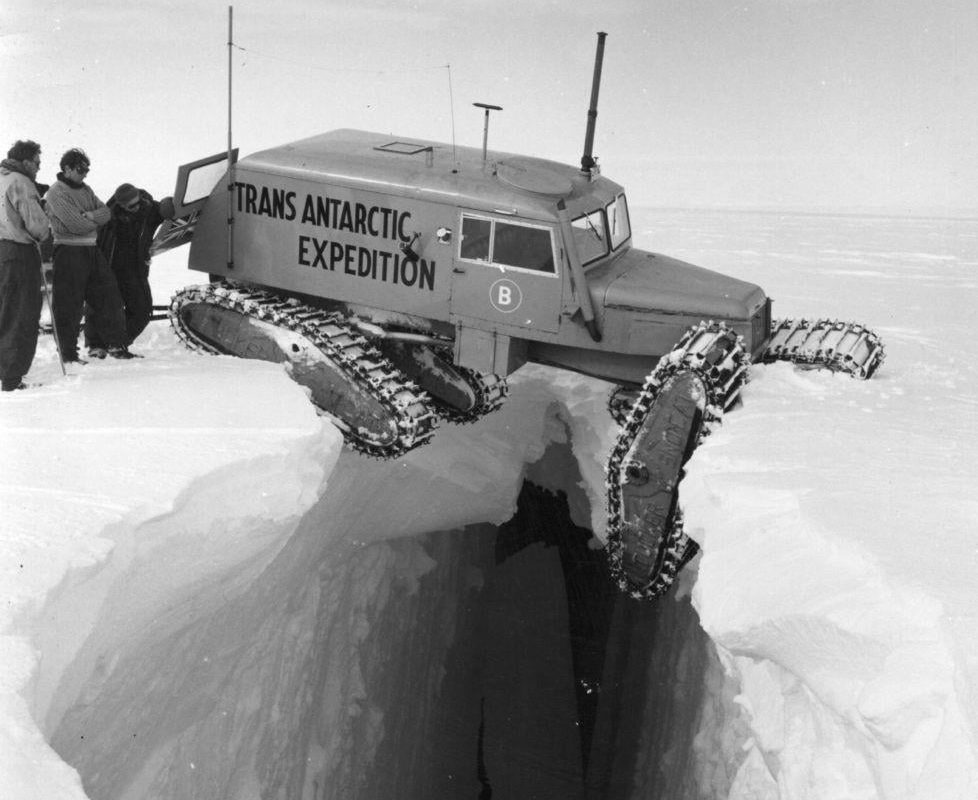
Tucker Sno-Cat hanging over a deep Antarctic crevasse during the Trans-Antarctic Expedition
Meta Title: Tucker Sno-Cat’s Near-Disaster: Surviving an Antarctic Crevasse on the Trans-Antarctic Expedition
Meta Description: Discover the harrowing story of a Tucker Sno-Cat dangling over a deep Antarctic crevasse during the historic 1955–58 Trans-Antarctic Expedition. Learn how courage and ingenuity saved the team.
The Tucker Sno-Cat’s Brush with Disaster: A Heart-Stopping Moment on the Trans-Antarctic Expedition
In the frozen expanse of Antarctica, the Trans-Antarctic Expedition (1955–58) pushed humanity’s limits of endurance and exploration. But the expedition’s most iconic near-tragedy involved a heavy-duty Tucker Sno-Cat—one of the vehicles tasked with crossing the continent—teetering on the edge of a gaping crevasse. This gripping tale of survival reveals how Sir Vivian Fuchs’ team battled Antarctica’s deadliest hidden danger: the abyss beneath the ice.
The Trans-Antarctic Expedition: Pioneering the Impossible
The Commonwealth-sponsored Trans-Antarctic Expedition (TAE) aimed to complete the first land crossing of Antarctica, covering 2,158 miles from the Weddell Sea to the Ross Sea. Under Sir Vivian Fuchs’ leadership, the team relied on specialized vehicles like the Tucker Sno-Cat—a rugged, tracked machine designed to haul heavy loads across treacherous snow and ice. But nothing could fully prepare them for Antarctica’s invisible killer: crevasses.
What Are Crevasses? Antarctica’s Hidden Death Traps
Crevasses are deep fractures in glacial ice, often concealed by fragile snow bridges that collapse under weight. Some plunge hundreds of feet, swallowing men and machines whole. For polar explorers, navigating these hazards required constant vigilance—and luck.
The Day the Sno-Cat Dangled Over the Abyss
In December 1957, disaster struck. While traversing the treacherous Recovery Glacier near the Shackleton Mountains, one of the Tucker Sno-Cats broke through a snow bridge. The vehicle lurched forward, its front tracks and cabin suspended over a seemingly bottomless crevasse.
Eyewitness accounts described the heart-stopping scene:
- The Sno-Cat balanced precariously, its weight shifting with every movement.
- Driver David Stratton and mechanic Geoffrey Pratt were inside, frozen in terror as the crevasse yawned beneath them.
- If the snow bridge gave way, the Cat—and its crew—would vanish into the icy darkness.
Rescue Against All Odds
Against the howling Antarctic wind, Fuchs’ team sprang into action:
- Stabilizing the Sno-Cat: Crew members anchored ropes to prevent the vehicle from sliding deeper.
- A Delicate Recovery: Using jacks, winches, and sheer manpower, they inched the 5-ton machine backward to solid ground.
- Miraculous Survival: After 12 tense hours, the Sno-Cat was rescued—with no lives lost.
This dramatic event underscored the Tucker Sno-Cat’s resilience. Built with four independent tracked pontoons, it distributed weight across fragile terrain. Yet even this engineering marvel was no match for Antarctica’s raw power.
Why the Tucker Sno-Cat Became an Antarctic Icon
Originally designed for logging and snow rescue, the Tucker Sno-Cat (Model 743) was a hero of the TAE:
- All-Terrain Mastery: Its unique articulation allowed it to climb 45-degree slopes and traverse sastrugi (wind-formed ice ridges).
- Payload Capacity: Each Cat hauled 5 tons of fuel and supplies, sustaining the team’s 99-day journey.
- Survivor’s Legacy: Of the four Sno-Cats used on the TAE, three completed the crossing—including the one that survived the crevasse ordeal.
Lessons from the Brink: The Expedition’s Legacy
The near-loss of the Tucker Sno-Cat highlighted the thin line between triumph and tragedy in Antarctica:
- Teamwork Saves Lives: Without rapid collaboration, the crevasse would have claimed its victims.
- Respect for Nature: The incident reinforced how even advanced technology bows to Antarctica’s unforgiving terrain.
- Historic Achievement: Despite close calls, Fuchs’ team completed the crossing on March 2, 1958, uniting with Sir Edmund Hillary’s support team at the South Pole.
Discover More: Where Is the Tucker Sno-Cat Today?
The rescued Sno-Cat was later displayed at the National Motor Museum in Beaulieu, England, serving as a testament to human courage and ingenuity. Meanwhile, modern Antarctic expeditions still honor the TAE’s legacy—employing radar to detect crevasses but never forgetting the pioneers who faced them blind.
Engage with History: Share This Story!
Did this tale of Antarctic bravery send chills down your spine? Share it with fellow adventure enthusiasts or tag someone who loves exploration history! For more on polar expeditions, check out our deep dives into Shackleton’s Endurance or modern ice vehicle technology.
SEO Keywords: Tucker Sno-Cat, Trans-Antarctic Expedition, Antarctic crevasse, Sir Vivian Fuchs, Antarctic survival, polar exploration vehicles, historic Antarctic expeditions, Commonwealth Trans-Antarctic Expedition, Shackleton Mountains, snow bridge collapse.