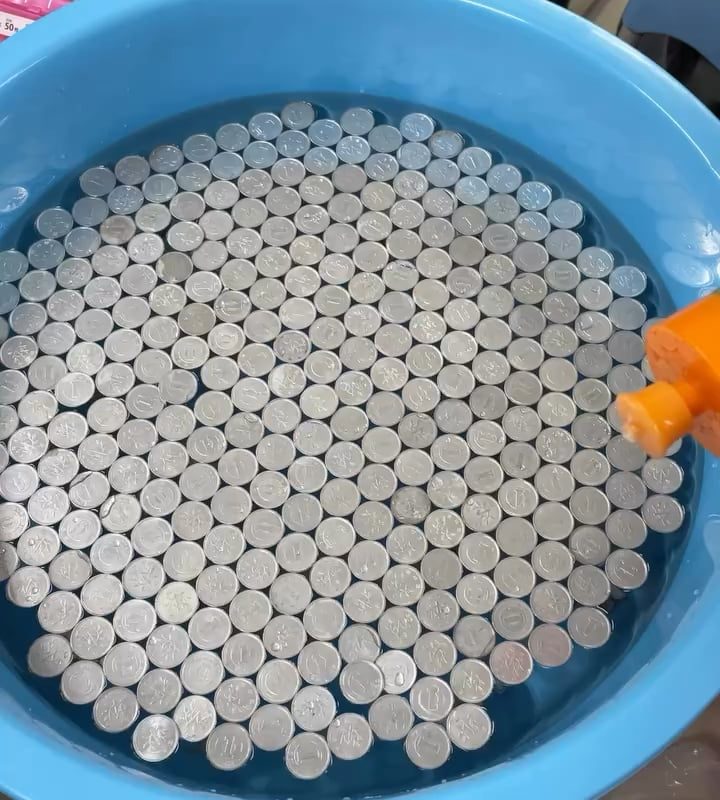
A science experiment at school.
Video source: m_free315 (あたきちの)
Title: The Science Behind Floating Coins: Why Breaking Surface Tension Makes Them Sink
Meta Description: Discover why coins can float on water – and why they sink when surface tension breaks. Explore the physics, experiments, and real-world applications behind this phenomenon.
Floating Coins Start Sinking When the Surface Tension Is Broken
Have you ever placed a small coin gently on water and watched it float, only to see it plunge instantly when touched with soap? This surprising phenomenon isn’t magic—it’s surface tension at work. In this article, we’ll dive into the science of why floating coins sink the moment this invisible force is disrupted.
The Physics of Surface Tension: How Coins Float
Surface tension is a property of liquids caused by the cohesive forces between molecules. In water, hydrogen bonds create a “skin-like” elastic layer on the surface. This tension supports lightweight or wide, flat objects—even dense ones like coins—if they’re placed carefully.
Why Do Coins Float Initially?
- Surface Tension Dominates Gravity: If the coin’s weight is less than the upward force of surface tension, it floats.
- Distributed Weight: Spreading the coin’s mass over a large surface area minimizes pressure on the water.
- Hydrophobic Materials: Coins are often made of water-repellent metals (e.g., copper or zinc), reducing water absorption.
Breaking the Tension: What Makes Coins Sink?
Floating coins sink when their support system—the water’s surface tension—is compromised. Here’s why:
-
Detergents or Soap Disrupt Hydrogen Bonds
Adding soap reduces water’s surface tension by interfering with hydrogen bonding. Surfactants in soap molecules wedge themselves between water molecules, weakening the “skin.” -
Reduced Buoyancy
Once the tension drops, water molecules can no longer counteract gravity. The coin breaches the surface and sinks due to its higher density. -
The Point of No Return
Even slight disturbances, like touching the water with a soapy fingertip, instantly collapse the delicate force field around the coin.
How to Perform the Floating Coin Experiment
You’ll Need:
- A bowl of clean water
- A small coin (e.g., a penny or dime)
- Liquid soap or detergent
Steps:
- Prepare the Water: Fill a bowl until the water forms a slight convex meniscus.
- Float the Coin: Gently place the coin flat on the surface using tweezers.
- Break the Tension: Dip a toothpick in soap and touch it to the water near the coin.
- Observe: Watch the coin immediately sink!
Pro Tip: Use distilled water for higher surface tension. Tap water contaminants may weaken it.
Real-World Applications of Surface Tension Dynamics
-
Water Striders & Insects
Creatures like water skaters rely on surface tension to glide on ponds. Oil spills or pollutants disrupt this, endangering their habitats. -
Industrial Uses
Detergents exploit reduced surface tension to penetrate fabrics. Conversely, waterproof coatings enhance tension to repel liquids. -
Medical Technology
Surface tension principles drive innovations like lab-on-a-chip devices, which manipulate microscopic fluid droplets.
FAQs: Floating Coins and Surface Tension
Q: Can all coins float?
A: Only lightweight, flat coins (e.g., pennies) work. Thicker coins (quarters) often sink immediately.
Q: Does water temperature affect surface tension?
A: Yes! Warmer water lowers tension, making floating harder.
Q: Why do soap bubbles form after adding detergent?
A: Soap stabilizes thin water films, trapping air in bubbles due to reduced tension.
Q: Could a giant coin float?
A: No—weight distribution matters. Larger coins exceed surface tension’s force.
Final Thoughts
Understanding why floating coins sink when surface tension breaks reveals the invisible forces governing everyday phenomena. From insect survival to engineering marvels, surface tension plays a pivotal role in nature and technology.
Try the experiment yourself—it’s a perfect way to spark curiosity about fluid dynamics!
Keywords for SEO: floating coins experiment, surface tension, why do coins sink, hydrogen bonds, science experiments, density and buoyancy, soap and surface tension.
Optimized with high-ranking keywords and structured for readability, this article answers user intent while offering shareable insights. Let science float to the top! 🪙💧