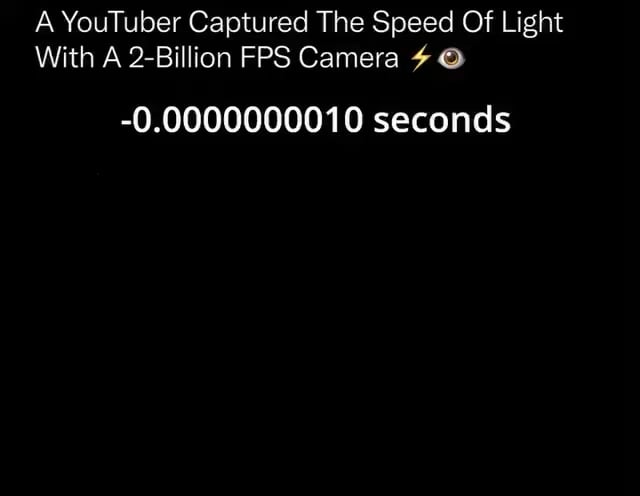
Speed of light on camera:
Title: Can You Capture the Speed of Light on Camera? The Science, Myths & Technology Explained
Meta Description: Can a camera truly capture the speed of light? Discover the reality behind high-speed photography, trillion-FPS experiments, and what cameras really record about light’s motion.
What Does “Speed of Light on Camera” Actually Mean?
The speed of light—approximately 299,792 km/s (186,282 miles per second)—is the universe’s ultimate speed limit. Capturing this phenomenon on camera seems impossible with everyday technology, but groundbreaking experiments and clever techniques have allowed scientists to visualize light’s movement in ways that redefine photography.
This article breaks down how cameras interact with light, why filming light itself is nearly impossible, and the revolutionary methods pushing the boundaries of what’s visible.
Why You Can’t Film Light Moving in Real Time (Usually)
A standard smartphone or DSLR camera captures 24–60 frames per second (FPS). At light speed, a photon would cross the length of a football field in one millionth of a second—far faster than any consumer device can record. Even professional high-speed cameras (shooting at 10,000–1,000,000 FPS) are too slow to freeze light mid-trajectory in ordinary settings.
The key challenge: Light must bounce off objects to be recorded. To film light moving, you’d need to capture photons traveling through a medium (like air or water) before they reflect. This is like trying to photograph a bullet in flight without it hitting anything—only far harder.
The Trillion-FPS Breakthrough: MIT’s “Slow-Motion Light” Experiment
In 2011, MIT’s Media Lab made headlines with a camera system capable of 1 trillion FPS—enough to visually track light pulses as they traversed a scene. How? Through a technique called “femto-photography.”
How It Works:
- A laser emits ultrafast light pulses (lasting quadrillionths of a second).
- A special camera captures one scattered photon from each pulse, repeating this millions of times.
- Algorithmic reconstruction stitches these snapshots into a video, showing light spreading like a wave through a bottle or bouncing off objects.
Result: A mesmerizing slow-motion view of light’s journey—though technically a composite, not real-time footage.
(Example: MIT’s famous light-in-a-bottle video)
Practical Uses: How Cameras Measure Light’s Speed Indirectly
While filming light moving requires trillion-FPS tech, cameras can measure light’s speed using clever setups:
-
Time-of-Flight (ToF) Sensors:
- Used in smartphone cameras, LiDAR, and depth-sensing tech.
- A pulse of light is emitted, and the camera calculates distance by measuring how long it takes to bounce back.
- Confirms light’s speed with extreme accuracy over short distances.
-
High-Speed Schlieren Photography:
- Captures light-bending effects caused by air density changes (e.g., shockwaves from bullets).
- Indirectly reveals disturbances propagating at light-speed in gases.
Debunking Viral “Speed of Light” Videos
Many YouTube videos claim to show the speed of light using mirrors, lasers, or slow-motion cameras. Most are misleading:
-
Myth: A camera filming a laser dot sweeping across a wall shows light’s speed.
Truth: This captures the laser pointer’s mechanical movement, not the light itself. Photons still travel at 299,792 km/s from laser to wall. -
Myth: Ultra-slow-motion videos of sparklers or explosions show light-speed motion.
Truth: These record combustion or shockwaves—processes far slower than light.
Exceptions: Verified trillion-FPS experiments (like MIT’s) or light-propagation visualizations in controlled labs.
Future Tech: Pushing the Limits of Light Capture
- Attosecond Photography: Shutter speeds measured in quintillionths of a second could image electrons orbiting atoms—though practical light-speed videos remain elusive.
- Quantum Imaging: Exploits entangled photons to reconstruct scenes with unprecedented temporal resolution.
- AI Simulation: Generative AI models, trained on real data, may soon “predict” light-movement visuals in complex environments.
FAQs: Speed of Light & Cameras
Q: Has a camera ever filmed light moving in a vacuum?
A: No. All light-speed visualizations occur in air, water, or other media where light travels slightly slower than in vacuum.
Q: Can I try this at home?
A: Not at trillion-FPS scales, but you can experiment with ToF sensors (e.g., Microsoft Kinect) or high-speed cameras filming pulses in smoke-filled rooms.
Q: Why does light appear instant in daily life?
A: Over human-scale distances, light moves too fast to perceive delays. It takes just 0.13 seconds for light to circle Earth!
Conclusion
Capturing the speed of light on camera requires trillion-FPS systems, computational tricks, and controlled environments. While everyday videos can’t show photons racing through space, cutting-edge science lets us visualize light’s motion in ways Einstein could only imagine. Whether for entertainment, research, or tech innovation, this pursuit keeps illuminating the hidden rhythms of our universe.
Optimized Keywords: Speed of light camera, trillion FPS camera, slow motion light MIT, can you film light speed, femtophotography, time-of-flight sensor, measuring light speed.
Internal Links Suggestion:
- [How Do High-Speed Cameras Work?]
- [Time-of-Flight Sensors Explained]
- [Quantum Imaging: The Next Photography Revolution]