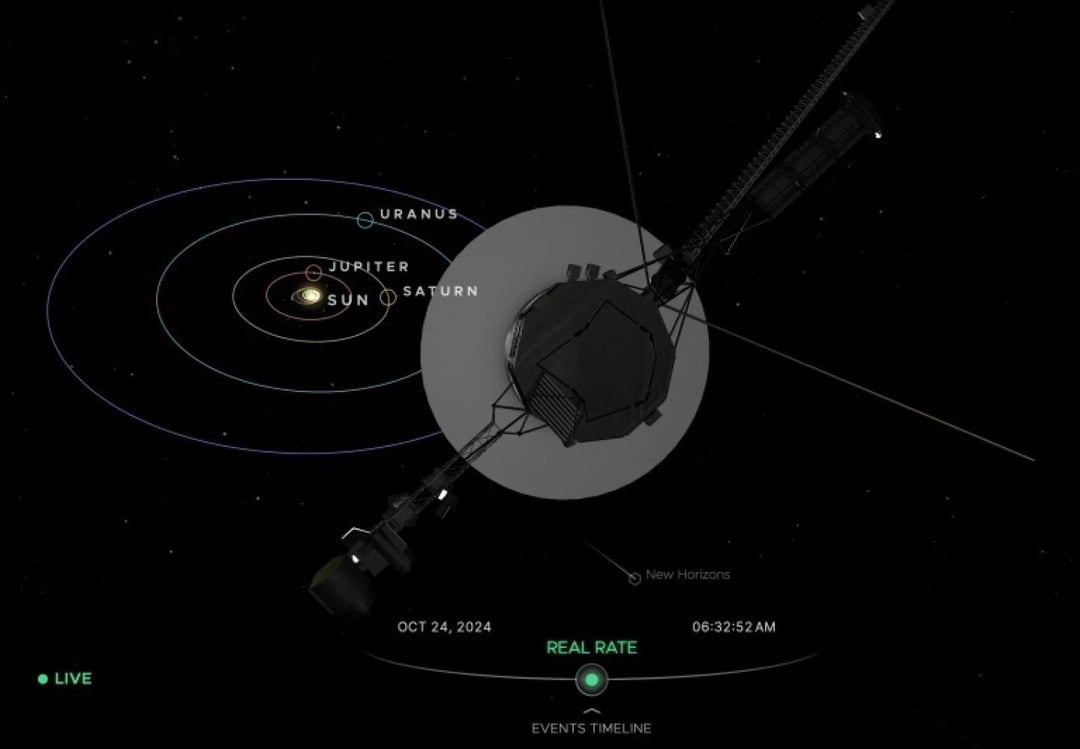
Voyager 1 approaches one light day from Earth
Title: Voyager 1 Nearing Historic Milestone: Approaching One Light Day from Earth
Meta Description: NASA’s Voyager 1, humanity’s farthest-reaching spacecraft, is on the brink of a new milestone: one light day from Earth. Discover its journey, significance, and legacy in this deep dive.
Voyager 1 Approaches One Light Day from Earth: A Cosmic Triumph
In the vast, silent expanse of interstellar space, NASA’s Voyager 1—a tiny human-made probe no larger than a compact car—continues its epic journey into the unknown. Launched in 1977 to study the outer planets, Voyager 1 has far outlived its original mission and is now nearing a staggering milestone: one light day from Earth. At this distance, a signal from the spacecraft takes nearly 24 hours to reach us, a testament to both its longevity and humanity’s ingenuity.
As the first human-made object to enter interstellar space (2012), Voyager 1 symbolizes the boundless curiosity of our species. Let’s explore what this new milestone means, the science behind its journey, and why it still matters after 47+ years.
What Is a Light Day? Grasping the Scale
A light day is the distance light travels in one Earth day: approximately 16 billion miles (25.9 billion kilometers). To put this in perspective:
- Light Speed vs. Human Tech: Light zips through space at 186,000 miles per second—fast enough to circle Earth 7.5 times in one second. Voyager 1, by contrast, travels at 38,000 mph, covering just 900 million miles per year.
- Solar System Scale: At one light day, Voyager 1 is 250 times farther from Earth than the Sun and well beyond Pluto’s orbit (which averages 3.7 billion miles away).
- Time Lag: Communications between NASA and Voyager 1 now take over 23 hours each way—a far cry from the near-instant signals we enjoy with Mars rovers.
Voyager 1’s Journey: From Planetary Explorer to Interstellar Pioneer
1977–1980: The Grand Tour
Launched on September 5, 1977, Voyager 1’s primary mission was to study Jupiter and Saturn. Its discoveries revolutionized planetary science:
- Jupiter’s Active Moons: It captured volcanic eruptions on Io, the first beyond Earth.
- Saturn’s Rings & Titan: Detailed images revealed Saturn’s complex ring structure and Titan’s thick atmosphere.
1990–2012: Into the Unknown
After completing its planetary mission, Voyager 1 turned toward interstellar space. In 1990, it snapped the iconic “Pale Blue Dot” photo—Earth as a speck in Saturn’s rings. By 2012, it crossed the heliopause, the boundary where the Sun’s solar wind gives way to interstellar space.
2024: Nearing One Light Day
As of July 2024, Voyager 1 is 15.2 billion miles (24.5 billion km) from Earth. At its current speed, it will reach one light day around early 2025.
The Challenges of Deep Space Communication
Operating a 1970s-era spacecraft from interstellar space is no small feat:
- Fading Signals: Voyager’s 23-watt transmitter is now so faint that NASA’s Deep Space Network (DSN) uses football-field-sized antennas to detect its whispers.
- Power Decline: Its radioactive power source decays by ~4 watts yearly; NASA has strategically shut down instruments to conserve energy.
- Recent Glitches: In 2024, Voyager 1 suffered a telemetry malfunction but was repaired remotely—a triumph of troubleshooting across 15 billion miles.
Despite these hurdles, four instruments still operate, studying cosmic rays, magnetic fields, and plasma in interstellar space.
Why Voyager 1 Still Matters
1. Interstellar Space Data
As the only probe in interstellar territory, Voyager 1 provides unparalleled insights into the “cosmic ocean”:
- It detected a persistent hum of interstellar gas.
- It revealed unexpected magnetic field structures beyond the heliosphere.
2. A Time Capsule for the Future
Voyager carries the Golden Record—a phonograph containing sounds, music, and images of Earth, intended for any extraterrestrial life.
3. Inspiration & Legacy
Voyager 1 embodies humanity’s drive to explore. Its longevity inspires modern missions like New Horizons (Pluto) and the future Interstellar Probe.
The Future: When Will Voyager 1 Go Silent?
Voyager 1’s journey is finite:
- 2025–2030: NASA projects its instruments will shut down as power dwindles.
- ~40,000 Years: The probe will drift within 1.6 light-years of star Gliese 445, though it won’t actively study it.
Even silent, Voyager 1 will continue drifting among the stars—a monument to human curiosity.
FAQs: Voyager 1’s One Light Day Milestone
Q: How far is Voyager 1 now?
A: As of July 2024, it’s ~15.2 billion miles (24.5 billion km) away.
Q: When was Voyager 1 launched?
A: September 5, 1977—48 years ago.
Q: What powers Voyager 1?
A: A plutonium-238 radioisotope thermoelectric generator (RTG).
Q: Will we ever retrieve Voyager 1?
A: No—its trajectory takes it irrevocably into deep space.
Conclusion: A Beacon of Human Achievement
Voyager 1’s approach to one light day from Earth is more than a numerical milestone. It represents the audacity of a species that dared to reach beyond its cradle. For decades, this intrepid probe has whispered secrets of the cosmos back to us, challenging our understanding of space and our place within it.
As Carl Sagan poignantly noted while reflecting on Voyager’s “Pale Blue Dot” image: “That’s here. That’s home. That’s us.” Voyager 1’s journey reminds us that even in the vast darkness of space, humanity’s light—ingenuity, perseverance, and wonder—shines brilliantly.
Optimized Keywords:
- Voyager 1 one light day
- NASA Voyager 1 distance
- Voyager interstellar mission
- How far is Voyager 1
- Voyager 1 spacecraft status
- Light day distance space
- Voyager 1 Golden Record
- Interstellar space probe
- Deep space communication
- Voyager 1 milestones
Internal Links (Suggested):
- NASA’s Voyager Mission Updates
- Voyager 2’s Journey Through Space
- The Golden Record: Humanity’s Message to the Stars
- How Do Space Probes Communicate?
External Links (Authority Sources):
Image Alt Text Suggestion:
“Artist’s concept of Voyager 1 against the backdrop of interstellar space, with Earth and the Sun as distant specks.”
Boost your content’s reach by sharing this article with space enthusiasts, educators, and science communities. Voyager 1’s story is a universal reminder: exploration is timeless. 🌌✨