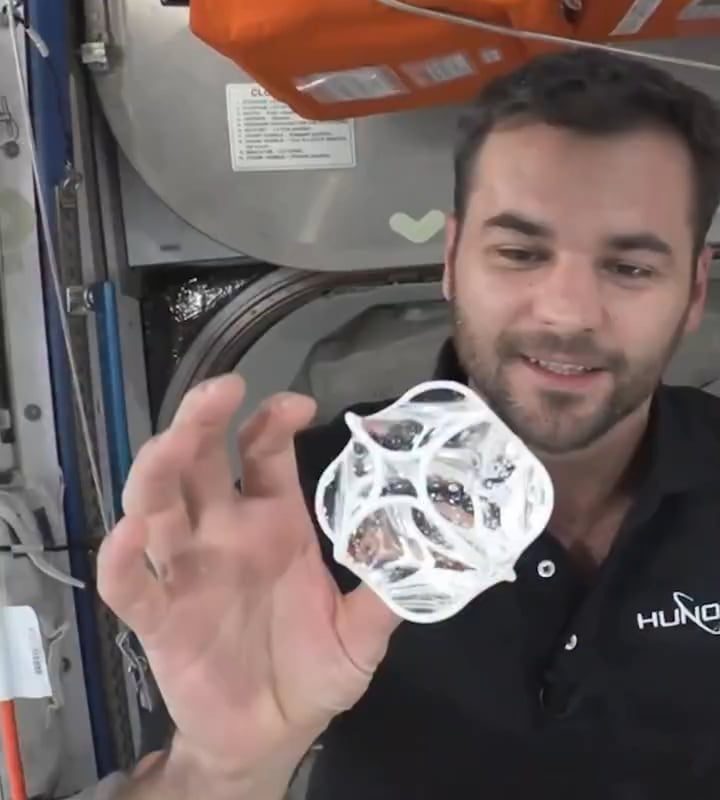
now there is a new way to storage liquids in space
Zero-Gravity Revolution: The Breakthrough Changing How We Store Liquids in Space
Introduction
As humanity’s ambitions in space exploration expand—from lunar bases to manned missions to Mars—the challenge of managing liquids in microgravity has remained a critical hurdle. Traditional methods rely on rigid containers, propellant management devices, or pressurized systems, which add weight, complexity, and risk. But a groundbreaking new approach is redefining liquid storage in space, promising safer, lighter, and more versatile solutions for future missions.
Why Liquid Storage in Space is So Difficult
In the microgravity environment of space, liquids don’t behave as they do on Earth. Without gravity to anchor them:
- Liquids float freely, forming bubbles or “blobs” that can damage equipment.
- Precision pouring is impossible, complicating fuel transfers or life-support systems.
- Containment requires energy-intensive solutions (e.g., pumps or spinning chambers), increasing spacecraft mass and failure risk.
These issues have plagued everything from rocket fuel systems to astronauts’ drinking water. But recent advances in fluid dynamics and materials science are unlocking a smarter way forward.
The New Frontier: Surface Tension-Driven Liquid Storage
Researchers at leading space agencies and private aerospace firms have unveiled a novel method leveraging surface tension—the same force that allows water striders to walk on ponds—to control liquids in zero gravity. This innovation, dubbed “Microfluidic Containment Architecture” (MCA), uses specially engineered containers with ultra-thin, nanotextured internal surfaces.
How It Works:
- Smart Surface Design: Containers are lined with microscopic grooves or hydrophilic/hydrophobic (water-attracting/repelling) patterns. These guide liquids into stable configurations, preventing unwanted drifting or vaporization.
- Passive Stability: Instead of relying on pumps or centrifuges, MCA uses capillary forces to “pin” liquids in place. This reduces energy consumption and mechanical complexity.
- Modular Scaling: Units can be combined for diverse uses, from storing drinking water to managing cryogenic rocket fuels.
Benefits Over Traditional Systems
This breakthrough offers transformative advantages:
- Weight Reduction: Eliminating bulky hardware could cut spacecraft mass by up to 30%, lowering launch costs.
- Enhanced Safety: No rotating parts or high-pressure systems mean fewer failure risks for crewed missions.
- Precision Control: Liquids can be directed on-demand for fuel transfers, experiments, or life-support systems.
- Scalability: Adaptable for small satellites, space stations, or interplanetary vehicles.
Real-World Applications
MCA technology is already being tested in orbit, with exciting implications:
- Long-Duration Missions: Safely store water and hydrogen-based fuels for Moon/Mars expeditions.
- In-Space Refueling: Enable reusable spacecraft by simplifying propellant transfers between orbiting “depots.”
- Space Manufacturing: Improve precision in processes like 3D printing with liquid metals or pharmaceuticals.
- Habitat Systems: Efficiently manage water recycling and hydroponics for off-world colonies.
The Future of Fluid Management in Space
Leading projects like NASA’s Space Technology Mission Directorate and private ventures like SpaceX’s Starship program are fast-tracking MCA adoption. Meanwhile, startups like OrbitFab aim to deploy fluid-storage “tankers” in low-Earth orbit by 2030.
Dr. Elena Rodriguez, a fluid dynamics expert at ESA, sums it up:
“This isn’t just about storage—it’s about revolutionizing how we use liquids in space. From sustaining human life to powering deep-space travel, this could be the missing link.”
Conclusion
The ability to store and control liquids reliably in microgravity is no longer science fiction. As MCA-style systems move from labs to launchpads, they promise to accelerate humanity’s reach into the cosmos—making space missions safer, cheaper, and more sustainable. For aerospace engineers, investors, and space enthusiasts alike, this innovation isn’t just a step forward; it’s a giant leap.
Stay tuned as this technology reshapes the future of space exploration—one droplet at a time.
Keywords for SEO:
liquid storage in space, microgravity fluid management, space technology breakthrough, surface tension in zero-g, spacecraft fuel systems, space exploration innovation, microfluidic containment, space mission sustainability, future of space travel.
Meta Description:
Discover the revolutionary surface tension-based technology transforming liquid storage in space—lighter, safer, and scalable solutions for Moon, Mars, and beyond. Explore the science and real-world impact.