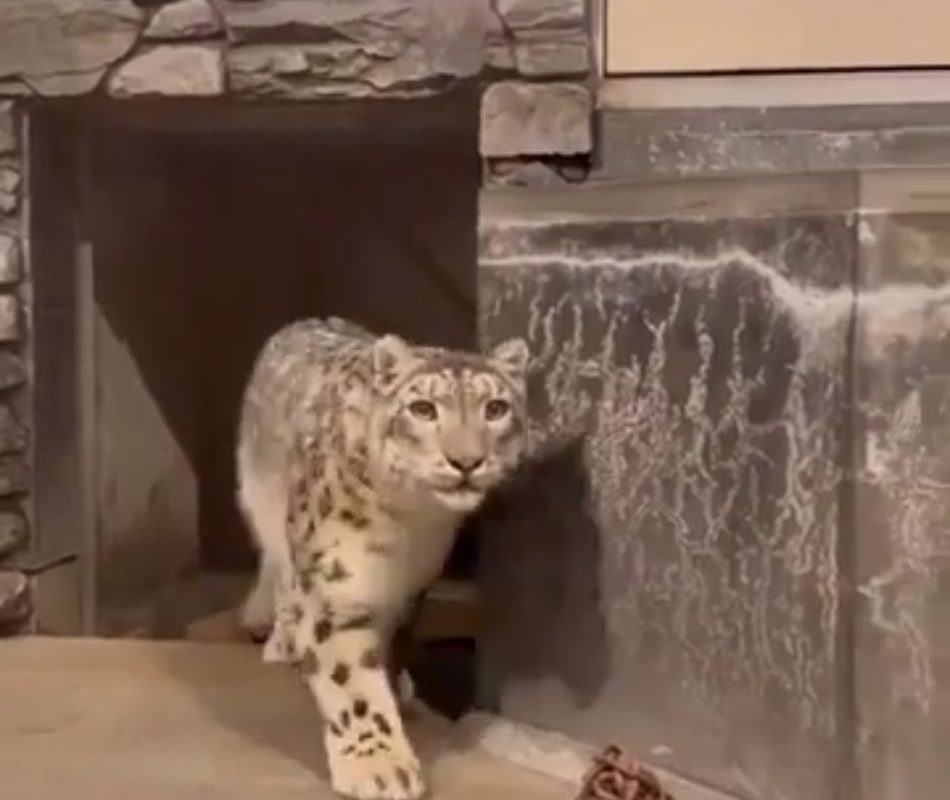
A snow leopard’s reaction after seeing a tiger
Title: Frozen Standoff: How a Snow Leopard Reacts to a Tiger (And Why It Matters)
Meta Description: What happens when a snow leopard encounters a tiger? Discover the rarely seen dynamics between these apex predators, their survival strategies, and the fragile ecosystems they share.
Snow leopards and tigers are two of the most iconic big cats on Earth, yet they inhabit vastly different worlds—until their paths might briefly cross. A snow leopard’s reaction to seeing a tiger isn’t just a wildlife curiosity; it reveals the hidden rules of survival in Asia’s most extreme environments. Here’s what science and rare field observations tell us about this high-stakes encounter.
The Unlikely (But Possible) Encounter
Where Would This Happen?
While snow leopards reign above 3,000 meters in the Himalayas and Central Asia’s rocky slopes, tigers dominate lower-elevation forests and grasslands. However, their territories overlap in fragmented zones like:
- Bhutan’s mountain valleys
- Northeast India’s fringes (e.g., Arunachal Pradesh)
- Russia’s Far East (Amur tigers and snow leopards)
In these regions, habitat loss and climate change could force fleeting interactions—though documented face-offs are extremely rare.
A Snow Leopard’s Reaction: Flight Over Fight
When a snow leopard detects a tiger, its response is shaped by instinct, size disparity, and survival calculus:
-
Instantaneous Alertness
Snow leopards rely on camouflage (“ghosts of the mountains”) but possess extraordinary senses. Their reaction begins with frozen stillness, ears pivoting to track the tiger’s movements. -
Strategic Retreat
Weighing just 60–120 lbs (compared to a tiger’s 300–600 lbs), a snow leopard never engages. It withdraws silently up cliffs or along precarious ridges, exploiting its agility in terrain tigers can’t navigate. -
Vocal Warnings
If cornered, snow leopards may hiss or growl—a last-resort bluff to deter pursuit. Unlike tigers, they lack a spine-chilling roar. -
Territory Surrender
In rare cases where tigers encroach higher elevations (often due to prey scarcity), snow leopards concede hunting grounds. Avoidance minimizes energy-wasting conflicts.
Why Don’t Tigers Hunt Snow Leopards?
- Energy Efficiency: Tigers prefer large prey like deer or wild boar. A snow leopard offers little caloric reward for the risk.
- Terrain Advantage: Snow leopards escape to vertical landscapes where tigers struggle (e.g., near-vertical cliffs).
- Nocturnal Timing: Both cats hunt at night but patrol different altitudes, reducing overlap.
A Tale of Two Cats: Key Differences
| Trait | Snow Leopard | Tiger |
|---|---|---|
| Habitat | High-altitude cliffs (>3,000m) | Forests, grasslands, mangroves |
| Size | 60–120 lbs | 300–600 lbs |
| Hunting Style | Ambush from above | Stealthy stalking |
| Conservation | ~4,000–6,500 remaining | ~4,500–5,500 wild tigers |
The Bigger Threat: Humans, Not Tigers
While tigers pose a minimal risk to snow leopards, human activities are catastrophic:
- Poaching: Both cats are hunted for fur and traditional medicine.
- Habitat Loss: Roads and mining fragment territories, forcing unnatural overlaps.
- Climate Change: Shrinking alpine zones push snow leopards lower—into tiger country.
Key Takeaways
- A snow leopard’s reaction to a tiger is avoidance at all costs, driven by evolutionary wisdom.
- These encounters are exceedingly rare but highlight biodiversity hotspots needing protection.
- Coexistence projects (e.g., in Bhutan) prove both species can thrive with safeguarded corridors.
Final Thought:
The snow leopard’s silent retreat from a tiger isn’t cowardice—it’s a masterpiece of survival. By protecting their high-mountain refuges, we ensure these elusive “ghost cats” never face a battle they can’t escape. Their fate, like the tiger’s, rests in our hands.
Support conservation efforts through organizations like the Snow Leopard Trust or World Wildlife Fund.