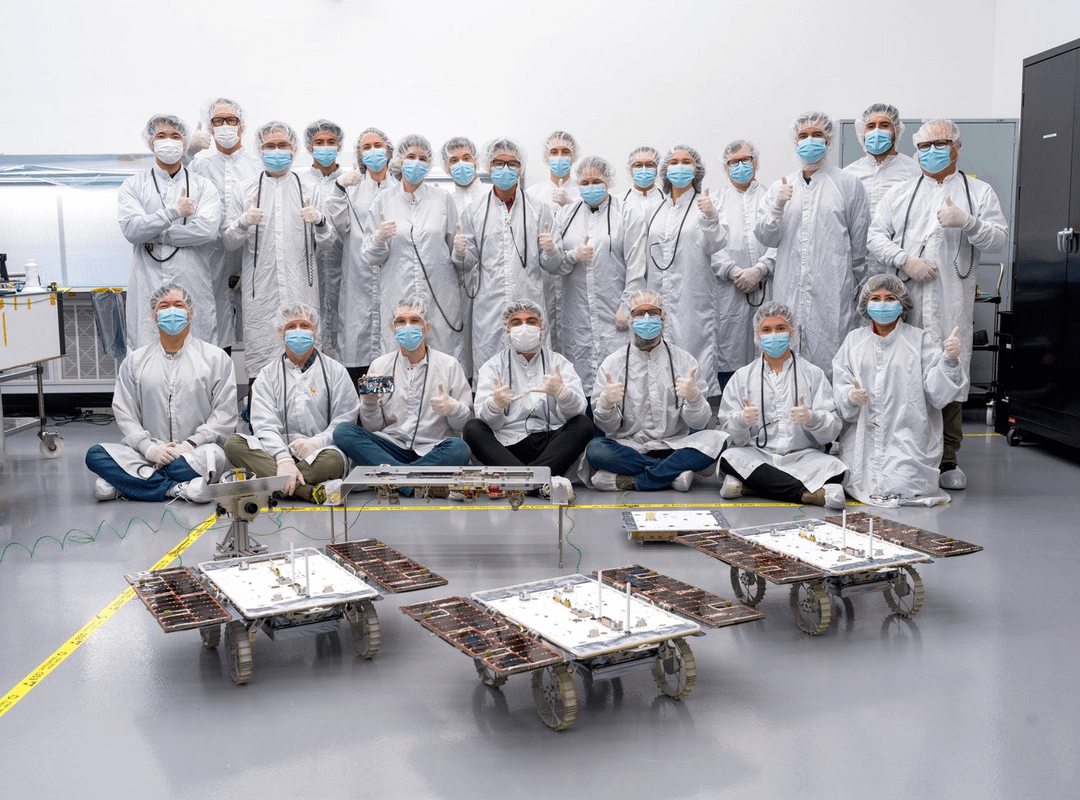
NASA’s CADRE Project will send 3 Small Rover to the Moon to Explore & Map the surface without Human Control
NASA’s CADRE Project: 3 Small Autonomous Rovers to Map the Moon’s Mysteries
Introduction
In a bold leap toward lunar exploration, NASA’s Cooperative Autonomous Distributed Robotic Exploration (CADRE) project is set to deploy three suitcase-sized rovers to the Moon. Slated to launch in 2024–2025, this groundbreaking mission aims to demonstrate how teams of small robots can autonomously traverse, explore, and map treacherous terrain—without real-time human control. As part of NASA’s Commercial Lunar Payload Services (CLPS) initiative, CADRE could revolutionize how we study the Moon and prepare for future human missions.
What Is the CADRE Project?
CADRE is a technology demonstration mission designed to test the viability of multi-robot cooperation on extraterrestrial surfaces. The project’s three rovers will land via Intuitive Machines’ Nova-C lander near the Moon’s Reiner Gamma region—a magnetic anomaly area with rugged landscapes ideal for testing autonomy.
Key Objectives:
- Collaborative Mapping: The rovers will synchronize movements to create detailed 3D maps of the lunar surface.
- Autonomous Decision-Making: They’ll share data via a mesh network, collectively deciding how to navigate obstacles or optimize exploration.
- Surviving Extreme Conditions: Operating on solar power, the rovers must endure the 14-day lunar night and temperature swings from 250°F to -208°F.
Meet the Rovers: Compact Powerhouses of Innovation
Each rover is roughly the size of a carry-on suitcase (16.5″ x 16.5″ x 12″), yet packed with cutting-edge tech:
- Solar Panels & Batteries: Vital for surviving the 2-week lunar night by hibernating in “survival mode.”
- Multi-Robot Algorithms: Software enables the trio to “vote” on optimal paths and distribute tasks efficiently.
- Ground-Penetrating Instruments: Measure subsurface features to identify resources like water ice.
- Mesh Network Radio: Maintains communication between rovers and relays data back to Earth.
How the Autonomous Team Works
Human intervention is impossible due to a 3-second communication delay between Earth and the Moon. Instead, CADRE’s rovers rely on embedded AI to:
- Divide Tasks: One rover might scout ahead while others analyze soil or avoid obstacles.
- Resolve Disagreements: If two rovers favor different routes, they recalculate for consensus.
- Adapt to Hazards: Crater walls or boulders trigger real-time replanning.
This collaboration mimics insect swarms or flocking birds, showcasing nature-inspired efficiency in robotics.
The Moon’s Harsh Challenges
The rovers will navigate a gauntlet of threats:
- Dust: Sharp lunar regolith can jam instruments and coat solar panels.
- Temperature Extremes: Electronics must rapidly switch between boiling days and frozen nights.
- Limited Power: With just one lunar day (14 Earth days) to complete their mission, efficiency is critical.
If successful, CADRE’s resilience will prove that small, affordable robots can endure on other worlds—even after a $5 million-per-rover investment.
Why CADRE Matters for Future Exploration
- Paving the Way for Artemis: The mission’s maps and data will help identify landing zones and resources for NASA’s crewed Moon missions.
- Scalable Robotic Teams: Future missions could deploy dozens of rovers to explore lava tubes or build lunar infrastructure autonomously.
- Democratizing Space Science: Small rovers reduce costs and risks, enabling more frequent missions.
“CADRE shows how robots can take on dangerous tasks so humans don’t have to,” said Subha Comandur, the project’s lead at NASA JPL.
Conclusion: A New Era of Lunar Discovery
NASA’s CADRE project isn’t just about sending robots to the Moon—it’s about testing a blueprint for the future of exploration. By proving that swarms of autonomous rovers can work together in hostile environments, CADRE unlocks the potential to explore Mars, asteroids, and beyond with unprecedented speed and safety. As the rovers land in 2025, the world will watch a milestone in off-world robotics that could redefine humanity’s place in the cosmos.
Stay Updated: Follow NASA’s CLPS and JPL social channels for mission timelines and breakthroughs!
Keywords for SEO: NASA CADRE Project, autonomous lunar rovers, Moon mapping, CLPS mission, robotic swarm exploration, lunar surface exploration, NASA Artemis program, space robotics, lunar technology demonstration.