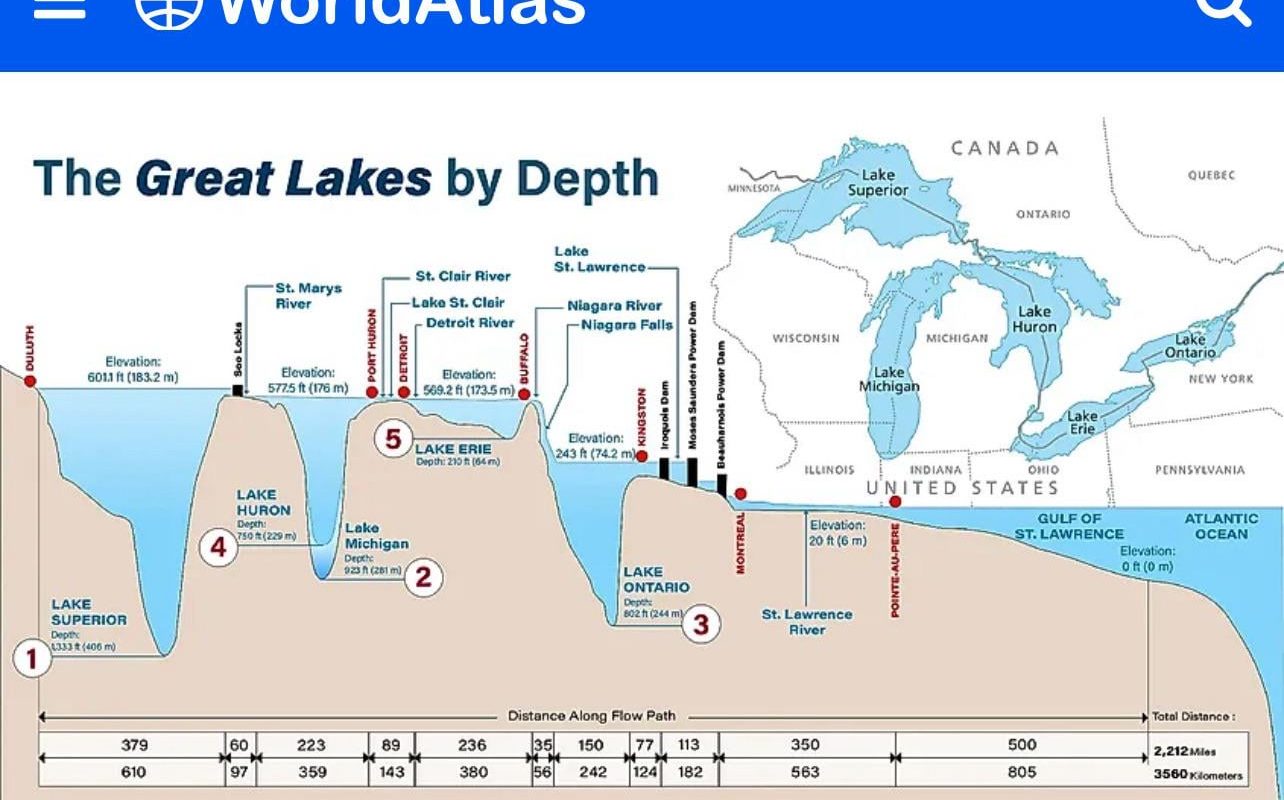
The Great Lakes (United States) By Depth
Title: The Great Lakes by Depth: Ranking North America’s Largest Freshwater Wonders
Meta Description: Explore the Great Lakes ranked by depth, from Lake Superior’s staggering abyss to Lake Erie’s shallower shores. Discover how depth shapes ecosystems, industry, and myth.
The Great Lakes—Superior, Michigan, Huron, Erie, and Ontario—are titans of freshwater, holding 84% of North America’s surface freshwater and 21% of the world’s supply. Beyond their ecological and economic importance, their depths tell a story of ancient glaciers, hidden ecosystems, and human reliance. This article dives into the Great Lakes ranked by depth, revealing how their unique underwater landscapes define life above and below the surface.
Why Depth Matters in the Great Lakes
Depth influences everything:
- Climate Regulation: Deeper lakes absorb and release heat slowly, buffering regional temperatures.
- Biodiversity: Depth gradients create habitats for cold-water species like lake trout.
- Navigation & Trade: Deeper channels support massive freighters shipping iron ore, grain, and more.
Ranking the Great Lakes by Depth: Deepest to Shallowest
1. Lake Superior: The Deepest and Largest
- Max Depth: 1,332 feet (406 meters)
- Average Depth: 483 feet (147 meters)
- Volume: 2,900 cubic miles (12,100 km³)
- Key Fact: Deep enough to submerge the Empire State Building with room to spare!
Lake Superior is not only the deepest Great Lake but also the world’s largest freshwater lake by surface area. Its depth sustains cold temperatures year-round, making it a refuge for Arctic-like species. Shipwrecks like the Edmund Fitzgerald lie preserved in its icy depths.
2. Lake Ontario: The Eastern Deep
- Max Depth: 802 feet (244 meters)
- Average Depth: 283 feet (86 meters)
- Volume: 393 cubic miles (1,640 km³)
Despite being the smallest by surface area, Lake Ontario is the second-deepest Great Lake. Its depth stems from its glacial trough formation and link to the Atlantic via the St. Lawrence River. Deep waters here support salmon and trout fisheries critical to New York and Ontario’s economies.
3. Lake Michigan: The Solo Giant
- Max Depth: 925 feet (282 meters)
- Average Depth: 279 feet (85 meters)
- Volume: 1,180 cubic miles (4,920 km³)
Lake Michigan—the only Great Lake entirely within the U.S.—boasts dramatic depth variations. Its northern basin plunges to 925 feet near Washington Island, while southern sections are shallower. Depth supports commercial fishing for whitefish and yellow perch, alongside tourism in cities like Chicago.
4. Lake Huron: Shipwrecks and Sunken Forests
- Max Depth: 750 feet (229 meters)
- Average Depth: 195 feet (59 meters)
- Volume: 850 cubic miles (3,540 km³)
Home to the largest shoreline of the Great Lakes, Huron’s depth hides over 1,000 shipwrecks and ancient submerged forests. Its Georgian Bay (sometimes called the “sixth Great Lake”) reaches depths of 540 feet. The lake’s variable depths also fuel algae blooms that challenge water quality.
5. Lake Erie: The Shallow Powerhouse
- Max Depth: 210 feet (64 meters)
- Average Depth: 62 feet (19 meters)
- Volume: 116 cubic miles (484 km³)
Lake Erie is the shallowest and warmest Great Lake, but its shallowness drives productivity. It supports the largest fishery by catch volume (50% of the Great Lakes’ total) and intense seasonal algal blooms. Erie’s western basin averages just 24 feet deep, ideal for walleye spawning grounds.
Comparing the Great Lakes: Depth and Beyond
| Lake | Max Depth (ft) | Avg Depth (ft) | Surface Area (mi²) | Water Volume (mi³) |
|---|---|---|---|---|
| Superior | 1,332 | 483 | 31,700 | 2,900 |
| Ontario | 802 | 283 | 7,340 | 393 |
| Michigan | 925 | 279 | 22,300 | 1,180 |
| Huron | 750 | 195 | 23,000 | 850 |
| Erie | 210 | 62 | 9,910 | 116 |
How Depth Shapes Ecology and Human Activity
- Deep Lakes (Superior, Ontario):
- Cold-water refuges: Sustain lake trout and deepwater ciscoes.
- Slower pollution dilution: Toxins like mercury linger longer in deep basins.
- Shallow Lakes (Erie, Michigan’s South):
- Warmer waters: Boost fish growth but increase toxic algae risks.
- Fertile basins: Erie’s nutrient-rich floor makes it North America’s “Walleye Capital.”
Threats to the Great Lakes’ Depths
- Climate Change: Warming reduces ice cover, disrupting deepwater oxygen renewal.
- Invasive Species: Zebra mussels smother lake floors, altering food webs.
- Pollution: Industrial chemicals sink into deep sediments, becoming long-term hazards.
Conclusion: Preserving the Depths
From Superior’s abyss to Erie’s sunlit shallows, the Great Lakes’ depths underpin their irreplaceable value. Protecting them demands cross-border conservation—reducing runoff, curbing invasives, and funding research. As climate stresses mount, understanding these lakes’ depths is key to safeguarding their future.
FAQ Section
Q: Which Great Lake is the shallowest?
A: Lake Erie, with an average depth of just 62 feet.
Q: Why is Lake Superior the deepest?
A: Its depth stems from ancient glaciers carving a massive bedrock basin.
Q: How do deeper lakes affect weather?
A: They absorb heat in summer and release it in winter, creating milder “lake-effect” climates.
Q: Can you swim in the deepest parts of the Great Lakes?
A: Only with specialized equipment—the pressure and cold (below 39°F/4°C) are extreme.
Optimize your knowledge of North America’s freshwater giants—share this guide to highlight the Great Lakes’ depths and their role in our planet’s health!