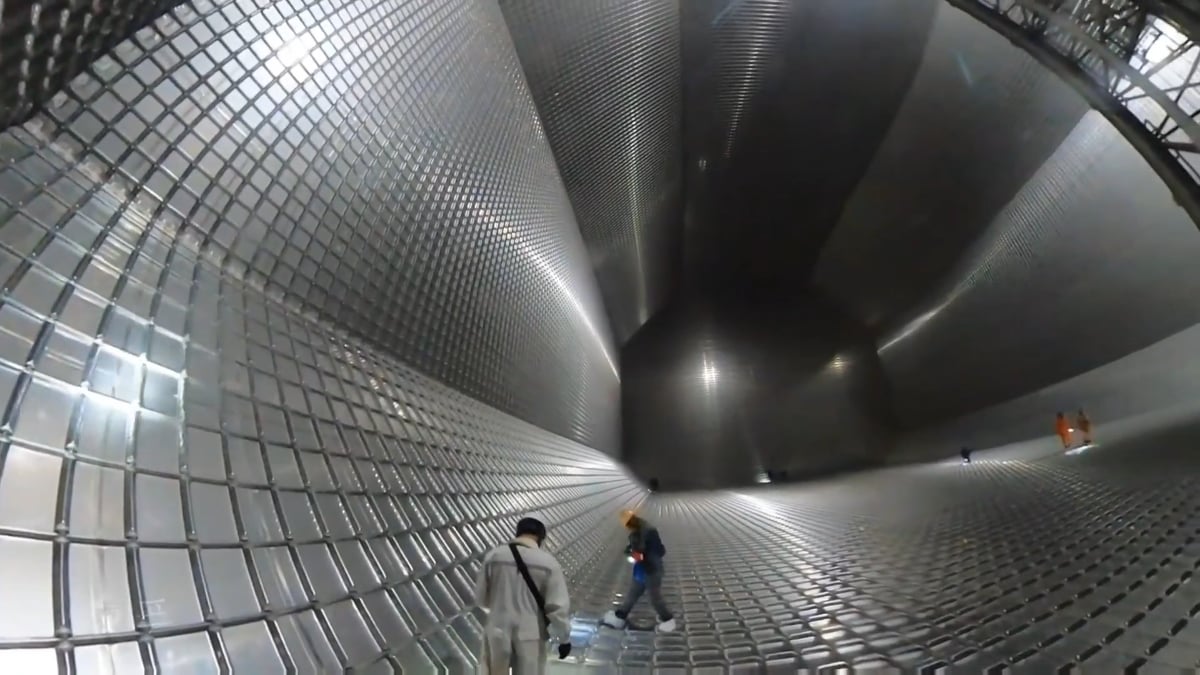
An inside view of one of the tanks in Cargo ship that carries Liquified Natural Gas
Title: Inside an LNG Tank: The High-Tech Heart of Modern Gas Carriers
Meta Description: Discover the engineering marvels inside LNG cargo ship tanks — from cryogenic insulation to cutting-edge safety systems — in this deep dive into how liquefied natural gas is transported globally.
For decades, liquefied natural gas (LNG) has fueled industries, homes, and power grids worldwide. But have you ever wondered how this super-cooled fuel travels safely across oceans? At the core of colossal LNG carriers lie their most critical components: cryogenic cargo tanks. These technological wonders are feats of engineering, designed to transport LNG at -162°C (-260°F) while battling extreme pressures and the relentless forces of the open sea. Let’s step inside one of these tanks and unpack how they keep this volatile cargo stable, secure, and ready for delivery.
Why LNG Tanks Are Engineering Marvels
LNG carriers are among the most specialized ships in the world, built to transport natural gas in its liquefied form. To achieve this:
- Natural gas is cooled to -162°C, shrinking its volume by 600 times for practical transport.
- Tanks must maintain this extreme temperature without fail, even amid scorching equatorial heat or freezing Arctic conditions.
- Safety is paramount. LNG is highly flammable if leaked and requires fail-proof storage.
Anatomy of an LNG Tank: A Layer-by-Layer Breakdown
Modern LNG tanks use two primary designs: self-supporting spherical (Moss-type) tanks or membrane-type tanks. Both rely on multi-layered construction to combat thermal, structural, and chemical challenges.
1. The Primary Barrier: First Line of Defense
- Material: High-nickel steel (e.g., 9% nickel steel) or invar (an iron-nickel alloy) to resist brittleness at cryogenic temperatures.
- Role: Directly contains the LNG, preventing leakage through its welded seams.
- Challenge: Must withstand thermal contraction as the tank cools from ambient to -162°C during loading.
2. Insulation: Guarding Against Heat Invasion
- Purpose: Minimize “boil-off gas” (BOG) — LNG evaporating due to external heat.
- Layers:
- Cork, Perlite, or Polystyrene Foam: Traditional rigid insulation in Moss tanks.
- Plywood-Backed Fiberglass & Aluminum Foil: Multi-layered membranes in modern designs.
- Space Vacuum: Some designs use vacuum-insulated panels for near-zero heat transfer.
3. Secondary Barrier: The Safety Net
- Critical Backup: If the primary barrier fails, this layer catches leaks, shielding the ship’s hull from cryogenic fractures.
- Materials: Stainless steel, invar, or specialized composites with high thermal resistance.
4. The Outer Shell: Structural Integrity
- Function: Protects insulation layers and transfers load from the tank to the ship’s hull.
- Material: Robust marine-grade steel or aluminum.
Safety Systems Inside the Tank
- Boil-Off Gas Management:
BOG is reliquefied using onboard plants or burned as fuel to power the ship, reducing waste and emissions. - Monitoring Sensors:
Lasers, pressure gauges, and temperature probes detect micro-leaks or hot spots instantly. - Inert Gas Blanketing:
Nitrogen gas fills void spaces above the LNG to prevent explosive air-gas mixtures. - Earthquake-Resistant Design:
Sloshing baffles reduce liquid movement in rough seas, while load-bearing structures absorb shocks.
Loading & Unloading: A Precise Choreography
- Loading Arms: Cryogenic pipelines connect shore terminals to the ship’s tanks, pumping LNG at controlled rates to avoid thermal stress.
- Stripping System: After unloading, tiny residues are removed using pumps and compressors to maximize efficiency.
- Pre-Cooling: Tanks are cooled gradually with LNG spray before bulk loading to prevent thermal shock.
Technology Advancements Shaping the Future
- MOSS vs. Membrane Tanks:
- Moss Tanks (Spherical): Visible domes offer robustness but limit cargo space.
- Membrane Tanks: Rectangular designs maximize capacity but rely on advanced materials.
- GTT’s NO96 & MARK III Systems: Leading membrane tech with tighter insulation and thinner barriers.
- Digital Twins: Real-time 3D simulations predict tank stress, corrosion, and BOG rates for safer voyages.
- Green Innovations: Zero-emission carriers with hydrogen-ready tanks are in development.
FAQs About LNG Cargo Tanks
-
Why aren’t the tanks made of regular steel?
Normal steel would shatter at LNG temperatures. Nickel alloys maintain flexibility even at -162°C. -
How much LNG can one ship carry?
Modern Q-Max carriers hold up to 266,000 cubic meters — enough to power 70,000 homes for a year. -
What happens if the tank leaks?
Multiple barriers, sensors, and emergency shutdown systems isolate leaks before they escalate. -
Are LNG carriers environmentally safe?
Yes. Methane emissions are minimized via BOG recovery, and LNG itself burns cleaner than coal or oil.
Conclusion: Engineering for Energy Security
LNG tanks are more than just steel containers — they’re lifelines of the global energy supply chain. As demand for cleaner fuels rises, these cryogenic chambers will evolve with smarter materials, automation, and carbon-neutral tech. Next time you see an LNG carrier gliding across the horizon, remember the silent, frost-coated titan within its hull, ensuring the world’s energy never runs cold.
Target Keywords: LNG cargo ship tanks, liquefied natural gas transport, cryogenic storage, LNG carrier insulation, Moss vs membrane tanks, LNG tank safety, boil-off gas management.
Optimized for Search Intent: Technical deep dive, LNG industry professionals, maritime engineering students, energy sector analysts.