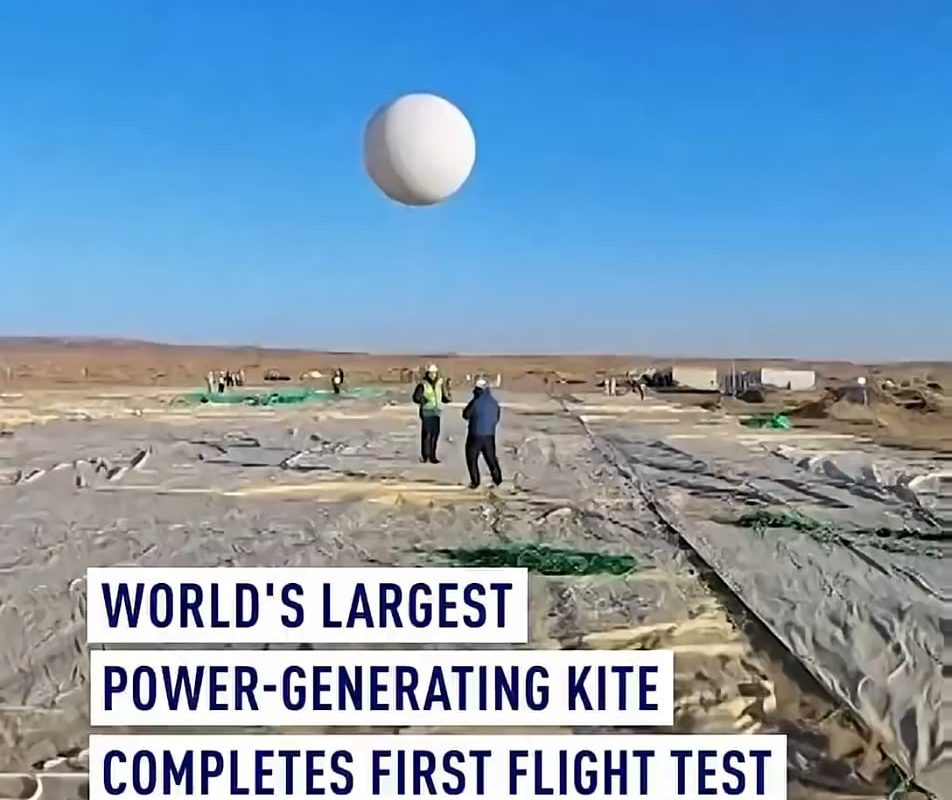
China lets fly world’s largest kite in Inner Mongolia for electric power generation.
Title: China Soars to New Heights: World’s Largest Kite Launched in Inner Mongolia for Revolutionary Wind Power Generation
Meta Description: Discover how China’s record-breaking kite in Inner Mongolia is harnessing high-altitude winds to generate renewable electricity, revolutionizing clean energy innovation.
Introduction: A Sky-High Leap for Renewable Energy
China has once again cemented its leadership in renewable energy innovation by launching the world’s largest kite in Inner Mongolia, designed explicitly for electric power generation. Weighing over 7 tons with a wingspan of 100 meters, this airborne wind energy (AWE) system marks a historic milestone in sustainable technology. This groundbreaking project not only sets a new Guinness World Record but also signals a paradigm shift toward harnessing high-altitude winds—a vastly underutilized energy source.
The Giant Kite: Engineering Marvel in Action
Developed by a collaboration between Chinese research institutes and clean energy firms, the colossal kite—dubbed the “Golden Dart” (Jin Jian)—operates at altitudes of up to 1,000 meters. Here, wind speeds are 5–8x stronger than at ground level, enabling consistent, high-yield energy capture.
How It Works:
- Tethered Flight: The kite is anchored to a ground station via ultra-strong composite cables.
- Figure-8 Maneuvers: Autonomous flight algorithms guide the kite in dynamic figure-8 patterns, maximizing aerodynamic lift and tension on the tether.
- Energy Conversion: The tether’s pull spins a generator on the ground, converting kinetic energy into electricity.
- Automated Cycles: Once fully extended, the kite retracts passively with minimal energy use, repeating the process endlessly.
This system leverages Airborne Wind Energy (AWE) technology, bypassing the need for massive towers and turbines while accessing more powerful wind resources.
Why Inner Mongolia? The Perfect Renewable Energy Laboratory
Inner Mongolia’s vast steppes and relentless winds make it an ideal testing ground for AWE systems. Already home to China’s largest onshore wind farms, the region now pioneers airborne solutions with three key advantages:
- Higher Efficiency: At 500–1,500 meters altitude, winds blow stronger and more consistently than at turbine hub heights (50–150 meters).
- Lower Costs: AWE systems require 90% less material than conventional turbines, eliminating concrete foundations and streamlining deployment.
- Minimal Land Use: Kites operate in airspace, freeing land for agriculture or conservation—a critical benefit for China’s land-stressed regions.
Power Potential: Lighting Up Thousands of Homes
While traditional wind turbines generate 2–5 MW per unit, a single large-scale AWE system like the Golden Dart can produce **up to 500 kW*—enough to power 500 households** annually. Though currently in pilot phase, China aims to scale this technology, deploying kite arrays across remote and offshore regions where grid access is limited.
*Source: China Renewable Energy Engineering Institute
Environmental and Economic Impact
Beyond its technical prowess, the project aligns with China’s dual carbon goals: achieving peak emissions by 2030 and carbon neutrality by 2060. Unlike fossil fuels or land-intensive renewables:
- Zero Emissions: Fully clean energy generation.
- Wildlife-Friendly: Reduces bird collision risks compared to spinning turbines.
- Job Creation: Supports green manufacturing and R&D sectors in Inner Mongolia.
Global Implications: A New Frontier for Renewable Energy
While AWE technology remains nascent globally, China’s leap forward accelerates its race to dominate the $50 billion airborne wind energy market (projected by 2030). Competitors like the EU and U.S. are testing similar prototypes, but none match the Golden Dart’s scale. If successful, China could export this technology worldwide, particularly to windy nations with limited land for turbines.
Challenges and Future Outlook
Despite its promise, AWE faces hurdles:
- Durability: Ensuring kites withstand extreme weather.
- Airspace Regulation: Coordinating with aviation authorities.
- Scalability: Moving from pilot projects to grid integration.
China’s State Grid Corporation plans to address these by 2025, aiming for AWE to supplement its existing 342 GW wind capacity (the world’s largest).
Conclusion: The Wind Beneath China’s Green Ambitions
With the launch of the world’s largest power-generating kite, China is redefining wind energy’s future. By tapping into untapped high-altitude winds, this innovation demonstrates how cutting-edge engineering and sustainability can converge to combat climate change. As the Golden Dart soars over Inner Mongolia, it symbolizes a cleaner, brighter energy era—one where the sky is no longer the limit.
Keywords for SEO:
Airborne wind energy, world’s largest kite, renewable energy China, Inner Mongolia wind power, high-altitude wind generation, Golden Dart kite, AWE technology, sustainable energy innovation, China carbon neutrality, wind energy revolution.