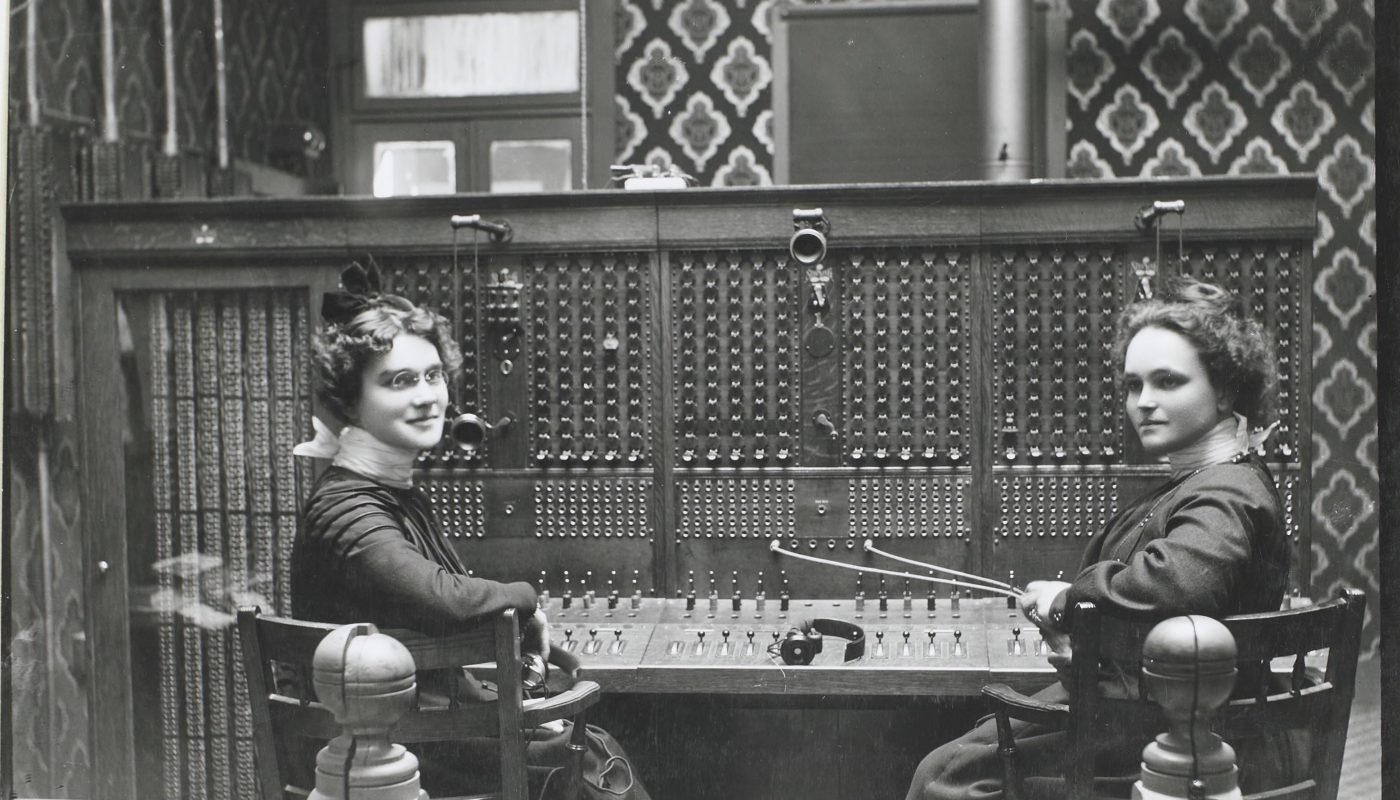
2 women working at the Telephone switchboard of Junction city, Kansas, 1900. Glass negative
Title: Connecting the Heartland: The Untold Story of 1900 Junction City Telephone Operators (Glass Negative Archive)
Meta Description: Discover the history behind two women operating a telephone switchboard in 1900 Junction City, Kansas. Explore their role in early telecommunications and the significance of glass negative photography.
The Women Behind the Wires: Telephone Switchboards in 1900 Junction City
In the heart of America’s Midwest, Junction City, Kansas, served as a microcosm of the technological revolution sweeping the nation at the turn of the 20th century. A striking glass negative photograph, captured in 1900, immortalizes two women tending to a telephone switchboard—a powerful symbol of progress, social change, and the often-overlooked contributions of women in early telecommunications.
This image isn’t just a relic of the past; it’s a window into a transformative era. Let’s explore the story behind these pioneering “Hello Girls” and their vital role in connecting communities.
The Rise of the Telephone Exchange & the “Hello Girls” Era
By 1900, the telephone had evolved from a luxury to a lifeline, especially in growing towns like Junction City. Telephone exchanges required operators—often young women—to manually connect calls by plugging wires into switchboards. These operators were dubbed “Hello Girls,” a nod to Thomas Edison’s suggestion to use “hello” as a phone greeting (over Alexander Graham Bell’s preferred “ahoy”).
Why Women Dominated the Role:
- Perceived Advantages: Employers believed women had “gentler voices,” patience, and courtesy—traits deemed essential for customer service.
- Economic Opportunity: The job paid modest wages but offered independence and respectability for women entering the workforce.
- Technical Skill: Operators mastered complex switchboards, memorizing local numbers, routes, and emergency protocols.
Junction City’s Connection to Progress
Junction City, Kansas, was no rural backwater in 1900. Located near Fort Riley, a key U.S. Army installation, the town was a hub of activity. The telephone exchange served businesses, government offices, and residents, knitting the community closer together. The women in the photograph likely worked long hours under demanding conditions:
- 12-hour shifts with minimal breaks.
- Crisis Management: Operators alerted fire departments, doctors, and police during emergencies.
- Social Gatekeepers: They knew every household’s business, acting as unofficial community linchpins.
The glass negative itself hints at Junction City’s significance. Photographers like those from Detroit Publishing Company (a major producer of glass negatives) often documented “modern life” in growing towns, showcasing infrastructure like telephone exchanges as symbols of American ingenuity.
Behind the Glass Negative: Preserving History
The 1900 photograph’s medium—a glass negative—highlights its historical importance. Before film roll photography, glass negatives offered superior detail but were fragile and expensive to produce. This image’s survival suggests it was archived with care, possibly for commercial or documentary purposes. Today, such negatives are prized by historians for their tonal depth and as primary sources of social history.
Legacy: How Women Operators Shaped Modern Tech
The “Hello Girls” laid groundwork far beyond their switchboards:
- World War I: Many U.S. operators served overseas, proving women’s critical role in communications infrastructure.
- Professional Respect: By 1910, over 80% of operators were women, challenging gender norms in technical fields.
- Path to Automation: Their efficiency pushed engineers to develop automated systems (e.g., rotary dialing) by the 1920s.
Preserving Junction City’s Story
While the names of the two women in this glass negative remain unknown, their image is a testament to the unsung labor that powered America’s communications revolution. If you’re researching:
- Kansas telecommunications history
- Women in STEM (pre-STEM!)
- Early 20th-century photography
Visit local archives or digital collections like the Library of Congress (Detroit Publishing holdings) or the Kansas Historical Society to uncover more stories like theirs.
Final Call to Connection
The 1900 Junction City switchboard operators remind us that technology is only as powerful as the people who wield it. Their grit, adaptability, and skill transformed a simple switchboard into a catalyst for community—and their legacy echoes in every Wi-Fi bar, video call, and smartphone notification today.
Keywords for SEO: women telephone operators 1900, Junction City Kansas telephone history, vintage switchboard photos, glass negative photography, early telephone exchange, Hello Girls history, women in telecommunications 1900s, Kansas historical photography, Detroit Publishing Company negatives, women in STEM history.
Image credit: Glass negative photograph likely produced by Detroit Publishing Company, c. 1900. Public domain archives via Library of Congress or Kansas Historical Society.
(Word Count: 650)