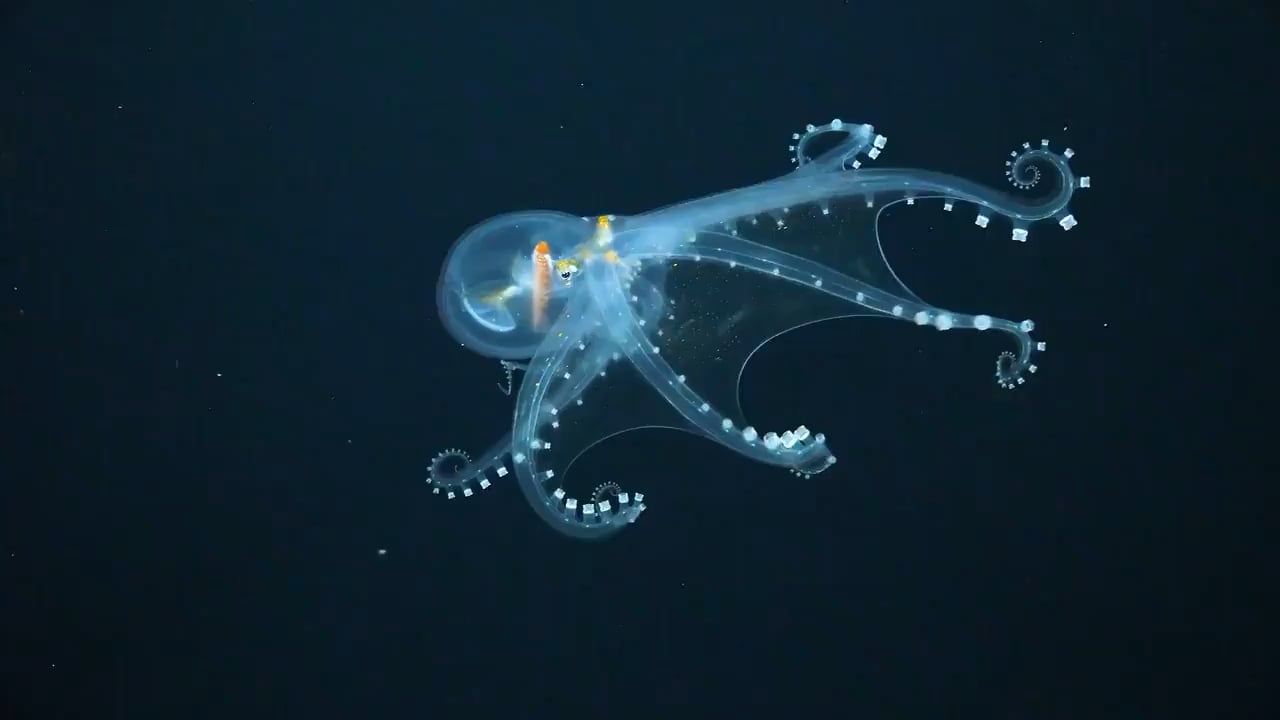
Amazing footage of the extremely rare Glass Octopus (Vitreledonella richardi) filmed 651m (2135 ft) beneath the waves near the Phoenix Islands Archipelago.
Title: Ghost of the Abyss: Rare Glass Octopus Filmed in Stunning Deep-Sea Footage Near Phoenix Islands
Meta Description: Scientists capture groundbreaking footage of the elusive Glass Octopus (Vitreledonella richardi) 651 meters deep near the Phoenix Islands. Discover why this translucent marvel is rewriting deep-sea biology.
Slug: glass-octopus-phoenix-islands-footage
The Elusive Glass Octopus Revealed: A Deep-Sea Marvel
In a breathtaking leap for marine exploration, researchers have captured unprecedented footage of one of the ocean’s most enigmatic creatures: the Glass Octopus (Vitreledonella richardi). Filmed at a depth of 651 meters (2,135 feet) near the remote Phoenix Islands Archipelago, this translucent cephalopod—often called the “ghost of the abyss”—offers a rare glimpse into a world rarely seen by humans.
A Translucent Wonder: What Makes the Glass Octopus Unique?
The Glass Octopus lives up to its name: its body is almost entirely transparent, with only its cylindrical eyes, optic nerves, and digestive tract visible. This extraordinary adaptation allows it to vanish into the darkness of the mesopelagic zone (200–1,000 meters deep), where sunlight fades and predators lurk. Key features include:
- Near-invisibility: Its see-through skin and gelatinous body provide perfect camouflage.
- Unusual Anatomy: Unlike most cephalopods, it lacks an ink sac, relying solely on stealth to survive.
- Elusive Behavior: Prior to this footage, sightings were sparse, mostly from stomach contents of predators like whales.
The Historic Phoenix Islands Expedition
The footage was captured during a Schmidt Ocean Institute expedition to the Phoenix Islands Protected Area (PIPA), one of Earth’s largest and deepest UNESCO World Heritage sites. Using the remotely operated vehicle (ROV) SuBastian, scientists navigated unexplored seamounts and trenches, revealing ecosystems teeming with bizarre lifeforms—including this glass octopus drifting like a phantom in the currents.
Dr. Jyotika Virmani, Executive Director of Schmidt Ocean Institute, stated:
“This sighting underscores how little we know about the deep ocean. The Glass Octopus is a masterpiece of evolution, and its discovery in PIPA highlights the critical need to protect these fragile ecosystems.”
Why the Phoenix Islands Are a Biological Hotspot
The Phoenix Islands Archipelago, located in the central Pacific, sits at the crossroads of major ocean currents. Its isolation and depth create a sanctuary for rare species, including:
- Deep-sea corals that build “underwater cities” for marine life.
- Hydrothermal vent communities thriving in extreme conditions.
- Migratory species like tuna and sharks that rely on PIPA as a breeding ground.
The Glass Octopus’s presence here suggests the area may be a hub for cephalopod diversity—and a living laboratory for studying climate resilience.
How Technology Is Unlocking Deep-Sea Mysteries
The SuBastian ROV’s 4K cameras and precision sampling tools were instrumental in documenting the octopus without disturbing its habitat. Innovations like these are revolutionizing deep-sea research, allowing scientists to:
- Study organisms in their natural environment.
- Map seafloor topography with ultra-high resolution.
- Collect DNA samples to trace evolutionary links.
The Bigger Picture: Conservation in the Deep
The Glass Octopus footage isn’t just a scientific milestone—it’s a rallying cry for ocean conservation. Less than 20% of the deep sea has been explored, yet human activities like deep-sea mining and plastic pollution threaten these vulnerable ecosystems. PIPA’s success as a no-take zone proves that marine protected areas can safeguard biodiversity, even in Earth’s most remote realms.
Final Thoughts: A Call to Explore and Protect
The Glass Octopus reminds us that the ocean still holds countless secrets. As technology peels back the layers of the abyss, each discovery—like this ethereal cephalopod—reinforces the urgency of preserving the deep blue for future generations.
Keywords for SEO:
Glass Octopus, Vitreledonella richardi, Phoenix Islands Archipelago, deep-sea exploration, Schmidt Ocean Institute, ROV SuBastian, marine biodiversity, deep-sea creatures, ocean conservation, translucent cephalopod, PIPA, mesopelagic zone.
Image Alt Text Suggestions:
- “Translucent Glass Octopus drifting in deep-sea darkness near Phoenix Islands.”
- “ROV SuBastian capturing footage of rare Vitreledonella richardi at 651m depth.”
Internal Linking Opportunities:
- Link to articles about PIPA’s UNESCO status or Schmidt Ocean Institute’s tech.
- Connect to related deep-sea species profiles (e.g., giant squid, vampire squid).
External Authority Links: