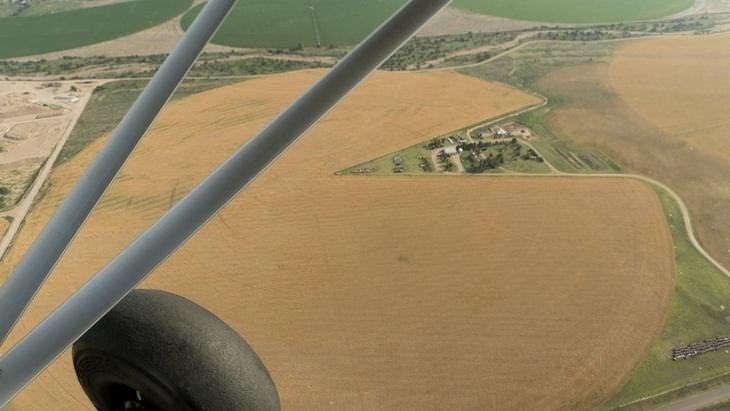
On Farmland That Looks Like A Pacman.
Title: When Farmland Meets Retro Gaming: The Fascinating World of Pac-Man Shaped Agricultural Fields
Meta Description: Discover why vast stretches of farmland around the world resemble Pac-Man from above. Dive into the science, history, and surprising beauty of circular irrigation patterns.
Introduction: A Quirky Aerial Phenomenon
Look out an airplane window over arid regions like the American Midwest, Saudi Arabia, or Australia, and you might spot something unexpected: sprawling farmland that eerily resembles the iconic Pac-Man arcade character. These geometric patterns of lush green or golden crops, punctuated by a missing slice like Pac-Man’s signature “mouth,” aren’t a glitch in the Matrix—they’re a triumph of agricultural engineering. This article explores the surprising science behind these whimsical landscapes.
Why Does Farmland Look Like Pac-Man? The Science of Center-Pivot Irrigation
The secret lies in center-pivot irrigation, a method invented in the mid-20th century to efficiently water crops in dry climates. Here’s how it works:
- The Pivot Point: A central water source anchors a rotating irrigation system.
- The Circular Motion: Long sprinkler arms pivot around this point, watering crops in a perfect circle.
- The “Mouth” Effect: The wedge-shaped gap (Pac-Man’s “mouth”) is left unwatered due to the system’s turning radius and fixed infrastructure like access roads.
The result? Massive circular fields spanning over 100 acres, with a slice missing—just like Pac-Man poised to devour digital ghosts.
The Economics and Efficiency of Circular Farms
Center-pivot irrigation isn’t just visually striking; it’s a game-changer for agriculture:
- Water Conservation: Precision sprinklers reduce waste compared to flood irrigation.
- Energy Savings: Automated systems require less labor and optimize water pressure.
- Crop Uniformity: Even water distribution boosts yields in regions like Nebraska’s Sand Hills or Saudi Arabia’s deserts.
In the U.S. alone, center-pivot systems water 27 million acres of farmland, turning arid zones into breadbaskets.
Environmental Considerations
While efficient, these systems have trade-offs:
- Groundwater Depletion: Over-reliance can drain aquifers (e.g., the Ogallala Aquifer).
- Soil Salinization: Arid regions face salt buildup from evaporation.
- Innovative Solutions: Many farms now use sensors, drip irrigation variants, and drought-resistant crops to mitigate risks.
Pac-Man Farms Around the World
These agricultural oddities exist globally:
- USA: Nebraska, Kansas, and Texas boast the densest clusters.
- Saudi Arabia: Desert farms use pivots to grow alfalfa and wheat.
- Australia: Circular fields sustain sheep stations and wheat crops.
Fun Fact: Google Earth and flight apps have turned these fields into tourist curiosities, spawning memes and viral drone footage.
Beyond Pac-Man: Other Geometric Farm Patterns
Circular fields aren’t alone in pleasing symmetry:
- Hexagons: Beehive-inspired layouts maximize space in experimental farms.
- Stripes: Contour farming follows hills to prevent soil erosion.
- Checkerboards: Crop rotation grids maintain soil health.
Conclusion: Where Agriculture Meets Art
What started as a practical solution for watering crops has unintentionally created landscapes that captivate gamers and geographers alike. The next time you fly over farmland, keep an eye out for Earth’s quirky homage to Pac-Man—a reminder that human ingenuity can be both functional and strangely beautiful.
Call to Action:
- Explore: Use Google Earth coordinates (e.g., 40.1096° N, 101.7252° W) to see Nebraska’s Pac-Man farms.
- Learn: Research water-smart agriculture to support sustainable farming.
Keywords: Pac-Man farmland, circular irrigation, center-pivot systems, agricultural patterns, aerial farmland, geometric farming, farming technology, water conservation, Ogallala Aquifer, agricultural engineering.
By blending pop culture with agricultural science, this piece connects curious readers to a fascinating real-world phenomenon—proving that sometimes, truth really is stranger (and more fun) than fiction.