Anish Kapoor Mirror
Beyond Reflection: Exploring the Mesmerizing World of Anish Kapoor’s Mirror Sculptures
Meta Title: Anish Kapoor Mirror Art: A Journey into Light, Space & Perception
Meta Description: Dive into the transformative world of Anish Kapoor’s mirror sculptures. Discover how his reflective art redefines space, perception, and the sublime.
Introduction: The Allure of Anish Kapoor’s Mirror Works
Anish Kapoor, the Turner Prize-winning British-Indian artist, has captivated the global art scene for decades with his profound exploration of form, void, and perception. Among his most iconic creations are his mirror sculptures, which transcend traditional artistry to become portals into alternative realities. These works don’t just reflect the world—they distort, invert, and reimagine it, inviting viewers into a dialogue with space, light, and their own existence.
In this deep dive, we explore the magic of Kapoor’s reflective art, tracing its conceptual roots, technical brilliance, and enduring cultural impact.
The Philosophy Behind Kapoor’s Mirrors: Distortion as Truth
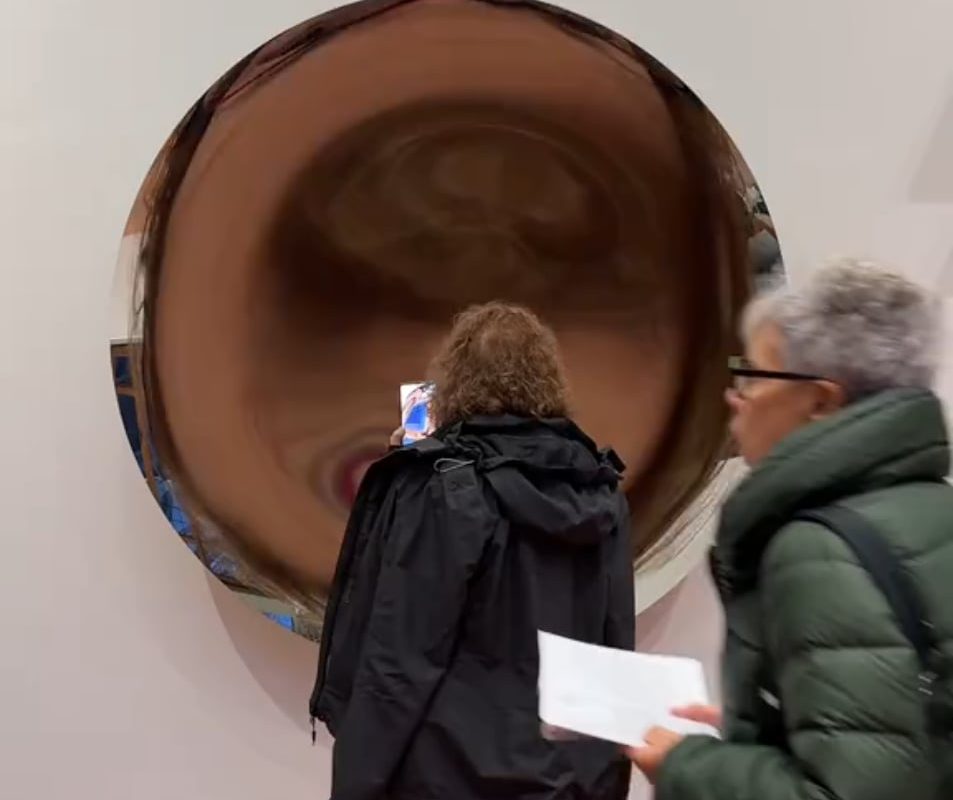
Kapoor’s mirrors challenge the very nature of perception. Unlike conventional mirrors, his curvilinear, concave, or convex surfaces manipulate reflections to create:
- Celestial Illusions: Some works evoke black holes or cosmic voids, playing with depth and infinity.
- Sublime Distortions: Bodies and landscapes stretch, warp, and dissolve, questioning the reliability of human sight.
- Participatory Art: Viewers become part of the artwork, their presence altering its meaning.
Drawing from both Eastern spirituality (notably the concept of maya or illusion) and Western minimalism, Kapoor’s mirrors exist at the intersection of philosophy and materiality.
Technical Mastery: The Science of Creating Kapoor’s Mirrors
Kapoor’s illusions are feats of engineering as much as artistry. His pieces employ:
- High-Precision Polished Stainless Steel: Used in sculptures like Cloud Gate (Chicago’s “Bean”), it creates seamless, liquid-like reflections.
- Layered Lacquer and Pigments: For colored mirrors, such as his deep-blue or blood-red works, which intensify emotional resonance.
- Mathematical Complexity: Algorithms calculate curves to achieve specific optical effects—bending light to obscure or reveal.
These technical choices ensure each mirror isn’t just a surface but a dynamic, interactive space.
Iconic Mirror Works by Anish Kapoor
1. Cloud Gate (2006)
📍 Millennium Park, Chicago
Arguably Kapoor’s most famous public work, this 110-ton stainless steel sculpture reflects Chicago’s skyline in a mesmerizing, dreamlike distortion. Dubbed “The Bean,” it epitomizes how public art can become a city’s soul.
2. Sky Mirror Series (2001–Present)
📍 Exhibited globally (New York, London, Nottingham)
These colossal concave mirrors act as frames for the sky, turning the heavens into a transient canvas. At 35 feet wide, Sky Mirror (Rockefeller Center, NYC) achieved cult status for its fusion of art and ephemerality.
3. Non-Object Series
These abstract mirrored forms—cones, spheres, and hybrid shapes—dissolve boundaries between object and viewer. Exhibited at venues like the Guggenheim and Tate Modern, they create immersive psychological landscapes.
4. Sectional Body to Mirror (2020)
A recent experiment in fragmented reflections, this work uses shattered mirror planes to evoke fragility and multiplicity.
The Vantablack Controversy: Beyond Mirrors
No discussion of Kapoor’s interplay with light is complete without addressing Vantablack—the “blackest black” pigment that absorbs 99.96% of light. Kapoor’s exclusive artistic rights to the material sparked debates about art-world monopolies. Yet, Vantablack’s void-like quality parallels his mirrors: one reflects everything, the other nothing, together embodying the duality of perception.
Legacy & Influence: Redefining Contemporary Sculpture
Kapoor’s mirrors have influenced:
- Architecture: Inspiring buildings with reflective facades (e.g., Frank Gehry’s Guggenheim Bilbao).
- Digital Art: Filter and AR effects echo his distortion techniques.
- Public Engagement: Proving art can be accessible while intellectually rigorous.
His works consistently fetch millions at auction (e.g., Untitled mirror piece sold for $1.8M in 2018), underscoring their market and cultural value.
FAQs about Anish Kapoor’s Mirror Art
Q: Where can I see Anish Kapoor’s mirror sculptures?
A: Major museums (Lisson Gallery, Tate Modern) and public installations (Chicago’s Millennium Park, Kensington Gardens).
Q: Why does Kapoor use mirrors?
A: To explore perception, the sublime, and the viewer’s role in completing the artwork.
Q: Are Kapoor’s mirrors safe for public spaces?
A: Yes, they’re engineered for durability, though touching is often discouraged to preserve finishes.
Conclusion: Mirrors as Portals to the Unseen
Anish Kapoor’s mirror sculptures are more than aesthetic triumphs—they’re gateways to introspection. By reshaping reality, they remind us that truth often lies in distortion and that art’s greatest power is to make us see ourselves, and our world, anew.
For collectors, critics, or casual observers, Kapoor’s mirrors remain an enduring testament to art’s ability to bend the rules of existence.
Explore Further:
- Kapoor at the Royal Academy (London, 2024 retrospective)
- Documentary: Anish Kapoor: Into the Void (Amazon Prime)
Keywords: Anish Kapoor Mirror, Kapoor mirror sculptures, reflective art installations, Cloud Gate Chicago, Sky Mirror, Vantablack art, stainless steel sculpture, contemporary public art.